


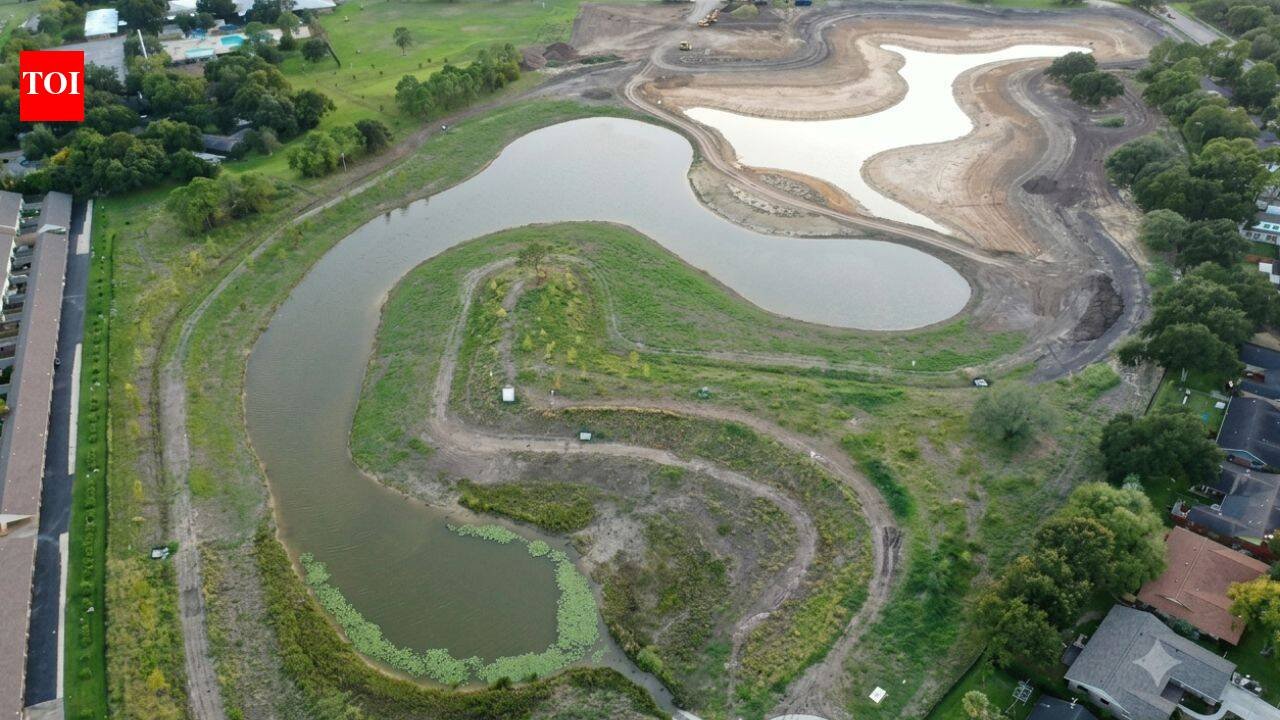
When Hurricane Harvey brought historic rainfall to the Houston area, residents of Clear Lake City, Texas, feared the worst. For Spyros Varsos, who had lived in the community for 50 years, the rising water was especially worrying. But his home did not flood.Varsos told Texas Tribune that he had taken steps himself, including clearing debris from drains on his street. But he said a nearby flood-control project made an even bigger difference. The project was still under construction when Harvey arrived.Just a few blocks away, the Clear Lake City Water Authority was transforming a shuttered golf course into Exploration Green, a nearly 200-acre green space designed to hold stormwater. The former golf course had been considered for high-density development.But instead of being used for housing, the property was turned into a system of stormwater detention lakes, wetlands and public spaces. The project was designed to address flooding while also giving the community trails, open areas and places for recreation.The idea was put to an early test during Harvey. At the time, only about 80% of the first detention pond had been excavated. Even so, it held about 100 million gallons of water.
Golf Course repurposed
Flooding had been a problem in Clear Lake City, a community about 30 miles southeast of downtown Houston. The area had experienced several one-percent annual chance flooding events linked to runoff and hurricanes.The old golf course became particularly important because developers were considering turning the large property into high-density housing. According to local officials, such development could have made flooding worse by replacing open land with more built-up areas.Fearing the worse, residents raised concerns through the Clear Lake City Civic League. In response, the water authority hired a hydrologist to study the 16,000 acres under its jurisdiction and recommend ways to reduce flooding.The study recommended increasing water retention. Since serious flooding was already occurring around the golf course, the water authority decided to buy the property and use it to hold stormwater.After six years of negotiations, planning and community meetings, the authority purchased the golf course in 2011 for about $6 million. The project was later named Exploration Green. The Clear Lake City Water Authority partnered with the Exploration Green Conservancy, a nonprofit group that helped develop the park and manage its conservation, landscaping and recreational features.
How detention lakes help
The main purpose of Exploration Green is to give excess stormwater somewhere to go during heavy rainfall. The project has five planned stormwater detention lakes. Together, they can store 500 million gallons of water. Instead of allowing large amounts of rainwater to immediately enter the drainage system, the detention areas provide space to hold it.The project also includes about 40 acres of wetlands, walking and biking trails, athletic fields and open space. NOAA describes the site as a 200-acre urban green space created from a defunct golf course to address stormwater flooding and recreational needs.This means the land has two major functions. During heavy rain, it provides space for stormwater. At other times, it can be used by residents as a park. That was an important part of the original vision. Branch said the community did not want the former golf course to simply become a collection of drainage ponds.“We don’t want it to just be a hole in the ground, we want it to be something nice,” Branch said, Texas Tribune quoted. “Unless there’s a hard rain, the public can use it every day for something other than flood control.”
The Harvey test
The strongest early evidence of the project’s flood-control role came before Exploration Green was even complete. When Harvey struck in 2017, the first detention pond was only about 80% excavated. Despite being unfinished, it detained about 100 million gallons of stormwater.Branch estimated that the pond saved 150 nearby homes from flooding. That result came as Houston was dealing with the effects of one of its most damaging storms. The project therefore became an example of how communities could use available land to address local flooding while waiting for larger flood-control projects.Officials and experts have said detention ponds cannot solve every flooding problem. They are one part of a wider system that can include larger drainage projects and other measures. But the Clear Lake City project showed how an existing piece of land could be used differently.
