


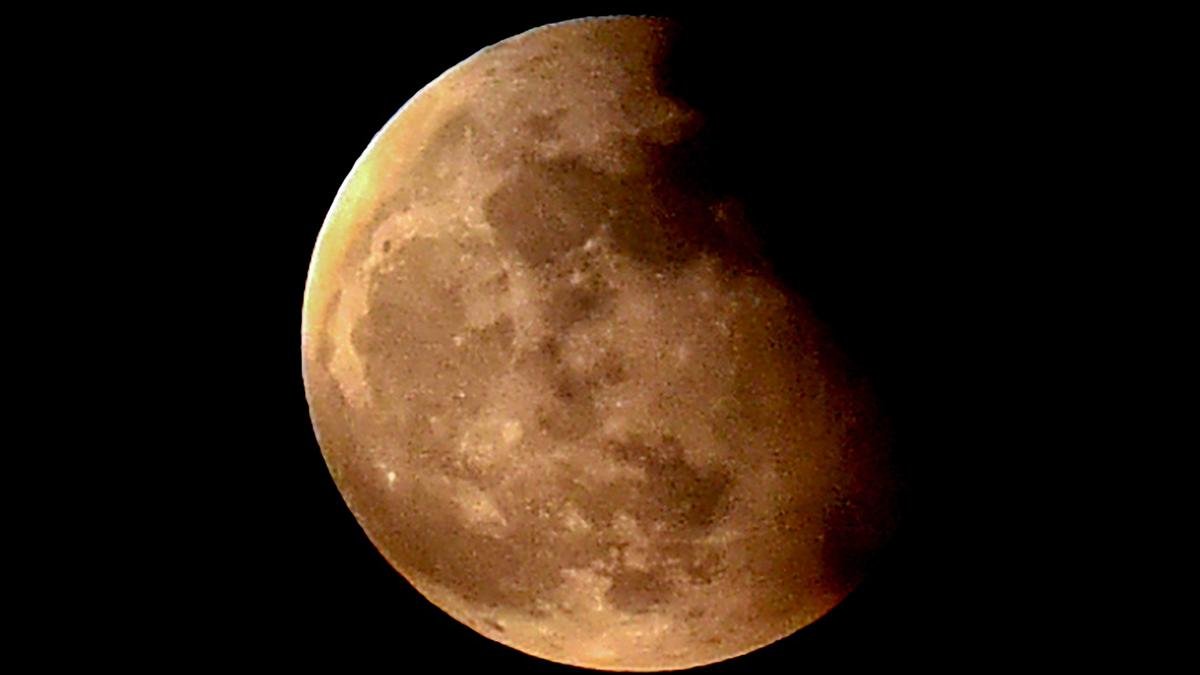
Representational Image
| Photo Credit: PTI
The world is scheduled to witness a lunar eclipse soon with almost 96% coverage of the moon’s surface, which will give the celestial body a deep red hue.
Our coverage of the August 12 solar eclipse
The lunar eclipse will occur on August 28, 2026 and will be visible across North and South America, with about one billion people having full access to view the event. Partial views will also extend to parts of Europe, Africa, and West Asia, with almost 44% of the world’s population having the chance to watch it.
What is a lunar eclipse?
A lunar eclipse is a celestial event that occurs when Earth passes directly between the Sun and the Moon, casting its shadow across the lunar surface. This alignment can only happen during a full moon.
Types of lunar eclipses
Total lunar eclipse: The Moon moves entirely into the darkest part of the Earth’s shadow, creating what is called a “Blood Moon,” where the moon appears reddish-orange due to sunlight refracting through Earth’s atmosphere.
Partial lunar eclipse: Only a portion of the Moon enters the darkest part of the Earth’s shadow, making an appearance as if a bite has been taken out of our planet’s satellite.
Penumbral lunar eclipse: The Moon passes through Earth’s faint outer shadow, and the eclipse is so subtle that it is often very difficult to see it with the naked eye.
Lunar eclipse 2026: Date and Time
The eclipse will begin at 6.53 a.m. and end at 12.32 p.m. IST on August 28, 2026. The maximum peak or the time when most of the Moon will be covered by Earth’s shadow will be at 9.43 a.m. IST.
| Phase | Time (IST) on Friday, August 28, 2026 |
| Penumbral Eclipse begins | 06.53 am |
| Partial Eclipse begins | 08.04 am |
| Maximum (Peak) Eclipse | 09.43 am |
| Partial Eclipse ends | 11.22 am |
| Penumbral Eclipse ends | 12.32 pm |
Will it be visible in India?
The lunar eclipse will not be visible in India as it will be daytime when the event occurs. It will not be visible from Australia, Antarctic and the area called the ‘Pacific Rim’ due to daylight hours.
There has been an increased interest in this lunar eclipse since it coincides with the Hindu festival of Raksha Bandhan prompting people to search for the timings and duration of the eclipse.
Published – August 23, 2026 02:15 pm IST
