


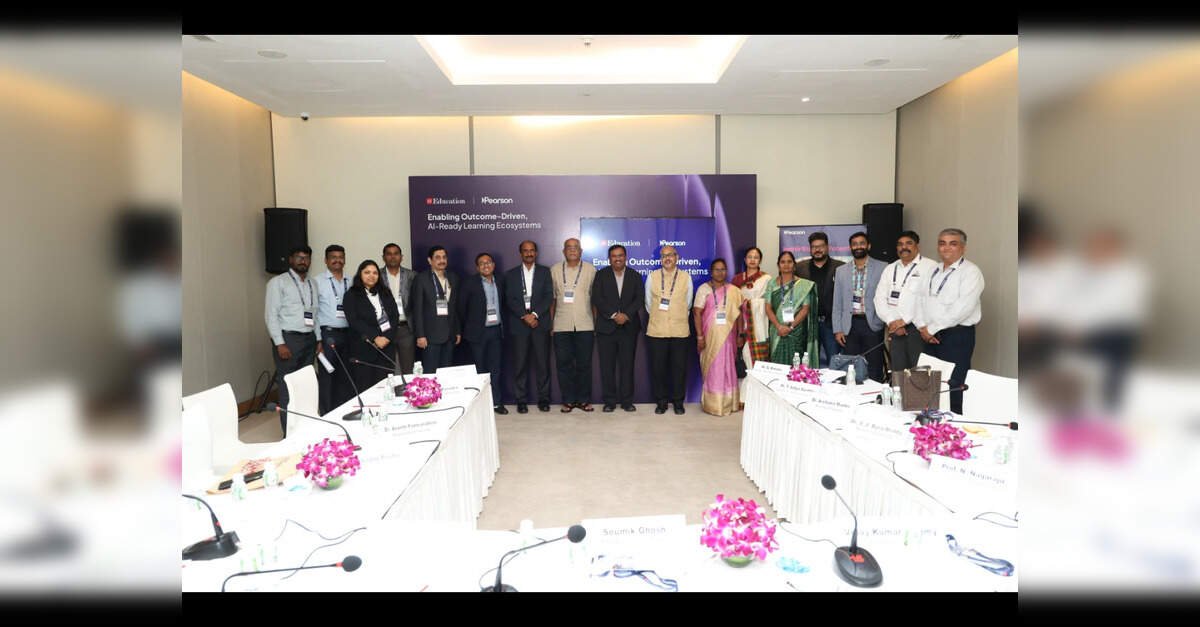
As Artificial Intelligence rapidly transforms the global education landscape, academic leaders, industry experts, and institutional stakeholders convened in Hyderabad for a high-impact leadership dialogue on the future of higher education in an AI-driven world. Hosted by ETEducation in collaboration with Pearson on 7 August 2026 at Trident Hyderabad, the closed-door roundtable explored how institutions can prepare faculty, students and institutional systems for an AI-enabled future through faculty transformation, assessment reform, experiential learning, and responsible AI adoption.
Titled “Enabling Outcome-Driven, AI-Ready Learning Ecosystems” the curated, by-invitation-only roundtable brought together leaders from academia and industry to examine how AI is reshaping faculty development, assessment, curriculum design, research and institutional governance. The session was moderated by Soumik Ghosh, Senior Assistant Editor, The Economic Times.
Among the prominent leaders who participated in the discussion were Vinay Swamy, Country Head, Pearson India, Prof Sriram Venkatesh, Executive Director, and Prof E Purushottam, Vice Chairman, Telangana Higher Education Council (TGCHE); Mohammed Sadiq Pasha, Executive Director, T-SAT; Prof Sandeep Shukla, Director, IIIT-Hyderabad; Dr Ananth Padmanabhan, Vice Chancellor, Sreenidhi University; Dr Archana Mantri, Vice Chancellor, Anurag University; Dr VJ Byra Reddy, Vice Chancellor , Woxsen University, Prof N Nagaraju Vice Chancellor, The English and Foreign Language University, Dr T Satya Savithri, Director of the Research & Development, JNTU, Dr Kasa Ravindra , Dean – School of Engineering, Malla Reddy University and Dr G Karuna Head of the Department for the Artificial Intelligence and Machine Learning (AIML), Gokaraju Rangaraju Institute of Engineering & Technology (GRIET), Hyderabad, from higher education institutes of varying specializations, curriculum, and student cohort. They contributed diverse perspectives on the evolving role of AI in education.The discussion made one thing abundantly clear: institutional AI readiness cannot be built on technology adoption alone — it demands a parallel transformation in faculty capability, assessment design, and institutional governance.
Faculty upskilling is the foundation of AI readiness
One of the strongest themes emerging from the discussion was the urgency of continuous faculty development. Participants agreed that Faculty Development Programs (FDPs), structured AI literacy training, dedicated Centres of Excellence, and global collaborations are no longer optional but foundational to institutional readiness..
Assessment models must move from memory to mastery
There was strong consensus that assessment frameworks require a fundamental reset — shifting away from summative, memory-based testing toward formative, skill-based evaluation. Participants advocated flipping both classrooms and assessments to prioritise real learning, competency development, and applied problem-solving over rote recall, arguing that evaluation systems built for a pre-AI era can no longer measure genuine understanding.
Experiential and industry-integrated learning takes centre stage
Experiential and industry-integrated learning emerged as another major thread of the conversation. Institutions represented at the roundtable are increasingly embedding internships, live projects, entrepreneurship modules, and industry partnerships directly into curricula.
Future-ready skills will define graduate success
The roundtable strongly reinforced that higher education institutions must move beyond technical knowledge and focus on building transferable, future-ready capabilities. Participants highlighted critical thinking, creativity, problem-solving, communication, teamwork, and ethical decision-making as the competencies that will differentiate graduates in an AI-augmented workforce, stressing that these human capabilities must be built deliberately rather than assumed.
AI should support learning, not substitute for it
A recurring theme throughout the discussion was that AI adoption must be tied to measurable educational outcomes and be the enabler rather than a replacement for human judgement. Participants repeatedly stressed that technology should enable institutions to improve student engagement, learning effectiveness, employability, and lifelong learning preparedness rather than become an end in itself.
Governance must follow understanding, not precede it
Data privacy, security, ethical AI use, and institutional AI policy emerged as major priorities in the discussion on governance. Participants stressed that institutions must first build a genuine understanding of AI’s capabilities and limitations before drafting governance frameworks, cautioning against policy-writing that outpaces institutional AI literacy.
Student expectations are shifting faster than institutions
The roundtable closed on a candid acknowledgement: traditional, one-size-fits-all learning models are becoming less effective. Today’s students increasingly seek personalised, interactive, and experiential learning experiences and institutions that fail to adapt risk falling behind student expectations as much as technological ones.
Building resilient institutions for an AI-driven future
Throughout the discussion, one message remained central: AI readiness in higher education requires a balanced approach combining faculty capability building, experiential learning, competency-based assessment, industry collaboration, and strong ethical guardrails. The goal, participants agreed, is not simply AI adoption, but creating future-ready graduates while preserving human agency and intelligence.
Leaders also underscored the importance of collaborative ecosystems that bring together academia, industry, government, and technology partners to improve educational quality, learner outcomes, and workforce readiness at scale.
As higher education enters a period of rapid technological transformation, institutions will increasingly be evaluated by their ability to balance innovation with ethics, scalability with inclusion, and automation with human-centric learning.
The ETEducation x Pearson Roundtable in Hyderabad served as an important platform for academic leaders and industry stakeholders to collectively examine these challenges and opportunities, while reinforcing the need for continuous dialogue, institutional agility, and collaborative action in shaping the future of education in the age of AI.
