


The 10 years Pep Guardiola spent at Manchester City represent one of the greatest acts of dynasty-building in the sporting universe.
Not only did the Catalan coach City to six Premier League titles, five League Cups, three FA Cups, one UEFA Champions League crown and one at the FIFA Club World Cup, he did so by assembling multiple great sides, revolutionising tactics, and constantly reinventing himself.
Dominant reign
Guardiola’s six Premier League trophies are second only to Alex Ferguson’s 13 at Manchester United, and even in the four years when City did not win the top prize, it stayed in the top three. No other coach won more than one Premier League title during Guardiola’s time in England.
When such a king abdicates the throne and leaves his kingdom, as Guardiola did at the end of the 2025-26 campaign, there is bound to be an almighty jostle among those below to be the immediate heir. The 2026-27 Premier League season, which got underway late on Friday (August 21), will be the battleground to decide whom the power is transferred to.
New challenges: Enzo Maresca and Andoni Iraola will want to get their respective terms at Manchester City and Liverpool off to a good start.
| Photo Credit:
Getty Images
The setting is conducive for an intriguing competition. City without Guardiola will be one of nine clubs to have new coaches, and two others in Manchester United and Tottenham Hotspur did not have Michael Carrick and Roberto De Zerbi in place at the start of the year.
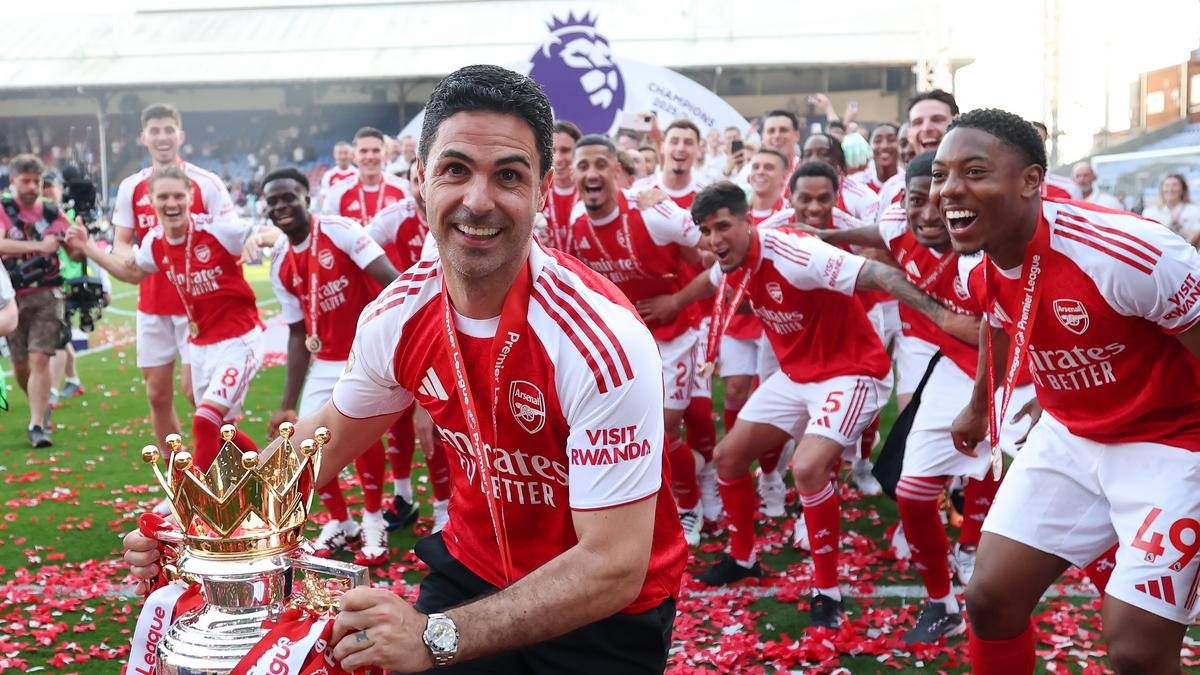
Mikel Arteta, who secured Arsenal its first English top-flight crown in 22 years, is the most experienced, having been in the job for a little over six years and seven months. Unai Emery, who masterminded Aston Villa’s 2025-26 Europa League triumph, is next, with a stint now at roughly three years and 10 months.
Though Guardiola has exited the scene, his giant shadow still looms. Enzo Maresca, who has replaced the 55-year-old at the Etihad, and Arteta have served as his assistants. Xabi Alonso, installed as Chelsea’s new manager, was once Guardiola’s midfield marshal at Bayern Munich.
The post-Pep Premier League era will not have a clean break in terms of tactics too, for Guardiola has left a deep imprint, both in terms of the first principles he introduced, and how he evolved and shed his orthodoxies to cater to the League’s fast-changing demands.
When he first arrived, Guardiola was a cleric of the possession-heavy school and was canonical in his belief that retaining the ball was the best route to success. So much so that even goalkeepers weren’t spared; one of his first decisions at City was to replace Joe Hart, a top-class shot-stopper, with Claudio Bravo, a ball-playing goalie.
And it felt like the league as a whole — with the glorious exception of Jose Mourinho’s Manchester United — was trying to inculcate parts of it.
Guardiola then changed tack to embrace high-energy players and those with great individual skills in order to adjust to the breathless, end-to-end football that the likes of Jurgen Klopp (Liverpool) and Mauricio Pochettino (Tottenham) introduced. The controlled aggression of the earlier years made way for a more expressive and expansive style.
Philosophical blasphemy
And in his last four seasons in charge, he played with one of world football’s purest strikers in Erling Haaland. For a man who once made Lionel Messi turn out as a False 9, and then won two Premier League trophies in 2020-21 and 2021-22 with midfielders as top-scorers (Ilkay Gundogan with 13 goals and Kevin de Bruyne 15), to have Haaland score 112 times over four campaigns would have been akin to philosophical blasphemy.
However, football is now more direct and physical than in recent times and it is to Guardiola’s credit that he tweaked his methods and put in place a blueprint for success. “You need to adapt, evolve,” City’s Maresca said recently. “Set-pieces, man to man — it’s a little bit the direction where football is going. We managers… it’s our duty to find solutions.”
Immediate impact: Michael Carrick, drafted in by Manchester United after Ruben Amorim’s sacking, has taken to managerial life at Old Trafford like a duck to water.
| Photo Credit:
Getty Images
Who among Arteta, Carrick, Alonso, Andoni Iraola and Maresca will answer the call? For one, the sight of Arteta, Carrick and Alonso walking briskly up and down the touchline is sure to remind fans of their glory days as players for Arsenal, Manchester United and Liverpool not so long ago. For a certain generation, it will appear like they are reliving a childhood dream.
Arteta has the first-mover advantage, having already won the League and possessing a winning combination. The addition of Bruno Guimaraes from Newcastle for GBP 75 million will reduce the inordinate burden on midfielder Declan Rice. But Arsenal’s unsuccessful pursuit of Vinicius Junior suggests that the outfit is mindful of the need of a world-class threat upfront.
Carrick, who took over at Old Trafford after the sacking of Ruben Amorim, had an impressive stint as caretaker manager, winning 12 and drawing three of his 17 matches in 2025-26, and helping United qualify for the Champions League after a two-season hiatus. The question before the astute 45-year-old is whether his United has the quality to sustain simultaneous domestic and continental challenges.
For Alonso, Chelsea is the opportunity to light up an aura that has seemingly dimmed after a failed seven-month stint as Real Madrid’s boss. The 44-year-old is known to possess a shrewd tactical brain, and his role in ending Bayern Munich’s hegemony in Germany — 11 straight Bundesliga titles from 2012-13 to 2022-23 — by leading a young Bayer Leverkusen side to its maiden crown is noteworthy. The addition of 24-year-old English attacking midfielder Morgan Rogers for a whopping GBP 117 million shows that he has Chelsea’s wholehearted trust.
Point to prove: For Xabi Alonso, the Chelsea job is the opportunity to light up an aura that has seemingly dimmed after a failed stint as Real Madrid.
| Photo Credit:
Getty Images
Andoni Iraola’s ascent to the top job at Liverpool after making a mark at Bournemouth is eerily similar to Graham Potter’s entry into Chelsea in 2022 after a stellar show at Brighton & Hove Albion. But Potter was dismissed in less than seven months, a fate Iraola will want to avoid.
The 44-year-old is agnostic to any style of play that is not front-footed, a factor that endeared him to the Liverpool hierarchy after a dreary end to Arne Slot’s time. Can he manage to keep the club faithful happy without the services of Mohamed Salah, who left after nine glorious years?
Tough act to follow
Maresca’s situation at City is comparable to what David Moyes faced at United after the latter succeeded Ferguson in 2013. The Italian’s first test will be to not get crushed under the burden of expectations after Guardiola’s supremely successful tenure. It helps that City is not known to be trigger-happy, for both Roberto Mancini and Manuel Pellegrini enjoyed tenures lasting three years or more before Guardiola arrived.
Maresca also comes with a certain pedigree, having led Chelsea to FIFA Club World Cup glory in 2025, and has added England midfielder Elliot Anderson for a hefty GBP 116 million fee. But he will have to compete without the talismanic World Cup winner Rodri, who has shifted to Barcelona, and fellow playmaker Bernardo Silva, who has moved to Real Madrid.
Will he be guided by the spirit of Guardiola or will the ghost of Guardiola haunt him?
