


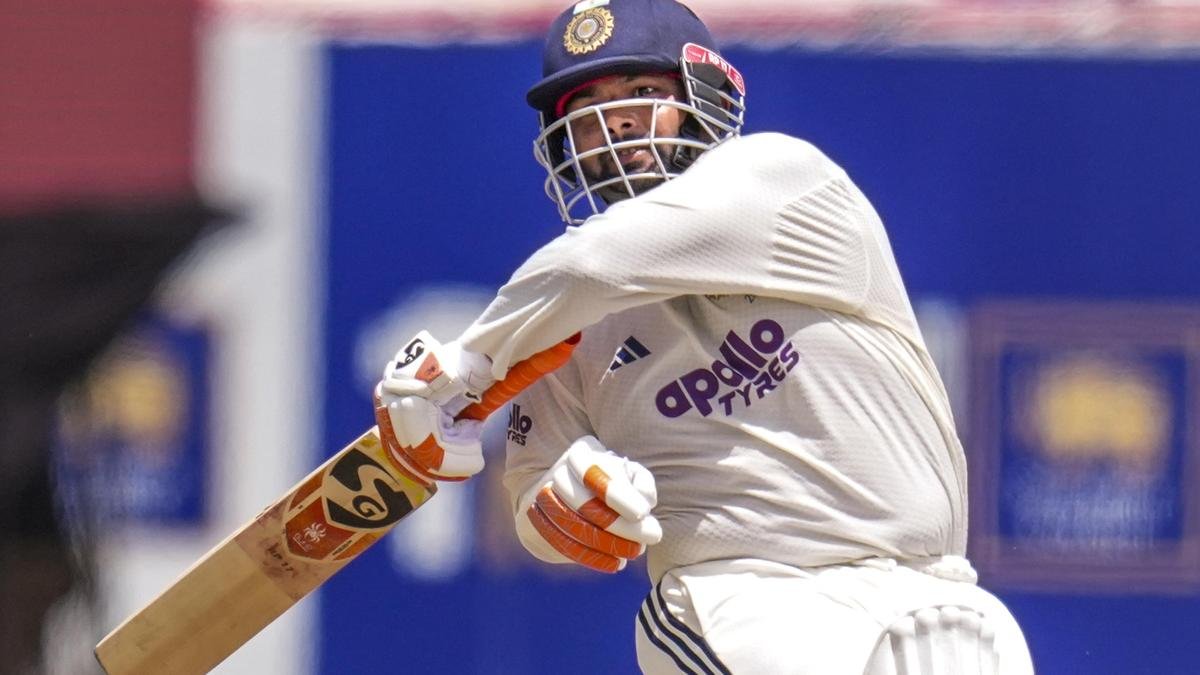
Rishabh Pant isn’t a blink-and-you-miss-it circus act, but you simply can’t take your eyes off him when he is on the cricket ground. Behind the stumps, he is a veritable motormouth, interspersing advice and tips to bowlers with hilarious one-liners bereft of foul language and malice. His sense of humour is earthy and relatable, and often elicits guffaws from opposition batters at whom smart comments are directed. He has quick hands, not quite as quicksilver as his hero and role model Mahendra Singh Dhoni but exceptionally rapid in their own right, and he has managed to strike a balance between the Dhoni school of wicketkeeping and his own brand, also steeped in unorthodoxy like the legendary Jharkhandi.
But it’s in front of the sticks that Pant is at his most entertaining. Or frustrating. Exhilarating. Or exasperating. Or all these at the same time. He cam make the most outlandish look ridiculously pedestrian, but he can also infuriate with an apparent disregard, if not disrespect, for game situations when he bats seemingly without a care in the world.
Immense self-belief
Pant has produced some of the most extraordinary efforts in Test cricket by an Indian in recent times. In Sydney and Cape Town and Leeds and Birmingham, as much as in Chennai on his comeback to Test cricket after his horrendous road accident in December 2022, he has enthralled and enchanted with his unchecked pyrotechnics steeped in immense self-belief and great faith in his abilities. Equally, like in Melbourne 2024 or even in Galle last week, he has almost infuriated with a carefreeness bordering on the careless.
But it’s all of these that contribute to the package that the little dynamite answering to the name of Rishabh Pant is. For some strange reason known only to those, a section of critics has taken it upon itself to dissect his every move and irrevocably affix the tag ‘irresponsible’ against his name. Pant and his fans, of whom there are millions, will happily take ‘irresponsible’ if it comes with 3,662 runs in 51 Tests, at a high average of 43.59 (which will put several specialist batters to shame), a stunning strike-rate of 74.21 and with eight wonderful centuries from 89 innings.
These same critics have wondered how much more productive Pant would have been had he not given into the striking streak of the maverick that oozes from every pore in his body. But then, he wouldn’t be Pant, would he? From Ravi Shastri to Rahul Dravid and perhaps grudgingly, Gautam Gambhir, and from Virat Kohli to Rohit Sharma and Shubman Gill, coaches and captains have generally desisted from constantly being in Pant’s ear, asking him to restrain himself and play in a manner than doesn’t come naturally to him. Pant has tried his utmost to not disappoint them, but from time to time, it is inevitable that he will fall back on his natural instincts, which is to hunt the bowlers down and establish his authority before they can even dream of starting to call the shots.
Just the other day in Galle, there was a spirited if somewhat banal discussion in the press box during one of the numerous rain-stoppages about whether Pant would retain his place in the playing XI for the second Test against Sri Lanka, starting at the SSC ground on Sunday. Actually, it was more than just a discussion; all those involved in that conversation were adamant that with Dhruv Jurel finding his range, perhaps there was a case for Pant to be dropped, for Jurel to take over the big gloves and for Sarfaraz Khan, a late replacement for the injured Sai Sudharsan, to return to Test action after 21 months in the wilderness.
The sheer vehemence and tone took one by surprise. It’s Rishabh Pant they were talking about, dismissing him as someone who was expendable, dispensable and eminently droppable. Admittedly, this was before his blazing 66 in the second innings, but even so, leave out Pant? Really? How does that even work?
Perhaps, returns of 81 and 39 in his two previous Test innings didn’t count for much in these pundits’ books? Maybe, they were so incensed by his charge down the track to swat Keshara Nuwantha’s left-arm spin to mid-off that they felt he needed to be taught a lesson, to be put in his place?
Perceived ‘irresponsible’ batting
Indian cricket is no stranger to players being sanctioned for perceived ‘irresponsible’ batting. Kapil Dev is one of the more visible victims of this tack, dropped from the Kolkata Test against England in 1984 after holing out to long-on in the loss in the second Test at New Delhi’s Feroze Shah Kotla ground. If Kapil’s omission was a witch-hunt of sorts, as whispers have indicated, it was ‘beautifully’ couched with Sandeep Patil emerging as collateral damage. Kapil returned to the playing XI for the fourth Test in Chennai and graced the five-day game for another decade, while Patil didn’t don the white flannels ever again.
But while egos might still be as prevalent now as they were more than four decades ago, the chances of leaving out a star player or two on a whim are miniscule to non-existent in the social media-driven era where it is hardly fanciful to whip up public sentiment and support. In any case, no one in his senses will (or at least, should) seriously contemplate ‘benching’ Pant on disciplinary grounds because why would you want to go into a Test match with one hand tied behind your back?
Perhaps, Pant was seized of the isolated overreactions to his first-innings misadventure when he tried to hit the cover off the cherry immediately after Sri Lanka summoned the second new ball and perished to the fourth ball of the first over, clattering Nuwantha into the deep field. Perhaps, he felt the need to convince himself, more than anyone else (he is, after all, the monologue king while batting, often advising or berating himself), that he could play the situation, that his game awareness was second to none, and that his discipline isn’t as fragile or tenuous was the world might believe.
No matter why, Pant batted a lot more within himself in India’s second innings, which they began with a lead of 178. There was a platform for him to build on, perhaps with typically explosive swag; India were 81 for three, 259 runs to the good, when Pant walked out to replace Gill. The foundation established, he could have chosen to cut loose from the get-go, but Pant employed an entirely different tactic.
Wonderful basics
Like all great destroyers of bowling, Pant has wonderful basics that don’t get enough credit. His defence is rock solid, though when he does offer a dead bat, it often feels like he is toying with the bowler. On Tuesday, he used barndoor defence to great effect, if only because… Not until his 14th ball did the Pant of usual, the impish and cheeky version, surface, through a reverse sweep against Nuwantha that sped away to square third-man for four. A little while later, after another stonewalling rigmarole, he ran at Lahiru Kumara faster than the Sri Lankan quick ran at the bowling crease, took the ball on top of its bounce and flat-batted with such ferocious power that the ball sailed well out of the stadium and scattered the pedestrians milling around the historic Dutch fort.
Pant took a liking to Kumara, pulling him over long-leg for six to bring up an eye-catching half-century and then smacking him for two fours in the pacer’s next over. Kumara might have had the last laugh as an attempted pull lobbed off the miscue into Dickwella’s gloves; by then, Pant had smashed 66 in just 69 deliveries, with eight fours executed with utmost precision and the two sixes off Kumara.
The second of those ‘maximums’ took him to not just his 20th half-century but also to 100 sixes in Test cricket. That’s no mean accomplishment, lest we should begin to think so. Until Pant, only three other batters had got to that rare milestone – the retired trio of Ben Stokes, Brendon McCullum and Adam Gilchrist. Hitting sixes in Test cricket is evidently not as easy as it might seem, or as easy as it is in the T20 format particularly. To therefore be in a select quartet is a grand achievement but when it comes to Pant, there are no half-measures, right?
The former India vice-captain got to that landmark in his 89th innings, a good 41 knocks faster than Gilchrist. On its own, that doesn’t mean too much because it’s more than possible that several of these knocks didn’t extend beyond ten deliveries. A more acceptable barometer when it comes to measuring rate of six-hitting is balls faced, which can then translate to balls per six. Gilchrist’s 100 sixes came in 6578 deliveries, which is roughly a six every 65.78 balls; Pant needed only 4918 balls to get to that same destination, meaning he strikes a six more than 16 deliveries quicker than his Australian counterpart. Talk about impact. Talk about destructive power. Talk about unchecked mayhem. Talk about game-changing influence.
As India brace for eight Tests in the next seven months, including two in New Zealand, they will need Pant firing on all cylinders. He will continue to annoy and anger with rushes of blood that are such an integral part of his DNA that there is no way he can excise them totally from his system. But he will also turn on the heat, the power, the potential for damage that perhaps no one else in world cricket currently possesses. Pant is the consummate professional but whether by accident or design, he is also the ultimate entertainer, lying flat on his back after playing a sweep for six or setting a field for himself when he is batting, like he convinced Bangladesh captain Najmul Hossain Shanto into doing in the Chennai Test of September 2024.
Pant can’t be excepted from accountability – no one is bigger than the team, ever – but he can’t also be expected to be something he isn’t. We must accept him for what he is, warts and all, because Pant is the master of his own world and we all cricket-crazy investors are privileged enough to be allowed entry into that very private space.
