


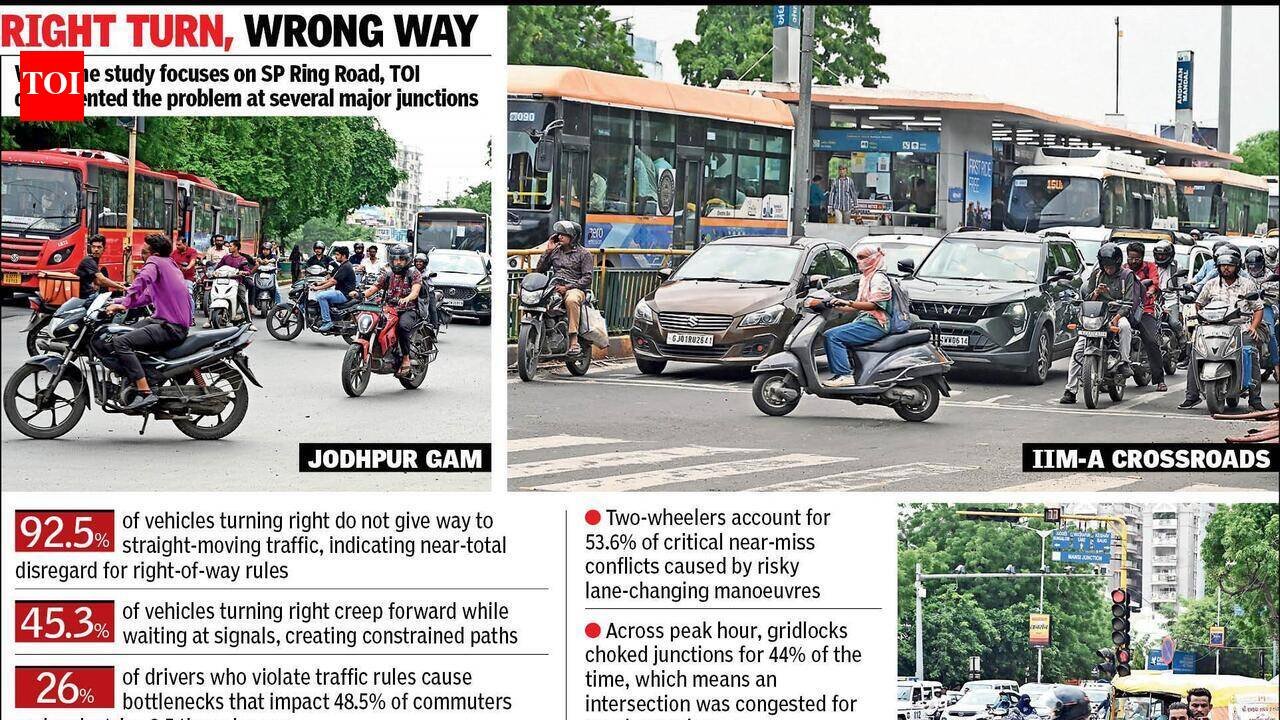
Ahmedabad: If you commute on SP Ring Road during rush hours, you will know the feeling. You are headed straight, but a vehicle going right creeps into your lane, forces you to brake, swerve or simply accept that your six-second stretch of road will now take 20 seconds. A new drone study has put exact numbers to this daily frustration, and they are worse than most commuters might imagine.Only 7.5% of motorists and riders turning right respected the right-of-way of straight-moving traffic. Put the other way, 92.5% of right-turning drivers on SP Ring Road routinely violated right-of-way rules. The study describes the driving culture bluntly — a “nonchalant attitude towards other road users, and competitive and non-uniform behaviours of drivers”.The consequences ripple outwards. About 26% of right-turning drivers engage in what researchers call “bursty and intermittent” violations — lurching forward into gaps, creating bottlenecks that slow down 48.5% of the oncoming straight-moving vehicles. Commute times surge 3.5 times as a result, stretching a normal six-second road run to over 20 seconds. Across the peak hour, localised gridlock affects 44% of all traffic at these junctions.The researchers Yagnik Bhavsar, Mazad Zaveri and Mehul Raval from Ahmedabad University, alongside Pancham Shukla of Imperial College London and Shaheriar Zaveri of Road Safety Automotive Management, used drones and AI vision. They analysed 2,406 vehicle trajectories during one morning rush hour on SP Ring Road. The paper, published in the journal Technologies, delivers a mathematically validated account of what Ahmedabad’s commuters experience every day.Even drivers who nominally wait their turn cause disruption. Rather than holding position at the median, 45.3% of right-turning vehicles crept forward into the major lanes, forcing straight-moving traffic onto constrained paths and nearly doubling their travel times.The researchers developed a new safety metric, “condPET” (conditioned post-encroachment time), which accounts for these evasive responses. It found that only 6.3% of vehicle conflicts were genuinely critical. But within that critical group, two-wheelers bear the sharpest risk: more than half — 53.6% — of vehicles involved in conflicts were two-wheelers, primarily changing lanes to avoid collisions from errant right-turning drivers.The road design itself is part of the problem, according to Abhijeet Lokre, co-founder of Urban Labs. “Because the junctions or the approach to junction sometimes are so wide open that they create a funnel at the intersection,” he said. “You have two or three lanes. While approaching the intersection, these suddenly widen into five lanes. This gives room for commuters to spill into the front of the funnel in a hurry to cross the signal.”What is the solution? Lokre is direct. “The only way is enforcement and keeping the lanes as they are. You will see people’s behavior change. I can’t think of a positive nudge as of now.”
