


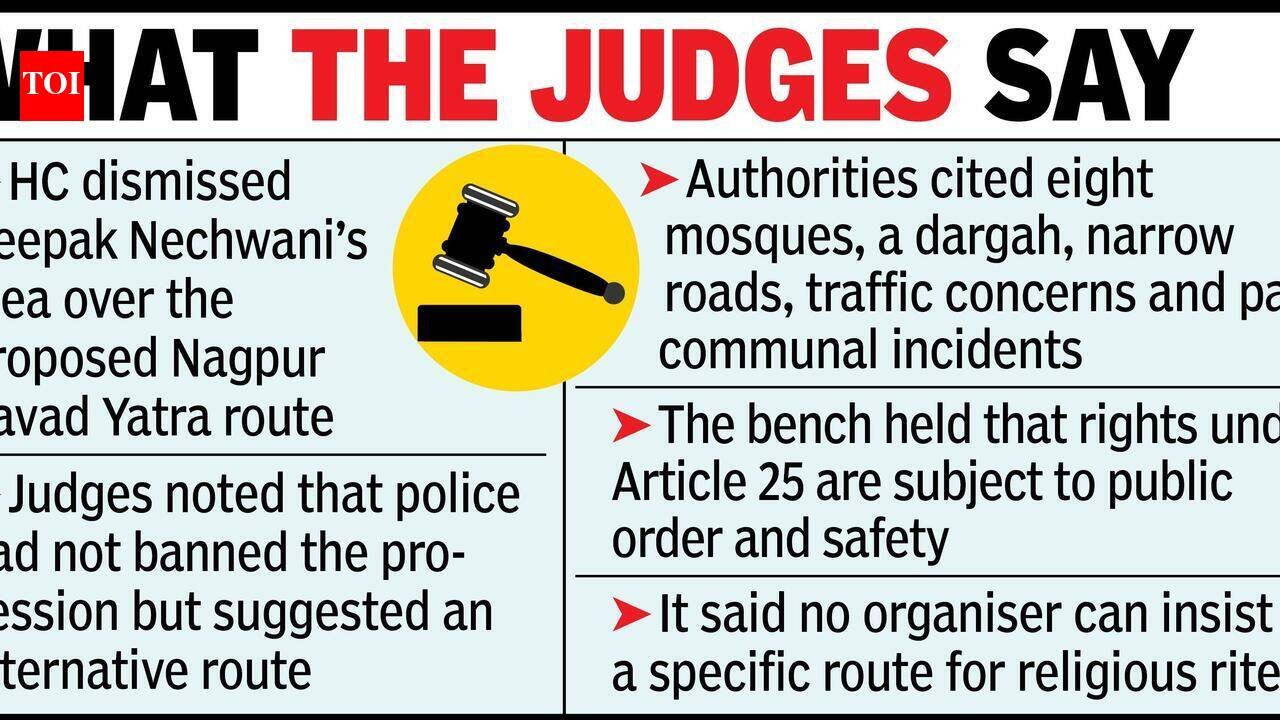
Nagpur: The Nagpur bench of Bombay high court last week clarified that the right to practise one’s religion under Article 25 is not absolute and must yield to the larger interests of law and order, public interest, and needs of other sections of society that may be adversely affected if a particular manner of religious practice is insisted upon and permitted.Dismissing a petition by Deepak Nechwani challenging police restrictions on the route of a proposed Kavad Yatra that was supposed to pass from Mominpura area dominated by the minorities, a division bench comprising Justices Anil Kilor and Rajnish Vyas ruled that the organiser has no fundamental right to insist on a particular road for a religious procession when authorities have cited public order, traffic and safety concerns.The petitioner had challenged a July 31 police report and DCP’s order of Aug 1 that declined permission for the route proposed for the Kavad Yatra. The procession was to carry consecrated water for jalabhishek of a Shivling.“This is not the case where the petitioner has been asked for not to take out the procession at all,” the bench said, noting that police had suggested an alternative route.Nechwani argued that India is a secular country and that religious processions cannot be barred merely because the route passes through areas where another religious community resides or does business.Govt pleader and senior counsel Deven Chauhan opposed the plea, saying the issue was not religious freedom but route regulation. He argued that no person or group has a fundamental right to use a particular road for religious rites, especially when police inputs indicate a likelihood of disturbance.DCP’s communication recorded that the proposed route was supposed to pass by eight mosques and one dargah, in what police described as a sensitive area. It also referred to earlier incidents, including a Jan 22, 2024, case near Jama Masjid in Mominpura and communal unrest on March 17, 2025, after a protest connected to Aurangzeb’s tomb.Police also cited narrow roads, heavy traffic, possible obstruction to ambulances and fire services, VVIP and VIP security duties, and lack of details from the organisers on traffic management, sound systems, estimated turnout, volunteers, identity cards, emergency response and crowd-control arrangements.The judges said the petitioner had failed to furnish necessary information even after the deficiencies were noted. “The petitioner cannot compel any private person to make him a part of such private temple for Kavad Yatra,” they said.The bench also cited an Allahabad high court ruling that religious freedom under Article 25 is subject to public order. “The exercise of right to practise one’s religion is one thing and to practise it in a particular way is another,” the court said.
