


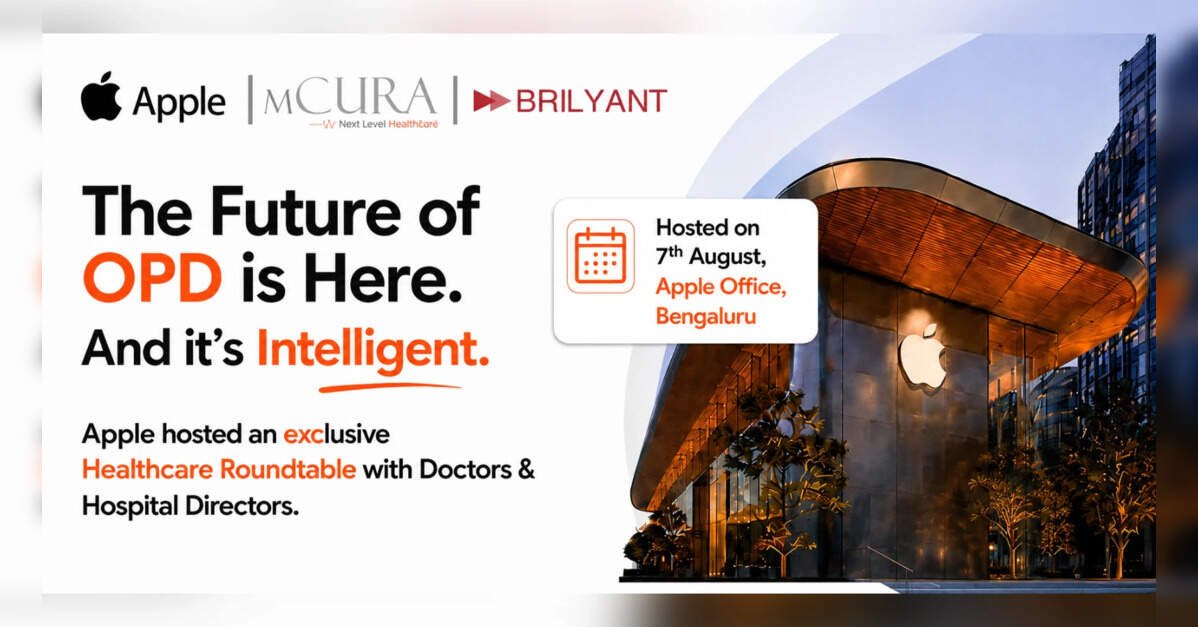
Apple, Brilyant and mCURA bring hospital leaders together in Bengaluru to discuss intelligent OPDs, Small Language Models, institutional clinical knowledge and the emerging idea of creating a “Digital Twin of a Doctor.”
As artificial intelligence rapidly reshapes industries, healthcare faces a more fundamental question than simply how quickly it can digitise: Can hospitals transform decades of clinical knowledge into institutional intelligence that remains within the hospital and continues to learn?
This was among the key themes that emerged at an exclusive healthcare roundtable hosted at the Apple office in Bengaluru on 7 August, bringing together doctors, hospital directors and technology leaders.
Conducted by Apple, Brilyant and mCURA, the discussion moved beyond conventional hospital digitisation to explore how Apple infrastructure, intelligent OPD workflows, Agentic AI and hospital-controlled Small Language Models could come together to shape the next generation of healthcare delivery.
Amit Tandon from Apple opened the technology conversation, sharing how Apple continues to drive innovation in healthcare and how its technology ecosystem can support clinicians and healthcare organisations as care delivery becomes increasingly digital. Apple also hosted the participating hospital leaders and partners, creating a forum for healthcare and technology stakeholders to exchange perspectives on where the industry is heading.
Brilyant presented the infrastructure opportunity around bringing Apple’s technology ecosystem deeper into hospitals. Combined with mCURA’s Smart OPD platform, the discussion explored how hospitals could move beyond isolated device deployment towards a connected digital environment spanning clinicians, patients and hospital workflows.
From digitising records to building hospital intelligence
Presenting mCURA’s perspective, Madhubala Radhakrishnan, Founder & Director, mCURA, argued that the next transformation in healthcare will not come merely from converting paper records into electronic records.
“Digitisation should ultimately create intelligence for the institution. Hospitals have accumulated enormous clinical knowledge over decades, but much of that knowledge today remains fragmented across doctors, departments, records and systems,” she said.
mCURA presented its approach towards cost-effective, end-to-end OPD transformation, combining Agentic AI, technology infrastructure and managed workflows rather than treating digitisation as another standalone software implementation.
A significant part of the discussion centred on mCURA’s ongoing work around Small Language Models (SLMs) designed to operate within the hospital environment.
Unlike an architecture where sensitive hospital information must continuously travel to large external AI systems, an on-premise SLM could potentially allow hospitals to build a controlled intelligence layer around their own clinical information, protocols and institutional experience.
According to Radhakrishnan, however, the opportunity extends considerably beyond data privacy.
“Individual doctor, hospitals should first think about creating their own clinical knowledge base,” she observed.
Such a knowledge layer could progressively organise and contextualise appropriately governed clinical records, treatment pathways, departmental protocols and years of institutional experience while remaining within the hospital’s controlled environment.
Taking specialist knowledge beyond the specialist
The discussion then opened another potentially significant use case.
If a hospital-specific SLM can contextualise institutional knowledge across specialties, could that intelligence eventually help make specialist clinical knowledge accessible to junior doctors and general medicine practitioners in locations where multi-specialty expertise is not always immediately available?
The intention would not be for AI to replace specialist judgement or independently determine treatment. Instead, it could evolve into a clinical knowledge and decision-support layer—helping doctors access relevant protocols, institutional learnings and multi-specialty treatment pathways at the point of care.
Such an approach could become particularly relevant in rural and underserved environments, where access to specialists remains uneven.
Building on the SLM and institutional knowledge discussion, Dr. Aravind of Cloudnine Hospitals raised a fascinating longer-term possibility: creating a “Digital Twin of a Doctor.”
Experienced clinicians accumulate knowledge over decades that goes well beyond textbooks—patterns recognised across thousands of cases, approaches to complex situations and invaluable clinical experience.
If appropriately consented, governed and clinically validated, AI could potentially help preserve elements of this knowledge and make it useful to future generations of clinicians.
The OPD could become the starting point
For mCURA, this transformation begins with the outpatient department, where enormous volumes of clinical information are generated every day.
An intelligent OPD can capture structured clinical information at the point of care and progressively transform longitudinal patient records into contextual knowledge. mCURA believes combining this foundation with Agentic AI and hospital-controlled SLMs could move healthcare IT from systems that simply store information towards systems capable of understanding context and assisting workflows.
The Bengaluru roundtable ultimately pointed towards a larger shift in healthcare technology.
The hospital of the future may not be defined simply by how many processes have become paperless or how many applications have been deployed.
Its competitive advantage could increasingly depend on how effectively it converts its own clinical experience into secure, governed and reusable institutional intelligence.
And if that intelligence can eventually help a young doctor access decades of accumulated clinical wisdom when and where it is needed, healthcare’s AI transformation could prove far more consequential than digitisation alone.
Disclaimer: The above content is non-editorial, and TIL hereby disclaims any and all warranties, expressed or implied, relating to it, and does not guarantee, vouch for or necessarily endorse any of the content.
