


Spotting a snake basking on a woodland path or tucked into tall grass on a countryside walk can send anyone’s heart racing, and if you’re anywhere across Britain, Scandinavia, or much of continental Europe, there’s a genuine chance it could be the European adder, the only venomous snake native to the UK and one of the most widely distributed snake species on the planet. Despite its fearsome reputation, the adder is shy by nature and generally bites only when startled, stepped on, or handled, but knowing exactly how to identify one correctly still matters, both for your own safety and for recognising a species that plays a genuinely important ecological role. Here’s a full breakdown of the key features that set the adder apart from other snakes you might encounter.
The classic zigzag pattern
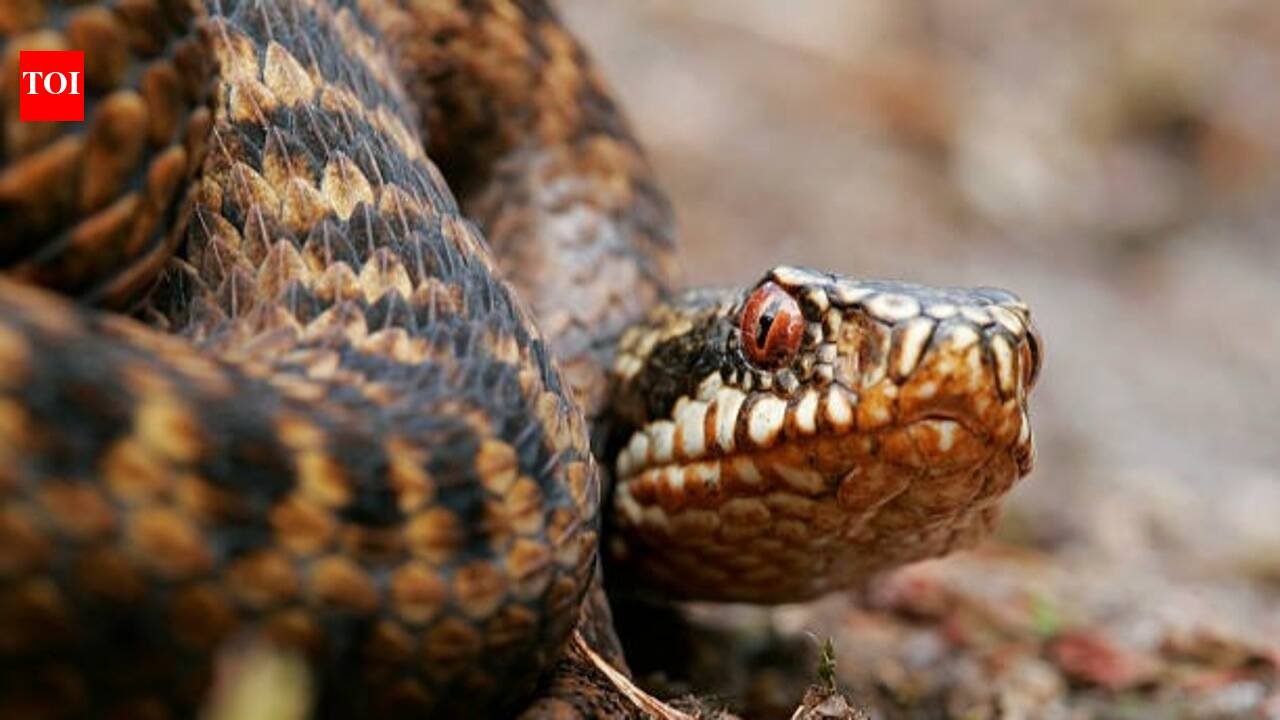
The European adder is immediately recognisable by one characteristic: the dark jagged zigzag stripe running the entire length of its back, from just behind the head to the tail. The pattern is usually darker than the base colour of the snake’s body, and is often bordered by rows of smaller dark spots along the sides. It’s considered the single most reliable field mark for identifying an adder at a glance, and it remains visible even on individuals with unusual colouring, making it the first thing most experienced observers look for.
The unique sign of a separate triangular head
The head of an adder is much broader than the neck, and has a distinct, angular, triangular shape which is very different to the more uniform, rounded heads of many non-venomous snakes. Look closely and you’ll often spot a dark marking shaped like a V, X, or H sitting toward the back of the head, right around the point between the eyes. This head marking, combined with the sharply defined triangular shape, is a strong secondary indicator alongside the zigzag pattern, and the two together make misidentification considerably less likely.
Vertical pupils, a crucial safety clue
This is one of the most important identifying details and also one of the easiest to check safely from a distance with a good look or a zoomed photo. European adders have vertical, slit-like pupils, similar in shape to a cat’s eye, rather than the round pupils found in most of Europe’s non-venomous snake species, such as the grass snake. If you’re ever trying to distinguish an adder from a similar-looking harmless species, the eyes are one of the clearest, most dependable features to check, provided you can observe safely from an appropriate distance.
A stout body with a short tail
Adders have a notably robust, thick-set body compared to many other snake species, tapering into a relatively short tail rather than a long, gradually thinning one. Adults typically measure between 60 and 90 centimetres in length, making them small to medium-sized as vipers go, but their stocky build gives them a heavier, more solid appearance than their modest length might suggest. Their scales are also very heavily keeled, meaning each has a raised ridge running down the middle so the skin has a rough, textured appearance rather than a smooth, glossy one.
European Adder snake
Colour varies, and males and females look different
Adders show genuine variation in colour, and interestingly, males and females tend to look noticeably different from one another. Males are typically a paler grey, silvery, or pale cream base colour with sharply contrasting black zigzag markings, while females lean toward brownish or reddish tones with markings in a softer dark brown rather than pure black. In some northern and higher-altitude populations, entirely black individuals occur through a condition called melanism, thought to help these snakes absorb heat more efficiently in cooler climates, so don’t rule out an adder just because it looks solid black.
Where you’re likely to encounter one
The European adder holds the distinction of being found further north than any other snake species on Earth, with a range stretching from the UK and Scandinavia across northern Europe and Russia all the way to the Pacific coast, crossing into the Arctic Circle in places. Adders are found throughout this wide range, favoring heathland, moorland, the edges of woodland, grassland and coastal dunes. They like sunny open places to bask in, with plenty of dense ground cover nearby for shelter. They are creatures of habit, too, often revisiting the very same hibernation sites year after year.
What to do if you spot one, or get bitten
Adders are shy, non-aggressive snakes that generally only bite as a last resort when they feel directly threatened or are accidentally trodden on or grabbed. If you do encounter one, the safest approach is simply to observe from a distance and let it move away on its own, never attempt to handle or corner it. While adder bites can be genuinely painful and cause swelling, they are very rarely fatal to healthy adults, though medical attention should always be sought immediately if a bite does occur, since reactions can vary considerably from person to person.
Disclaimer:
This article is intended for general informational purposes only and is not a substitute for professional medical or wildlife expert advice. If you are bitten by a snake you believe to be a European adder, seek immediate medical attention rather than attempting to treat the bite yourself. Never attempt to handle, capture, or provoke a wild snake, even if you believe it to be non-venomous, as misidentification is possible even among experienced observers.
