


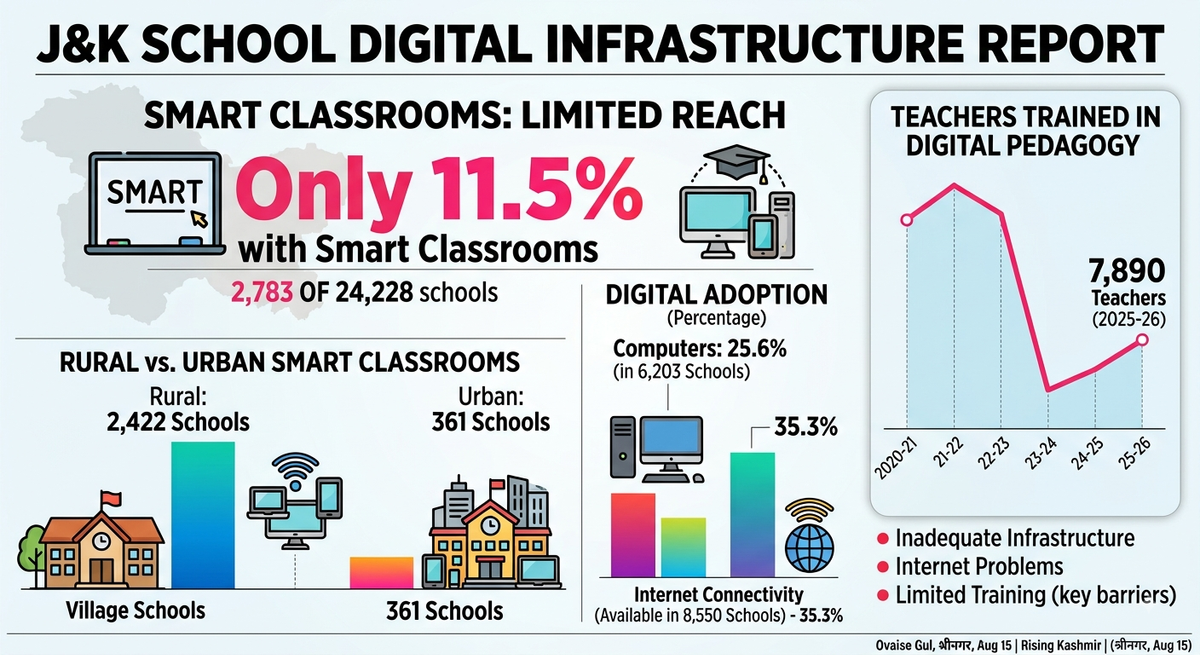
Srinagar, Aug 17: Rural Jammu and Kashmir is leading the Union Territory’s smart classroom expansion, but the overall reach of digital infrastructure remains limited, with only 2,783 of 24,228 operational government-run schools equipped with smart classrooms.
The data shows that 2,422 rural schools have the smart classroom facility compared to 361 urban schools, while 7,890 teachers were trained in digital pedagogy, digital teaching methodology and use of technology during 2025-26.
Computer facilities are available in 6,203 schools, or around 25.6 per cent, while 8,550 schools, accounting for about 35.3 per cent, have internet connectivity, according to details accessed by Rising Kashmir.
The rural-urban divide is particularly notable. Of the 2,783 schools with smart classrooms, 361 are in urban areas and 2,422 in rural areas. Computer facilities are available in 644 urban and 5,559 rural schools, while internet connectivity is available in 577 urban and 7,973 rural schools.
The figures assume significance as Jammu and Kashmir has been pursuing digital transformation in school education, including the expansion of ICT labs and smart classrooms. The Union Ministry of Education prioritises 100% internet connectivity in secondary and senior secondary schools to bridge the digital divide and support modern learning.
The data on teacher training, however, shows some improvement after a sharp decline. As many as 97,141 teachers in J&K were trained in digital pedagogy, digital teaching methodology and use of technology in 2020-21, followed by 84,882 in 2021-22. The number fell to 1,483 in 2022-23 and 401 in 2023-24.
Training numbers subsequently increased to 6,443 in 2024-25 and 7,890 in 2025-26.
The figures indicate that while efforts to strengthen teachers’ digital skills have resumed, infrastructure remains a major challenge.
A recent NCERT-published study on rural schools in Jammu Division also identified inadequate ICT infrastructure, internet connectivity problems and limited teacher training as key barriers to technology adoption.
The Jammu & Kashmir government has planned further expansion of digital infrastructure, including ICT labs and smart classrooms, under its education initiatives.
The gap highlights the need to ensure that expansion of digital teaching is matched by reliable internet, computers and smart classroom facilities, particularly in schools serving remote and rural communities.
