


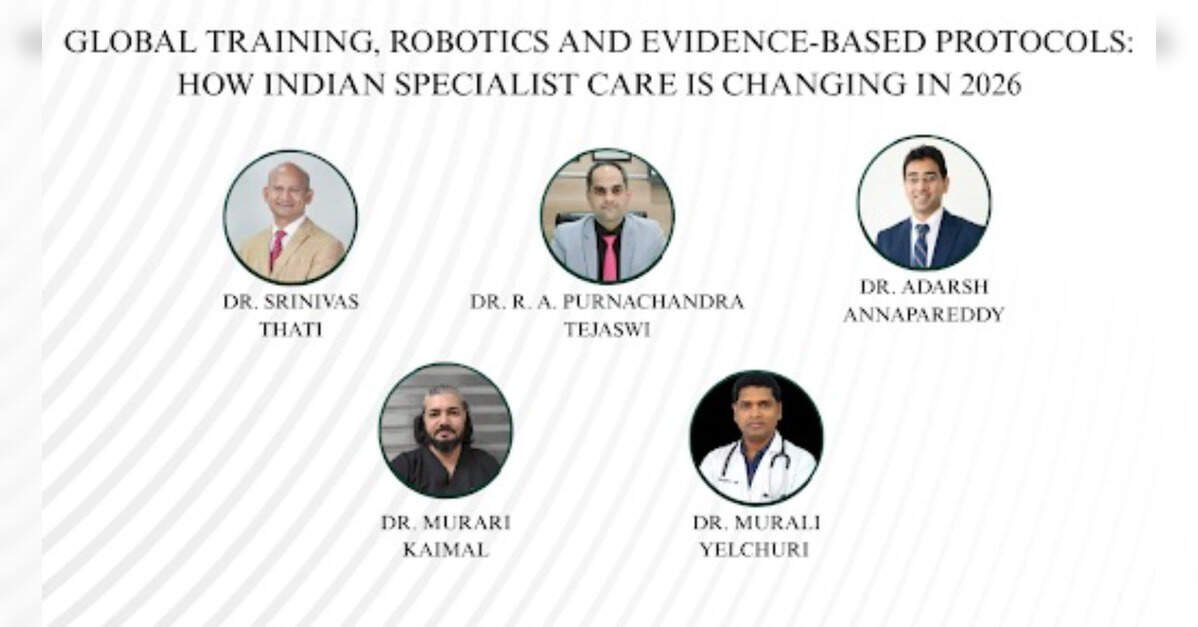
India’s healthcare system is going through a quiet shift. Across orthopaedics, ENT, and respiratory medicine, a growing number of specialists trained internationally are bringing global protocols, robotic-assisted techniques, and AI-supported diagnostics into everyday clinical practice. The result is a visible move away from generalized treatment toward precision, evidence-based care – a shift shaped, in large part, by individual clinicians who trained abroad and chose to bring those standards back into Indian hospitals.
Robotics and Joint Preservation in Orthopaedics
Orthopaedic care has seen some of the most visible changes, particularly in joint replacement and sports medicine. At AIG Hospitals, Gachibowli, Dr. Srinivas Thati, Director and Head of the Department of Orthopaedics, Trauma and Sports Medicine, has built his practice around joint preservation, cartilage regeneration, arthroplasty, and robotic-assisted joint replacement surgery. His training spans an MS in Orthopaedics, MRCS, FRCS in Trauma and Orthopaedics, a Fellowship of the European Board of Trauma and Orthopaedics, and a Lower Limb Arthroplasty Fellowship completed in the United States. That combination shapes how he approaches each case: rather than defaulting to standard surgical protocols, every decision is weighed against current clinical evidence, from imaging to post-operative rehabilitation planning. He also serves as a Co-opted Member of the Telangana Medical Council, working on broader questions of healthcare governance alongside his clinical practice.
A similar philosophy drives Dr. R. A. Purnachandra Tejaswi’s work at KIMS Hospitals, Hyderabad, where he serves as Director and Head of the Department of Sports Orthopaedics, Arthroscopy and Shoulder Service. His North American fellowship training informs a practice centered on arthroscopic surgery, joint preservation, and complex shoulder procedures. What distinguishes his approach is the emphasis on long-term outcomes over surgical technique alone – patients go through a personalised rehabilitation plan built specifically around their recovery timeline, not a generic post-op protocol. He remains active in clinical research and medical education alongside his surgical practice.At KIMS-Sunshine Hospitals, Dr. Adarsh Annapareddy, Executive Director and a specialist in robotic knee and hip replacement, has taken the international-training model a step further by training surgeons from other countries in robotic-assisted techniques. His academic output – more than 30 publications in peer-reviewed journals – sits alongside a hands-on surgical practice, reflecting how research and robotic-assisted technique are increasingly expected to move together in this specialty. Outside the operating theatre, he has also worked in short film direction and acting, a detail that speaks to how varied the professional lives of India’s newer generation of specialists have become.AI Integration in ENT Diagnostics and Surgery
Technology adoption isn’t limited to orthopaedics. In ENT care, Maj (Dr.) Murari Kaimal, Senior Consultant Surgeon and Lead ENT at CIMS, has spent over 19 years practicing across India, the UK, Central Asia, Europe, and the Middle East, including service as a decorated Indian Air Force officer. A University Gold Medalist in MS-ENT with Advanced Rhinology Fellowship training from the UK, he has since added AI certifications from Cambridge and Stanford to his clinical background. That combination now shows up directly in his endoscopic surgical practice, where AI-supported diagnostic tools are used alongside traditional endoscopic technique – part of a broader move of AI from research settings into day-to-day ENT care.
Evidence-Based Respiratory Medicine
The same shift toward evidence-driven care is playing out in pulmonology. Dr. Murali Yelchuri, who practices at Srikara Hospitals, Miyapur, Hyderabad, has spent over a decade focused on the diagnosis and management of complex respiratory conditions. A graduate of Dr. NTR University of Health Sciences, he holds a Diploma in Tuberculosis and Chest Diseases from Osmania Medical College and active membership with the European Respiratory Society. In practice, that membership isn’t just a credential – it keeps his diagnostic and treatment approach aligned with international pulmonology standards, at a time when respiratory disease management in India is increasingly expected to match global benchmarks.
What This Means for Patients
Taken together, these five practices point to a broader pattern in Indian healthcare: specialists trained across global institutions are bringing back not just technical skill, but a more standardized, evidence-first approach to treatment. For patients, this translates into surgical and diagnostic decisions increasingly benchmarked against international protocols rather than shaped by convenience or cost alone. As robotic-assisted surgery, AI-supported diagnostics, and structured rehabilitation become more common across Indian hospitals, this shift – driven by individual clinicians rather than institutional mandate – is likely to keep accelerating through 2026 and beyond.
Disclaimer: The above content is non-editorial, and TIL hereby disclaims any and all warranties, expressed or implied, relating to it, and does not guarantee, vouch for or necessarily endorse any of the content.
