


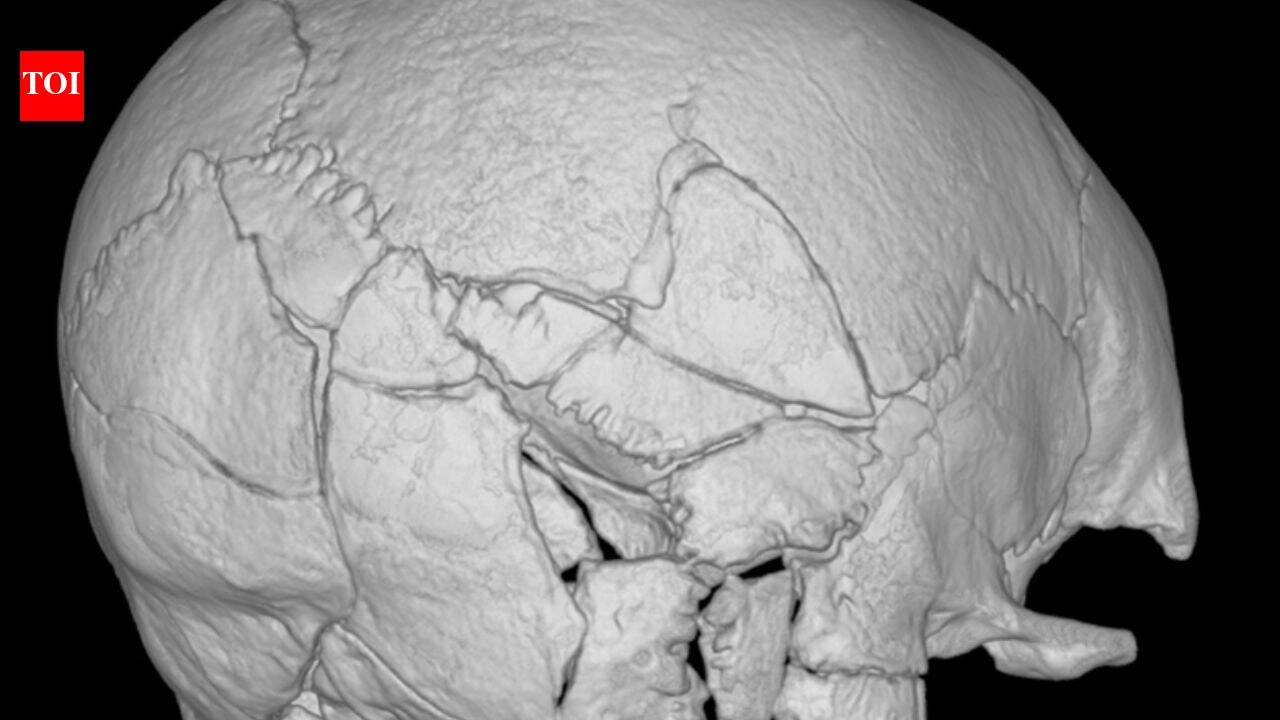
A skeleton uncovered beneath Scotland’s Stirling Castle may be the first confirmed archaeological evidence of a person killed by a trebuchet. Known to archaeologists as Skeleton 150, the remains belong to a defender who appears to have been killed during a battle in the early 14th century by a weapon that sent a huge boulder flying through the air.According to Science Magazine, the skeleton was uncovered in 1997 during excavations beneath the chapel at Stirling Castle. Researchers found nine skeletons in graves at the site, with five of them dating to the 1300s. Several of the remains showed signs of injuries linked to violence and combat.Now, a detailed study of Skeleton 150 has provided the first confirmed archaeological evidence of trauma caused by a trebuchet. A trebuchet was a large medieval siege engine used to throw heavy objects, including stones, over long distances. The pattern of injuries suggests that the man was hit by a very large object travelling at high speed.Jo Buckberry, a bioarchaeologist at the University of Bradford, presented the findings at the biennial European meeting of the Paleopathology Association in Berlin last week. She said, “The breaks indicate a very large area of impact and devastation. It’s likely the individual was killed by a siege engine.”
Stirling Castle findings
The remains were discovered during archaeological excavations beneath the chapel at Stirling Castle in 1997. The nine skeletons were buried at the site, and five of them, including Skeleton 150, dated to the 1300s.The period was marked by major fighting between English and Scottish forces. The conflict was linked to Scotland’s struggle for independence, and Stirling Castle had an important military position. It was located on a key road towards Edinburgh and was known as the gateway to Scotland.The castle changed hands five times between 1296 and 1304. In 1304, it eventually fell to English forces after a long siege.The location of the graves also gave researchers an important clue. Burial inside the castle chapel was unusual at the time. Researchers believed this could have happened because the people had died during a siege, when it may not have been possible to take bodies outside the castle walls for burial.Examining the bones showed several types of injuries, including cut marks, penetrative injuries and blunt force trauma. Among the remains, Skeleton 150 showed the most extreme injuries.
More than 160 fractures
Skeleton 150 was about 165 centimetres tall. Researchers counted more than 160 separate fractures across the remains. The skull alone had been broken in 61 places. The skeleton also had a deep, zigzag-shaped break in one shoulder and almost 60 unusual zigzag fractures across the ribs.Patrick Randolph-Quinney, a biological anthropologist at Uppsala University who worked with Buckberry on the skeletal analysis, said, “It’s very clear the energy is going through the chest. The individual is pinned to the ground quite quickly afterwards.”
Stirling Castle stood on a key route to Edinburgh and was known as Scotland’s gateway.
The injuries also helped researchers rule out some other possible explanations. At first, a fall from the castle walls could have appeared to be a possible cause of death. However, the damage was spread across too much of the body for a simple head-first fall to explain it.The condition of the ribs and the shattered right leg were especially important. Researchers also considered whether the remains could have been damaged by horses trampling the body or after burial. But the shape and texture of the fractures did not support those explanations.This left researchers looking for another cause that could explain the unusual pattern of damage.
A modern comparison
To understand what could have caused such injuries, Buckberry examined forensic and medical research. She also looked through anatomical collections for cases with similar patterns of damage.The closest comparisons she found involved people who had been involved in serious modern accidents. “It looks like he was hit from behind by something traveling at a great velocity,” Buckberry said. “The most similar cases I was finding were car crashes and people hit by trains.”But there was a clear problem with that comparison. The victim had died in medieval Scotland, more than 700 years ago. Buckberry therefore looked at what could have produced such a powerful impact in 1304. Historical records from the siege of Stirling Castle provided a possible answer.English forces under Edward I used trebuchets during the 1304 siege. These machines were among the siege weapons used to attack fortified positions. A trebuchet worked by using a long throwing arm to launch heavy objects, including large stones. The weapons could throw boulders weighing more than 100 kilograms over hundreds of metres.
Use of ‘war wolf’
One trebuchet used at Stirling Castle was known as ‘War wolf’. According to Buckberry, it was the biggest trebuchet built at that point.Historical accounts confirm that the large siege engine was used during the battle. It was powerful enough to break through two stone walls. Accounts described the destruction by saying the machine tore through the walls ‘as an arrow would fly through a piece of cloth.’Speaking about Skeleton 150, Waltenberger said such damage is rarely seen in human remains from the past. “It’s a huge amount of energy delivered in milliseconds,” he said. “In skeletons from past times you rarely see this.”Researchers believe the man was likely hit from behind by a flying boulder. It is not possible to say with certainty whether the projectile came from War Wolf or another trebuchet used during the siege.However, the combination of the historical evidence, the location of the burial and the extensive pattern of fractures has given researchers a strong explanation for the death of Skeleton 150.
