


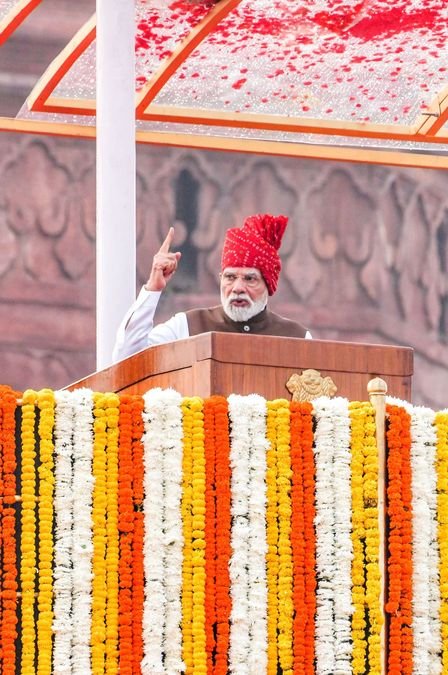
New Delhi, Aug 15: Prime Minister Narendra Modi on Saturday highlighted India’s transformation over the last 12 years in his Independence Day address, outlining significant progress across manufacturing, digital infrastructure, basic amenities, energy security, youth empowerment, innovation, social security and other key sectors.
Addressing the nation from the ramparts of the Red Fort, the Prime Minister said India has witnessed rapid and inclusive development over the past decade, with the removal of numerous, decades-old obstacles to development.
The Prime Minister pointed to remarkable growth across manufacturing sectors over the last 12 years. Defence production has increased nearly four times, while Khadi and Village Industries production has grown nearly five times. Electronics manufacturing has increased nearly seven times, modern railway coach production has risen 21 times, and mobile phone production has surged 35 times.
Modi underscored the rapid expansion of India’s digital and innovation ecosystem, noting that internet consumers have increased nearly four times, patent grants have grown fourfold, and digital transactions have increased around 100 times. India has built a significantly larger digital and innovation ecosystem, he said.
The Prime Minister drew attention to the faster pace at which basic facilities are reaching ordinary citizens. Tap-water connections have been provided at an average annual pace nearly 15 times faster, LPG connections at nearly six times faster, toilets for the poor at nearly four times faster, and pucca houses for the poor at nearly three times faster. Hundreds of obsolete laws have been abolished, and modern public transport, including metro systems, has reached several more cities.
Modi stressed India’s progress in building domestic semiconductor capabilities, stating that India earlier had no major semiconductor manufacturing plant but now a complete ecosystem is being built. Three semiconductor plants have been initiated, and India has also started exporting chips.
Underlining that energy security is essential for building a developed India, the Prime Minister referred to the SHANTI Act as a major reform in the nuclear energy sector and India crossing an important milestone in Fast Breeder Nuclear Technology. He said nearly 99 per cent of India’s offshore area was earlier classified as a No-Go Area, but the approach has now changed to Go Ahead Area, creating possibilities for discovering new oil and gas reserves.
The Prime Minister also noted rapid energy diversification, pointing out that City Gas Distribution, available in fewer than 70 cities in 2014, is now available in around 700 cities. Piped cooking gas has expanded from around 20-22 lakh households to nearly 1.75 crore households today, while solar energy capacity has grown from around 2 GW in 2014 to around 160 GW today. The PM Surya Ghar Muft Bijli Yojana has crossed 50 lakh households.
Turning to the transformation of Indian Railways, the Prime Minister observed that in 2014, after nearly 90 years, only around 30 per cent of the railway network had been electrified. Today, Indian Railways has moved towards near-complete electrification, and India has started work on its first Made-in-India hydrogen train, being developed as the world’s longest and most powerful hydrogen train.
PM Modi said the capabilities built over the last 10-12 years were tested during the COVID-19 pandemic, the Russia-Ukraine war and conflicts in West Asia, demonstrating India’s strength and determination to scale new heights.
Highlighting the government’s efforts to protect farmers from high global fertiliser prices, the Prime Minister stated that while urea costs around Rs 3,000 per bag internationally, Indian farmers get it for less than Rs 300. Similarly, DAP costs more than Rs 5,000 internationally but is available to Indian farmers for Rs 1,350.
Since 2014, India has entered into Free Trade Agreements with around 40 countries, opening new opportunities for agriculture, fisheries, MSMEs, textiles and other export sectors, he added.
The Prime Minister emphasised that India’s youth have a major role in building Viksit Bharat, pointing to new pathways opened up for them through Startup India, the Rs 1 lakh crore Research Fund, Digital India, Skill India, opening of the space sector for private participation, the National Drone Policy, and the strengthened sports ecosystem under Khelo India.
Modi spoke about the expansion of educational and innovation opportunities, noting that the National Education Policy 2020 was introduced after a gap of 35 years. He said fewer than 350 universities were added during 2004-2014, while around 650 new universities were added in the following decade. Medical colleges increased from fewer than 400 before 2014 to around 850 today. More than 10,000 Atal Tinkering Labs have been established in schools.
Pointing to India’s growing startup and innovation ecosystem, the Prime Minister noted that an Indian space startup has launched a Made-in-India rocket, India now has around 2.5 lakh registered startups, and AI is creating new opportunities for young Indians. India hosted the AI Impact Summit this year.
The Prime Minister highlighted the expansion of India’s bioeconomy from around Rs 60,000 crore in 2014 to nearly Rs 20 lakh crore today. Electric vehicle sales have grown from around 1.5 lakh annually towards the end of the previous decade to around 25 lakh last year. New airports and routes are creating employment, and India is moving towards Made-in-India aircraft manufacturing, with the Made-in-India C-295 defence transport aircraft having successfully completed its flight.
Modi emphasised the impact of the SVAMITVA initiative, stating that around 3.25 crore families have received property cards, unlocking around Rs 140 lakh crore of economic potential in rural areas. Property records are enabling villagers to access bank loans against their property.
The Prime Minister pointed out that defence exports have increased more than 50 times, with Indian defence equipment now exported to around 100 countries. He also noted that the target of 3 crore Lakhpati Didis has been achieved, with women from general, Dalit, backwardsz and tribal families becoming Lakhpati Didis.
Highlighting the expansion of social security coverage, the Prime Minister said that before 2014, around 25 crore people were covered by social security, while today, around 100 crore Indians are covered by one or another social security scheme. He further observed that beneficiary families have avoided an estimated Rs 2 lakh crore in medical expenditure through Ayushman Bharat.
