


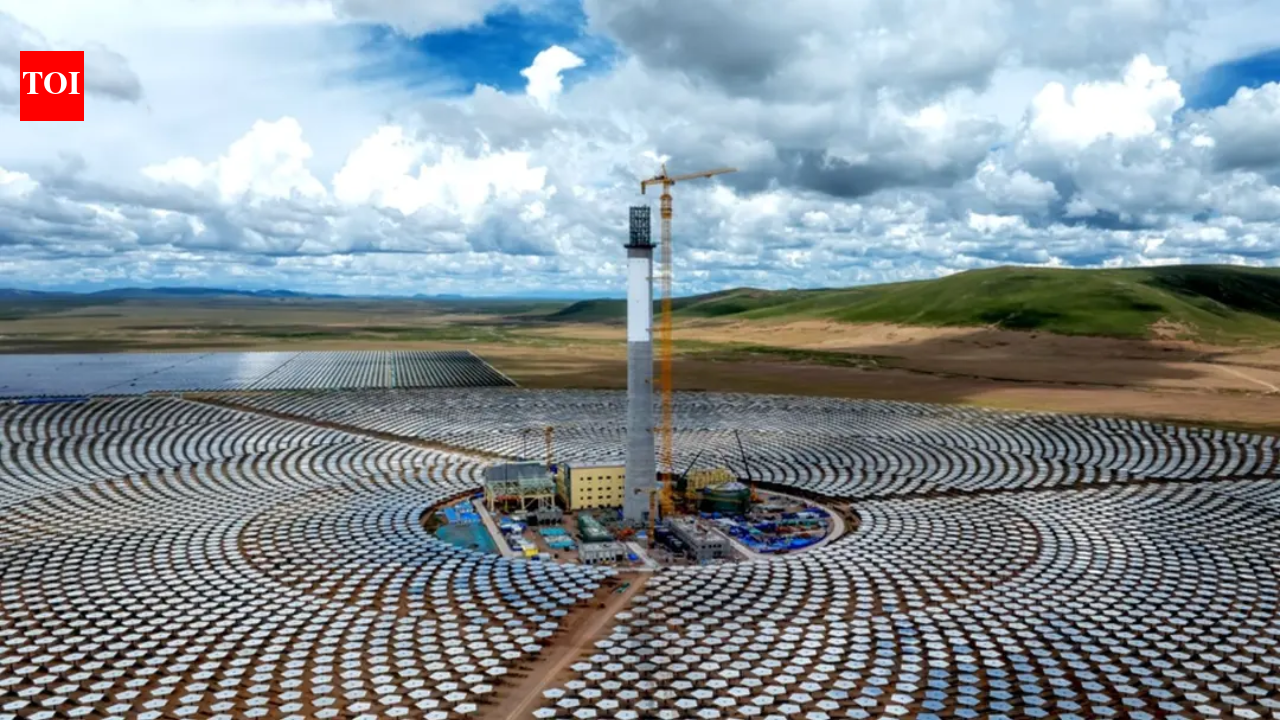
China has completed the construction of the world’s highest solar thermal plant on the Qinghai-Xizang Plateau, located at the height of 15,258 feet in Amdo County. The 100 megawatt (MW) project is designed to operate in an environment characterised by strong winds, sub-zero temperatures, and high ultraviolet radiation. According to information released by CGTN, the Tushuo plant has become the highest-altitude concentrated solar thermal facility ever built in the world. It is also the first tower-type solar thermal plant developed in this region. It has installed 15,927 mirrors, called heliostats that occupy approximately 800,000 square meters and need to direct solar radiation to virtually the same point: a receiver installed atop a 210-meter-high tower. Here, the concentration of energy raises the temperature of molten salts to approximately 1,040°F.
A system made up of nearly 16,000 mirrors
The principle of this solar plant is different from that found in photovoltaic solar parks around the world. Instead of directly converting sunlight into electricity, the Chinese installation first transforms solar radiation into thermal energy. Each heliostat tracks the sun’s apparent motion and continuously adjusts its position. The goal is to keep the reflected light focused on the receiver at the top of the tower.The accumulated heat is transferred to molten salts, which can later be used to produce steam. This steam drives turbines connected to electric generators, in an architecture that at the final generation stage bears similarities to a conventional thermoelectric power plant.It is precisely at this point that the technology gains strategic importance. A conventional photovoltaic installation drastically reduces its output when solar radiation disappears. In a solar thermal plant with thermal storage, part of the energy collected during the day remains stored in the form of heat. In the Amdo project, the system is designed to provide eight hours of thermal storage.In practice, the plant will be able to continue supplying electricity even after sunset. For electrical systems that increasingly receive larger volumes from intermittent renewable sources, this capability is as valuable as the installed capacity: it is not enough to produce a lot of energy; it is necessary to shift some of that production to the times when it is needed.
An engineering marvel
The altitude that makes this Chinese plant stand out and become a record holder was also one of the greatest challenges for the project. Building a facility of this magnitude on the plateau means dealing with strong winds, persistent cold, and intense ultraviolet radiation. Additionally, a field composed of thousands of large reflective surfaces presents another challenge: the mirrors must withstand the weather conditions without losing the precision needed to direct light to the receiver.The team developed lightweight, yet highly rigid heliostat supports specifically to withstand wind loads. The solar tracking mechanism was also designed with extremely small mechanical tolerances. The mirrors themselves were treated with coatings resistant to ultraviolet radiation, a concern especially relevant in high-altitude regions.To manufacture the components for the solar field, a fully automated production line for heliostats was implemented. According to information released about the project, this is the first facility of its kind operating at such a high altitude. Its capacity reaches 6,000 square meters of heliostats per day. The outcome can now be observed in the solar field. There are nearly 16,000 units working in coordination around the central tower.
225 million kWh per year
The plant is expected to be connected to the power grid by October 2026. When operational, the project’s leaders anticipate achieving an annual generation of approximately 255 million kilowatt-hours (kWh). This volume would be sufficient, according to the disclosed estimates, to power around 50,000 homes.Developers also estimate that production could replace the consumption of approximately 60,000 tons of coal annually, avoiding the emission of about 165,000 tons of carbon dioxide each year.With 100 MW of generating capacity, eight hours of thermal storage, and projected annual generation in the hundreds of millions of kWh, Amdo also acts as a commercial-scale test for a technology aiming to tackle one of the most well-known limitations of solar generation.
