


For nearly 15 years, Indian cricket trusted MS Dhoni to decide how the story ended. He decided when a chase needed to accelerate and when it needed another quiet over. He decided which bowler could survive the pressure of a final over, which batter needed shielding, when a field had to move by five yards and, sometimes, when conventional cricketing wisdom could simply be ignored.
Then came the one ending he could not quite control.
Martin Guptill‘s throw arrived from deep square leg at Old Trafford on July 10, 2019. Dhoni stretched desperately towards the crease. The replay showed him short. Not by much, but enough.
India still needed 25 runs from 10 balls in their World Cup semi-final against New Zealand. Dhoni had dragged them back into a match that had appeared lost at 92 for six, adding 116 with Ravindra Jadeja and carrying India’s hopes deep into another chase.
But this time there would be no finish.
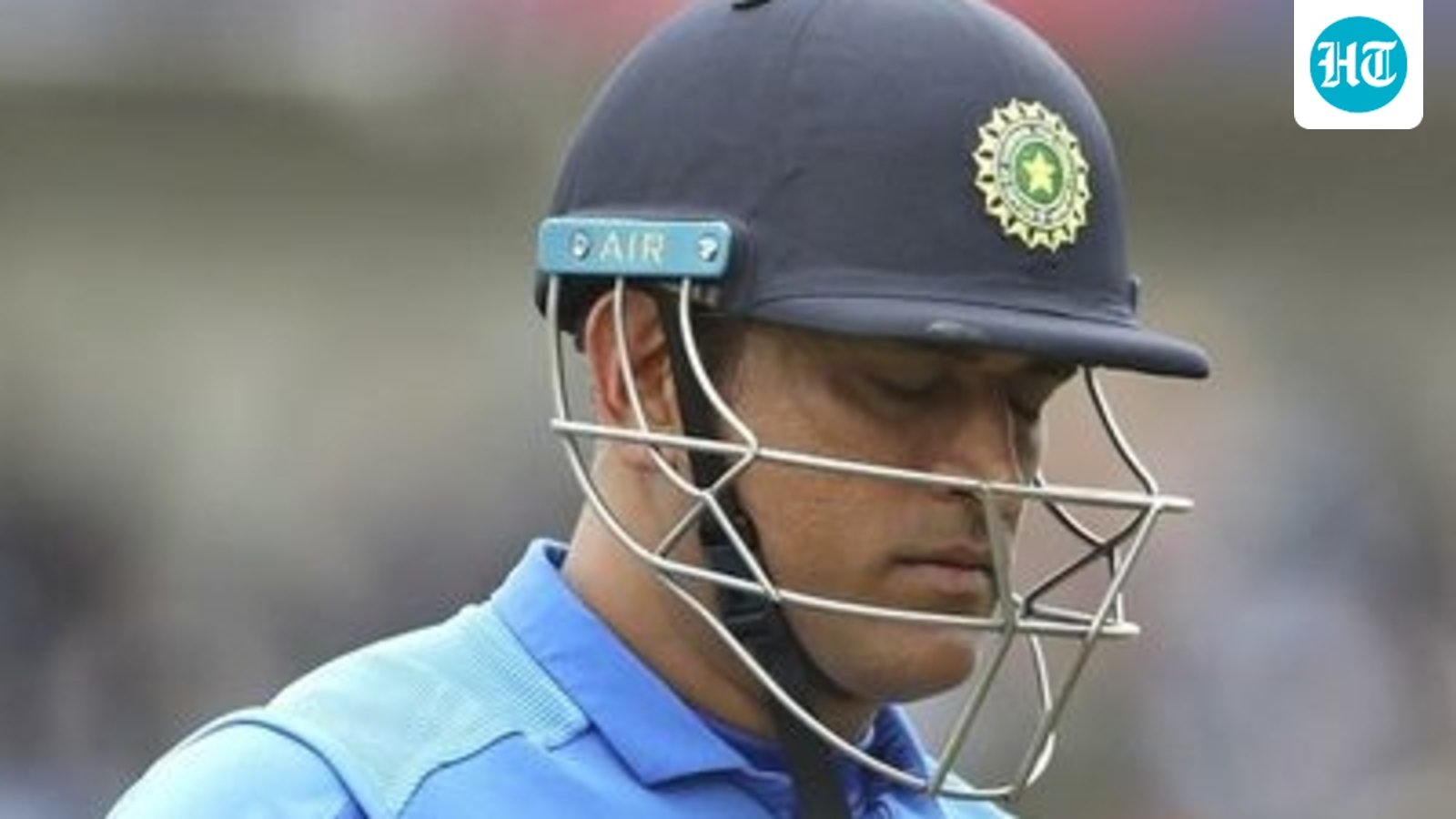
Dhoni walked towards the dressing room after making 50. India lost by 18 runs. Nobody inside Old Trafford knew with certainty that they had just watched the final international innings of one of India’s greatest cricketers.
There would be no farewell match. No final ODI at Ranchi. No guard of honour. No lap around a packed stadium. No press conference announcing that the journey was over.
For 13 months, Dhoni simply disappeared from international cricket. And then, at 7.29 pm on August 15, 2020, he ended it in a manner only he could have.
“Thanks a lot for ur love and support throughout. From 1929 hrs consider me as Retired.”
That was it.
A short Instagram post accompanied by a montage of memories and the melancholy strains of Main Pal Do Pal Ka Shayar.
For a man who had spent his career turning complicated cricket matches into simple equations, even retirement required just a few words.
Six years later, Dhoni’s international career can be remembered through the enormous numbers he left behind: 538 matches across formats, 17,266 runs, 829 dismissals as a wicketkeeper and a collection of trophies unmatched by any other Indian captain.
But statistics alone struggle to explain his importance. Dhoni did not merely accumulate runs and trophies. He altered Indian cricket’s imagination.
The outsider who changed the centre
Indian cricket had produced great players from outside its traditional metropolitan centres before Dhoni, but few had arrived carrying such a conspicuous sense of difference.
He came from Ranchi, long before Jharkhand became a familiar stopping point on Indian cricket’s talent map. He had worked as a railway ticket collector. He arrived in international cricket with long hair, enormous wrists and a batting technique that occasionally appeared to have been invented without consulting a coaching manual.
There was nothing polished about the early Dhoni.
That was precisely the point.
His 148 against Pakistan at Visakhapatnam in 2005 introduced the brutality. Later that year came 183 not out against Sri Lanka in Jaipur, still the highest ODI score by a wicketkeeper in men’s international cricket.
Within 40 ODIs, he had climbed to No.1 in the ICC batting rankings. The boy from Ranchi had not entered the establishment. He had forced the establishment to make room for him.
A generation of Indian cricketers emerging from smaller cities could look at Dhoni and see something previously harder to imagine: geography did not have to determine destiny. His rise also transformed expectations of an Indian wicketkeeper.
The keeper was no longer merely expected to collect cleanly behind the stumps and contribute useful runs. Dhoni could change matches with the bat, captain the side and produce moments of absurdly quick glovework that made stumpings look almost instantaneous.
Yet even those qualities eventually became secondary to what would define him most. Pressure.
Dhoni appeared to understand it differently from everyone else. Johannesburg in 2007 offered the first great glimpse.
India were playing Pakistan in the final of the inaugural T20 World Cup. Pakistan needed 13 from the final over with one wicket remaining. Dhoni handed the ball to Joginder Sharma.
It looked like a gamble. Misbah-ul-Haq scooped. Sreesanth caught. India became world champions.
Four years later came the defining image of Dhoni’s career.
India were chasing 275 against Sri Lanka in the 2011 World Cup final at the Wankhede Stadium. Virat Kohli had been dismissed. Yuvraj Singh, India’s outstanding player of the tournament, was expected next.
Instead, Dhoni promoted himself. He had scored only 150 runs in eight innings during the tournament before the final. Once again, the decision looked strange until it stopped looking strange. Dhoni made an unbeaten 91. Then Nuwan Kulasekara pitched one in his hitting arc. The bat swung. The ball disappeared over long-on.
And Ravi Shastri’s commentary became permanently attached to the sight of Dhoni standing still for a fraction of a second, watching India become world champions before beginning his celebration.
He did not just finish the match. He created perhaps the most recognisable ending in Indian sporting history.
There would be another ICC trophy in 2013, when India beat England in a rain-shortened Champions Trophy final at Birmingham. That completed an extraordinary captaincy collection: the T20 World Cup, ODI World Cup and Champions Trophy.
India had also risen to No.1 in the Test rankings for the first time under him in 2009. But Dhoni’s greatest captaincy legacy may lie beyond trophies.
He was willing to make decisions that carried the possibility of looking foolish. The established choice rarely interested him merely because it was established.
His cricket existed in probabilities rather than appearances. The same thinking shaped his batting.
Dhoni turned finishing into an art form because he understood that a chase was not about dominating every moment. Sometimes the objective was simply to ensure that the match remained alive long enough for him to control its final moments.
Singles could be valuable. Dot balls could be survived. Required rates could climb alarmingly. The crowd might panic. Dhoni often did not.
He trusted himself to solve the equation later. That is why Manchester remains such an uncomfortable final image. India’s chase had collapsed. Jadeja attacked while Dhoni held the innings together. Gradually, improbably, India returned to the contest.
Then Jadeja fell. Dhoni remained.
For anyone who had spent the previous decade watching him, that alone was enough reason to believe. He hit Lockie Ferguson for six in the 49th over.
The equation suddenly looked possible. Two balls later, Guptill threw down the stumps. For once, Dhoni had taken the game deep and discovered there was nowhere deeper to go.
Perhaps that is why his eventual retirement required no manufactured farewell. His career had already supplied enough endings.
There was Misbah’s scoop in Johannesburg. The six at Wankhede. The Champions Trophy celebration in Birmingham. Countless stumpings completed before television replays could adequately explain how quickly his hands had moved. Helicopter shots disappearing towards the boundary. No.7 emerging from the pavilion with a match entering its most anxious phase.
And finally there was Manchester.
Thirteen months after that walk back to the dressing room came a phone screen, an Independence Day evening and a message timestamped 19:29. No speech explaining himself. No attempt to dictate how he should be remembered.
That, too, fitted the man.
Dhoni spent much of his career surrounded by noise while appearing strangely detached from it. Praise rarely seemed to expand him. Criticism rarely seemed to consume him.
Then, when it was finally time to leave international cricket, he removed himself from the story almost as quietly as he had once inserted himself into its biggest moments. Some cricketers leave records. Some leave trophies. Some leave photographs. MS Dhoni left situations.
Ask an Indian cricket supporter about him, and the memory is rarely just a number. It is a moment, a television screen, a delivery, a decision, a feeling that, however impossible the equation appeared, the match was somehow not over yet.
For nearly 15 years, Indian cricket trusted Dhoni to decide how the story ended. When it came to his own ending, he needed seven words:
“From 1929 hrs consider me as Retired.”
