


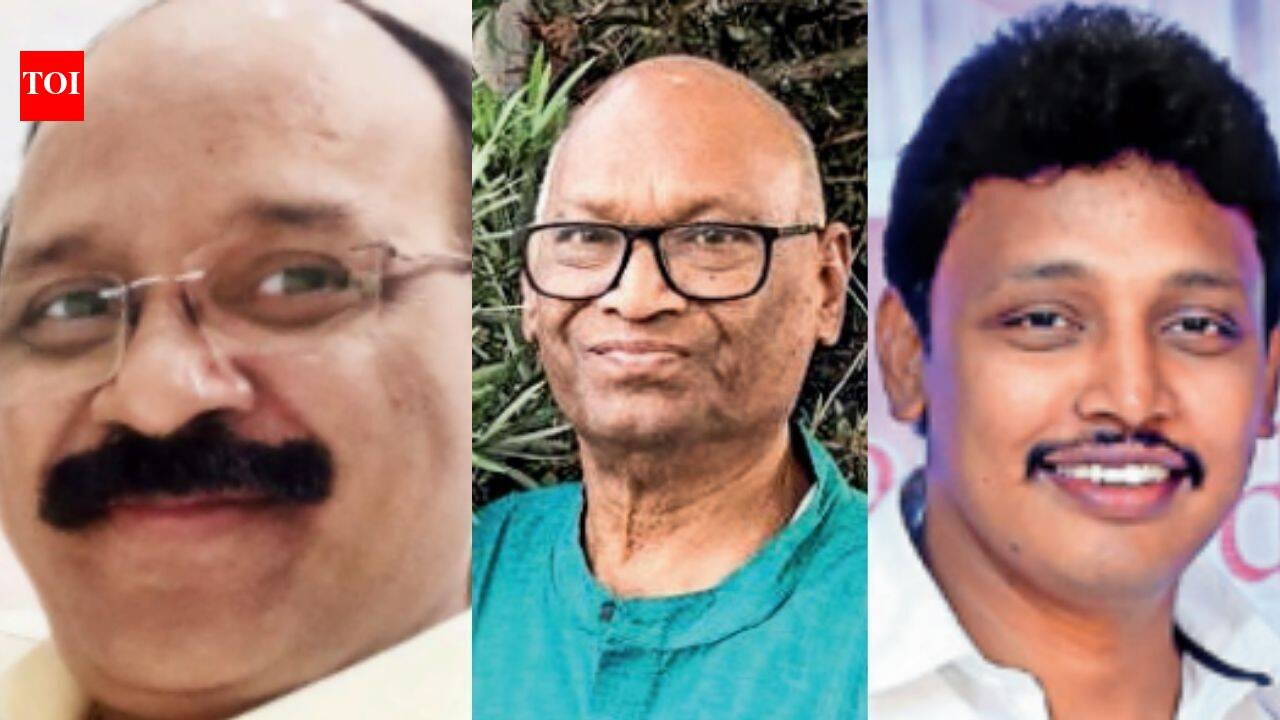
HYDERABAD: “Jawaharlal Nehru?” “Present, Sir.” “Subhas Chandra Bose?” “Present, Sir.”Along with Nehru, Gandhi and Bhagat, such names could once make a classroom attendance register sound like a roll call from India’s freedom movement. For a generation of parents, naming children after freedom fighters and national leaders was a way of honouring their legacy and passing on their ideals.Today, such names are harder to find, with Aaravs, Adviks, Ananyas and Aadhyas more common in school registers. But some people still carry the names of the country’s iconic leaders, and for them, the names have become more than just an identity.
Jawaharlal Nehru : A name with commitment
Born in the 1960s to freedom fighter Mutteswara Rao, Jawaharlal Nehru says his father was determined that his son should carry the name of India’s first Prime Minister.His father reportedly secured permission for the name. The Prime Minister’s Office, however, pointed out that Nehru was a surname and suggested that the child could instead be named using the remaining part of the leader’s name.Mutteswara Rao refused to give up.“My father was very clear. He insisted he had received permission and even had a letter. That is how I became Jawaharlal Nehru,” says Nehru, who now heads the Telangana government-run Tele-MANAS Centre.For him, the name has also carried a sense of responsibility. “Being Jawaharlal Nehru, I feel, needs commitment. Many questioned my decision about encouraging my son to join the Army. But I stand for the country,” says Nehru, a senior psychologist at Tele-MANAS.
Vijayalakshmi Pandit : A progressive father’s dream
Born in the 1960s on an auspicious Sravana Friday, Vijayalakshmi Pandit was named Vijayalakshmi by her mother. Her father, a freedom fighter, added Pandit to her name after Vijayalakshmi Pandit, the freedom fighter and sister of Jawaharlal Nehru, became president of the UN General Assembly.“My father wanted me to be named after her and hoped that I would become successful like her,” she says.A former botany lecturer, she has since turned to writing ghazals.
Nomula Bhagat: Rebellious name, rebellious streak
For former BRS MLA Nomula Bhagat, the name was a reflection of his family’s political ideology.The son of former Communist Party of India (Marxist) MLA Nomula Narasimhaiah, Bhagat was named after revolutionary freedom fighter Bhagat Singh.“My father was an ideologue, so he named me after Bhagat Singh. I started reading books about Bhagat Singh when I was very young. I was part of student politics and I always felt like fighting for others,” he says.Bhagat says he identifies with the rebellious streak associated with both his family and his namesake. He has named his own son Rana.
CLN Gandhi: Living up to ideals
For retired additional commissioner in the transport wing CLN Gandhi, the name came from a chance influence on his father.“When I was born, one of our neighbours was in the Army. That inspired my father. He named me after Mahatma Gandhi as suggested by the Armyman,” he says.Known simply as Gandhi in bureaucratic circles, he says the name made him conscious of the values associated with the Mahatma.“I was always conscious of the value of the name,” he says.Gandhi says he never drank alcohol and largely remained vegetarian, taking to non-vegetarian food only much later for protein. A rationalist, he also chose an intercaste marriage.For him, the name became a reminder of the ideals he wanted to live by.
Subhas Chandra Bose : Don’t do anything mediocre
For 33-year-old NIMS employee Subhas Chandra Bose, his name came with expectations from an early age.“Since my school days, everyone used to tell me that I should not do anything mediocre or bad because of my name,” he says. “I still feel that responsibility. I don’t even lie.”His father, an ideologue, extended the naming tradition to the rest of the family. Bose’s two brothers were named Chandrasekhar Azad and Ambedkar.
‘A name is a memory’
Socio-political analyst S Ramakrishna says names can serve as living memorials to historical figures.“A statue stands in one place. A road carries a name in one city. But when a child is named after Gandhi or Nehru, that memory travels with the person,” he says. “It goes to school, becomes part of friendships. The name brings history into an ordinary life.”For those who carry these names today, that history continues to follow them — into classrooms, workplaces, families and everyday choices.
