


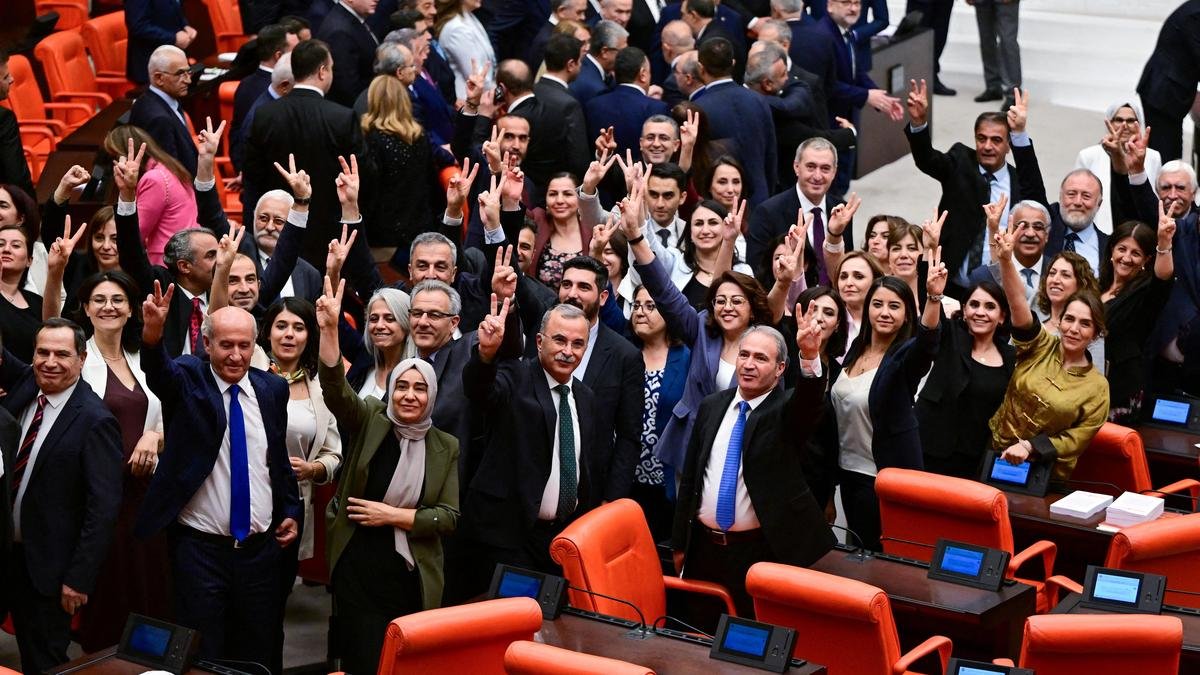
Lawmakers of the pro-Kurdish Peoples’ Equality and Democracy Party (DEM Party) flash V-signs as they pose for a group picture after voting on a Bill establishing a legal framework for the disbandment of the Kurdistan Workers Party (PKK) at the Turkish parliament in Ankara, Turkey, August 10, 2026. Parliament later passed the Bill, a major step toward ending a conflict that has killed tens of thousands.
| Photo Credit: Reuters
The story so far:Turkiye’s Parliament on Monday (August 11, 2026) passed a 12-point legislation that seeks to offer conditional pardon to thousands of Kurdish militants, advancing efforts for peace after decades of unrest. Mainly aimed to rehabilitate members of the Partiya Karkari Kurdistan, or the Kurdistan Workers Party (PKK), into the Turkish society, the law, however, offers only selective amnesty applicable to low-ranking members of the PKK without serious charges against them. The legislation, part of Turkish President Recep Tayyip Erdogan’s assurances for peace following the PKK’s announcement of disarmament and disbanding, also does not address the aspirations of the Kurdish people, one of the largest state-less ethnic community in the world. Turkish legislators voted 468-88 in favour of the measure that would only come into effect after authorities have verified that the PKK has fully disarmed.
What is the context behind the legislation?
Kurdish people, a traditionally nomadic society spread mainly across Turkiye, Syria, Iran, and Iraq, have always been a community without history, moving around in search for Kurdistan — a state which has been imagined by its people ever since the concept of a ‘nation state’ emerged from the West.
However, modern-day nationalist sentiments, especially in Turkiye, sought to take away the authenticity of Kurdish people, with former Deputy Prime Minister of Turkiye, Bulent Arinc, reportedly having said: “Kurdish is a language without a civilisation” while he was Speaker of the parliament in 2012, underlying the Turkish resentment towards the Kurds.
Existing without a state or identity, Kurdish people have been demanding acceptance in various forms, and their struggles became violent in the second half of the twentieth century. PKK was the main platform Kurdish people had to express both their aspirations and anguish. Founded in 1978 by Abdullah Ocalan, who now being held in a prison at Imrali island in the Sea of Marmara off the Turkiye coast, where he has been kept in solitary confinement since 1999, the PKK was the response to persecution faced by the Kurdish people. Its main targets were the fascist right, Turkish left, state agents, and, above all, Kurdish landlords who worked in tandem with the state to exploit the Kurdish masses.
Editorial:On Türkiye and the Kurdistan Workers Party’s announcement
The PKK launched its armed insurgency in Turkiye in 1984, with bloody guerilla campaigns that continued for decades with Turkiye attributing at least 40,000 deaths to the group’s actions. However, Mr. Ocalan gave a call for disbandment of the PKK in February 2025 after talks with Turkish lawmakers including MPs from pro-Kurdish Peoples’ Equality and Democracy Party (DEM). The founder’s announcement was cemented at a PKK congress held in northern Iraq in May and led to 30 PKK members destroying their weapons at a ceremony in Iraqi Kurdistan, a semi-autonomous region, in July. Mr. Erdogan immediately acknowledged the symbolic burning of the weapons and announced the establishment of a commission plan for a legislation in the Turkish parliament for the path to peace. He also admitted that previous governments had pursued policies that contributed to conflict, an important shift in tone. Mr. Erdogan, who is seeking support from lawmakers to bypass the two-term limit for his post to extend his presidency, can also use the legislation to improve relations with the DEM and other Kurdish allies for votes in parliament.
What are the provisions of the new legislation?
The legislation, named ‘Law on Strengthening National Solidarity and Social Integration’, contains 12 articles and was drafted to “verify the dissolution” of organisational structures of PKK and other allied and affiliated groups. It covers offenses related to establishing, leading, or joining a terrorist organisation, knowingly assisting or inciting such an organisation, conducting propaganda on its behalf, and crimes committed within the organisation’s activities or in its name. It, however, excludes premeditated murder, crimes committed before June 1, 2005, and crimes that amount to life imprisonment to graver punishment. Kurdish militants have a six-month period from the date of formal notification of the law to apply for benefits under it, and judicial bodies will be set up to determine whether an individual is qualified for pardon. The law proposes suspending investigations, trials, and sentences for a period ranging from 5 to 10 years depending on the nature of crimes committed by those seeking pardon. The law provides for cancellation of sentences if a pardoned individual refrains from any new crimes during the period of suspension.
What are the shortcomings of the legislation?
While the new law will offer rehabilitation for several PKK members, many more are convicted by Turkish authorities under charges that fall outside the purview of the legislation, making a huge number of former militants ineligible for the proposed rehabilitation. Mr. Ocalan and several other senior leaders of the group who are currently in prison will continue the same even after the new law, despite demands from PKK allies for their release as condition for disarmament.
PKK leaders, who see the continued imprisonment of Mr. Ocalan as a contradiction after his push for disarmament in favour of the Turkish state, have warned that the new law would be a “dead letter” if their leader is not released. The law also does not address Kurdish aspirations and political demands, ignoring the community’s quest for protection of its language and cultural identity in the Turkish society and voice and representation in lawmaking in the society it is asked to integrate into. While the DEM has welcomed the legislation as a first step towards broader peace, it has stressed the need for the integration process to go forward from here, with reforms in legal and political system respecting Kurdish culture and their persecuted history.
Published – August 14, 2026 10:23 am IST
