


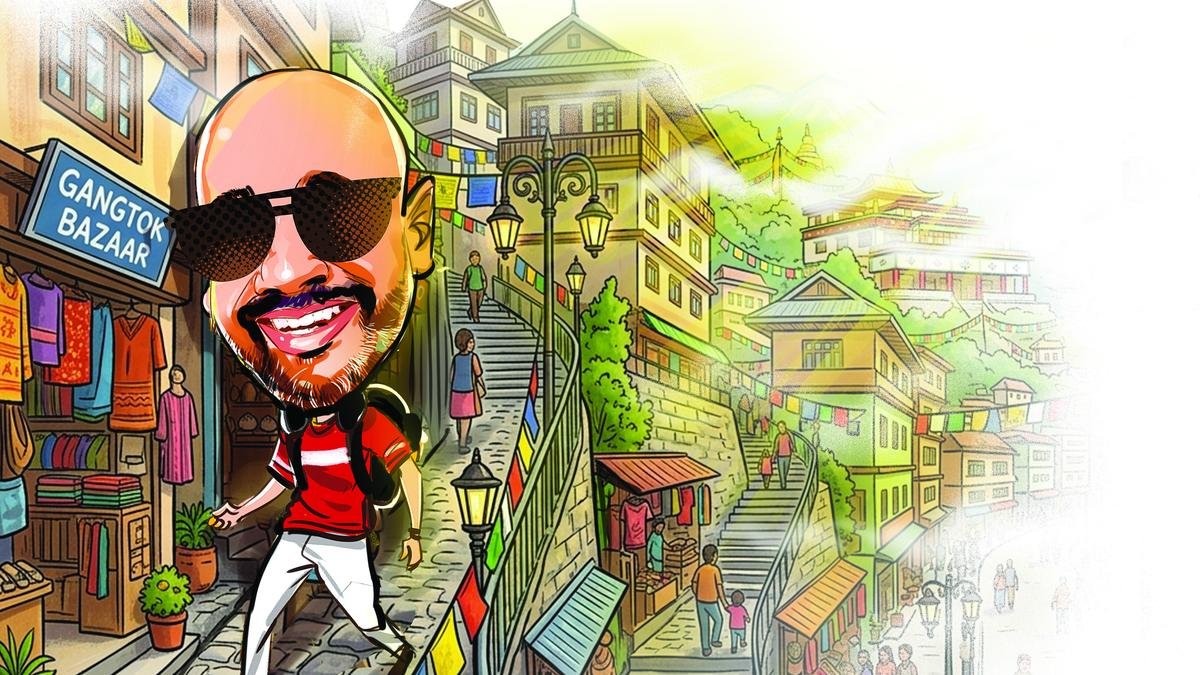
Gangtok, my hometown in the Himalayan foothills, was a walker’s city when we were growing up. We went everywhere on foot. Uphill from home to school. Downhill from school to home. Downhill from home to Paljor Stadium. Knee-obliterating uphill from Paljor Stadium to town. Uphill for Mr CSP Singh’s Physics tuition classes at the crack of dawn. Up-down, up-down. Covering four to five kilometers a day on foot was normal. That was life in a tiny town perched on a hilltop.
Between then and now, if anything, Gangtok has become an even better city for walkers. In 2009, we pedestrianised our main square, the MG Marg, one of the few stretches of straight road in town. It was here that everyone convened to shop, eat out and stroll. Prashant Pradhan — one of the architects instrumental in sowing the seeds of an automobile-free square and also responsible for designing some of the footpaths around town — tells me there were murmurs of discontent when the proposal to make MG Marg car-free was floated. Shop owners complained that the lack of vehicular traffic would destroy business. I remember residents wondering how they would ferry their sick grandmas to and from the hospital. The MG Marg soon became our pride and joy. It came “alive with people walking, meeting, and engaging with the city rather than simply driving through it,” Prashant says. Everyone — without exception — is thrilled with the change now.
At MG Marg street, on a rainy day in Gangtok
| Photo Credit:
Getty Images
We may have had very little character, but we did succeed in making every other hill station look like our impoverished cousin. Middle-class domestic travellers, our tourism industry’s bread and butter, marvelled at the cobbled path, the cleanliness and the foreignness of a vehicle-free city centre. Influencers yammered about the civic sense — no spitting! No litter! — in breathless tones. No overcrowding in vehicles, no public defecation, they roared. And yet no one spoke about the inherent walkability of the 150,000-strong city.
As a somewhat well-travelled person, I am yet to find an Indian city that could brag about being as pedestrian-friendly as Sikkim’s capital. A 12-kilometre footpath runs along the highway (yes, the highway). It snakes downhill into the suburbs of Tadong and 5th Mile and 6th Mile and does not stop until the next town over. You could walk all the way down to the neighbouring town of Ranipool without straying from the footpath.
Our footpaths are actual footpaths. They have proper railings on both sides. There are some metros, like, Bengaluru and Delhi, that may not exactly be suitable for navigation on foot but have enough parks and outdoor spaces. Chennai, I sadly have to add, isn’t one of those metros. Gangtok is that rare Indian city whose network of stairs, flyovers, and footpaths lends itself to a walking experience beyond just parks and gardens. You can completely run errands on foot.
One would think that a city that is as well-equipped to handle foot transportation as ours would have no traffic jams, but one would be wrong. Measures to keep car ownership under check — one isn’t allowed to purchase an automobile unless one shows proof of parking space at home — can only help so much. The Government’s odd-even rule has seen some traffic relaxation. But we people are mostly to blame. We are becoming too posh to walk these days. Places that were easily reachable by walking 20 years ago are now deemed inaccessible unless we get there by car. Wealthy people not wanting to be seen on foot unless it is for a morning walk is a uniquely South Asian insecurity.
In Gangtok, I have done it all. I have hiked all the way up monasteries and hilltop temples. I walk the short distance from home to Rachna Books — up the stairs, up the footpath, up the flyover, and up the footpath again before making my way downhill — because it takes half the time it would in a car. I walk to the dentist. I walk to the tailor. I walk to friends’ houses. A cousin and I once attempted to cover in a day the 76 kilometres from Gangtok to Kalimpong, another hill station across the border in West Bengal, but had to abort it around the 60-kilometre mark, when it got too dark (There’s something so cute and wonderfully provincial about a 60-km walk along the highway).
The residents take this great gift for granted. It is only when we encounter the no-walk zones that most South Asian cities are that we get smug about our good fortune. I can think of no other Indian city, big or small, with the exception of Chandigarh that is considerate of the walker. Shimla and Pondicherry try. So do Pune and Shillong, though less so. Aizwal, I have been told, is walkable. I will never take lightly my city’s pedestrian-centricity because I live in Chennai part of the year. Frantic for a pleasant urban walking experience, I concoct ridiculous routes mixing and matching alleyways, where the cars whizz by too close for comfort; beaches, where the sun ruthlessly beats down; and traffic-clogged main roads, where footpaths are almost always non-existent. More often than not, I fail.
Prajwal Parajuly is a novelist. Karma and Lola, his new book, is forthcoming in mid-2027. He teaches Creative Writing at Krea University and oscillates between New York City and Sri City.
Published – August 14, 2026 07:34 am IST
