


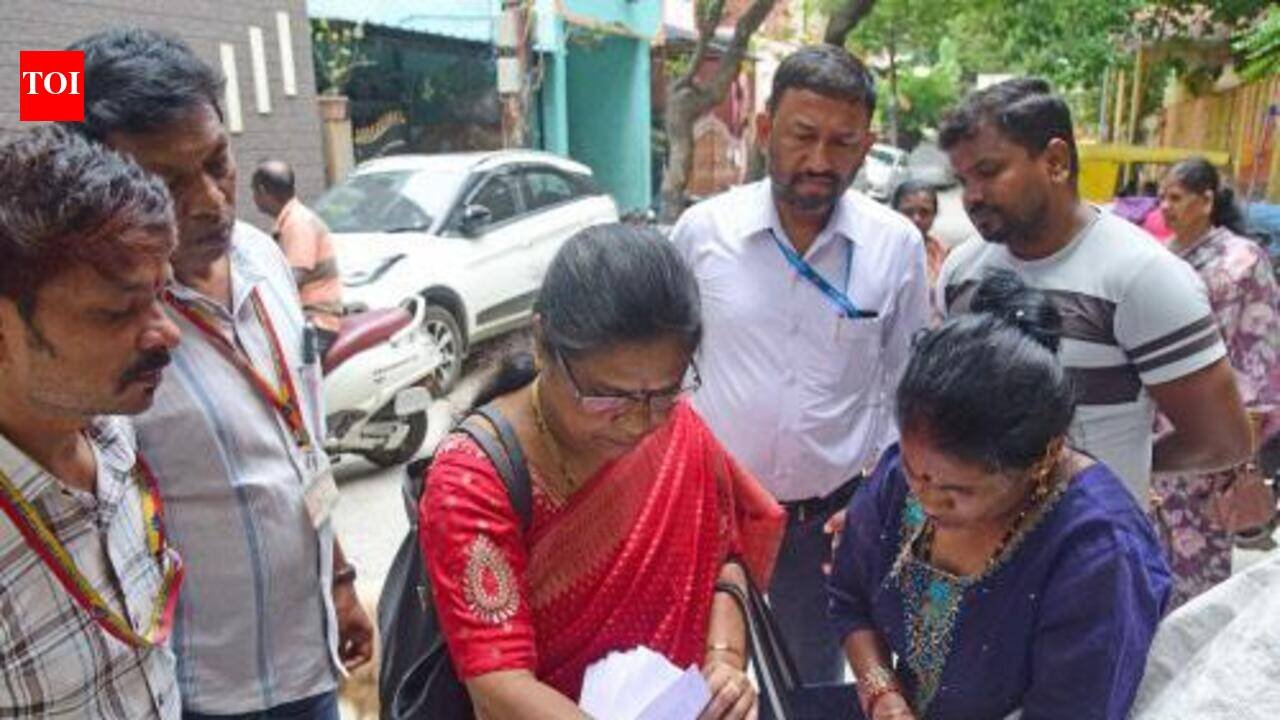
Hyderabad: Around 60.5 lakh electors across Telangana are likely to receive notices over anomalies detected during the Special Intensive Revision (SIR), including those who could not be mapped to the 2002 electoral rolls, Chief Electoral Officer C Sudarshan Reddy told TOI. The notices will cover different categories of discrepancies detected during scrutiny of enumeration forms, with unmapped electors forming one of the categories. He said the draft electoral rolls will be published on Aug 17, after which a meeting with political parties will be held.The scale of anomalies varies sharply across Telangana. While more than one in four electors fall under the anomaly category in some districts, the rate drops to about 8% at the other end of the table.Across the 26 assembly constituencies in Hyderabad, Rangareddy and Medchal-Malkajgiri districts, around 12 lakh to 13 lakh electors could receive notices, GHMC commissioner and Hyderabad district election officer RV Karnan said. A major share of the cases in the Greater Hyderabad belt relates to electors whose enumeration forms have been submitted but who remain unmapped. Karnan said many electors had not furnished details linking themselves or their relatives to the 2002 electoral rolls.Their forms have therefore been received, but the mapping could not be completed. Other anomalies, including discrepancies related to age and relationship, could also result in notices. Karnan said Hyderabad district alone could account for around six lakh to seven lakh notices. The number could rise after the system completes its analysis and identifies further cases requiring verification.Despite the volume of notices, Karnan said Hyderabad has comparatively fewer anomalies than several other districts. The district-wise data bears this out: Medchal-Malkajgiri has an anomaly rate of 11.11%, Hyderabad 14.15% and Rangareddy 15.12%. Karnan said Hyderabad’s lower voter turnout over the years was also partly linked to electoral rolls continuing to carry names of people who had died or permanently shifted. He said the deletion of names of deceased and shifted electors had not been carried out comprehensively over the past 10 to 12 years.Many electors had moved to other districts or states, while some preferred to enrol in their native villages or rural constituencies, he said. The revision exercise, Karnan said, would help remove ineligible entries while retaining eligible electors. This means that in Hyderabad and its surrounding urban constituencies, the non-mapping of electors who submitted enumeration forms, rather than non-submission alone, is emerging as a major reason for the likely notices.More than one in four flagged in six districtsOn the other hand, Adilabad recorded Telangana’s highest anomaly rate at 28.51%, involving 1.3 lakh electors. It was followed by Wanaparthy at 27.83% with 76,693 anomalies; Nizamabad at 27.26% with 3.9 lakh; Mahabubnagar at 26.84% with 1.9 lakh; Narayanpet at 26.45% with 1.3 lakh and Nirmal at 26.03%.In these districts, more than one in four electors falls under the anomaly category. The high-anomaly geography stretches across both northern and southern Telangana and is not confined to one part of the state. Several districts with high anomaly rates are also located along interstate borders. Nizamabad stands out in absolute numbers, with nearly 3.92 lakh anomalies, despite ranking third in percentage terms.At the lower end, Jayashankar Bhupalpally has the state’s lowest anomaly rate at 8.01%, involving 22,269 electors. It is followed by Khammam at 10.79% with 1,34,199 anomalies and Medchal-Malkajgiri at 11.11% with 3,30,862. The district anomaly rate therefore ranges from 8.01% to 28.51%, a spread of 20.5 percentage points. The overall anomaly percentages in the worst-affected districts, at around 26% to 29%, are substantially higher than the individual shares accounted for by ASD and DSE categories, indicating that the total anomaly pool extends beyond those categories.
