


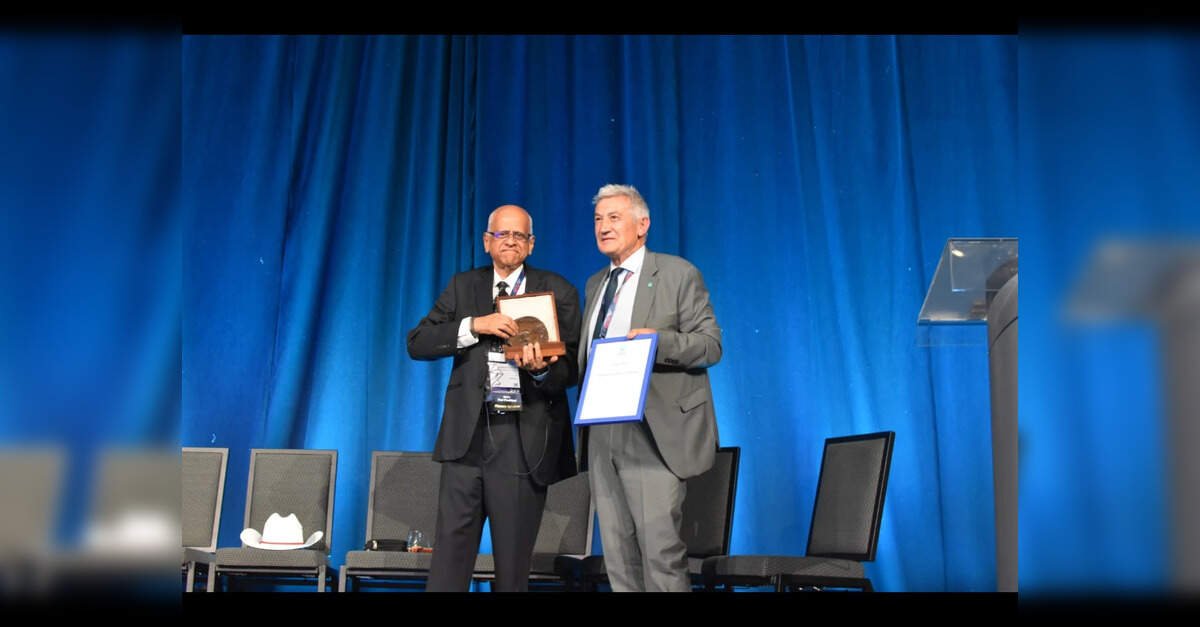
New Delhi: Gautam R Desiraju, Distinguished Professor at the Indian Institute of Technology Mandi and Emeritus Professor at the Indian Institute of Science, has been awarded the 14th Ewald Prize by the International Union of Crystallography (IUCr) for his pioneering contributions to crystal engineering and molecular crystallography.
The award, presented once every three years at the International Congress of Crystallography, recognises outstanding contributions to crystallography. Desiraju received the 2026 prize at the IUCr Congress in Calgary, Canada, on August 11.
Desiraju was recognised for pioneering crystal engineering and the supramolecular synthon concept, as well as for establishing the structural significance of weak hydrogen bonding and halogen bonding in molecular crystals and biology.
From understanding crystals to designing them
Desiraju’s work helped shift crystal engineering from the study of existing crystal structures towards a more predictive, design-oriented discipline.
A central idea in his work is the supramolecular synthon, a concept he defined in a 1995 review. It treats molecular crystals as structures that can be designed by identifying and assembling predictable modules through intermolecular interactions.
His research also helped establish the importance of weak intermolecular interactions, including the C—H···O interaction. Work by Desiraju and Thomas Steiner later established these interactions as genuine weak hydrogen bonds with structural significance in molecular crystals and biological systems.
Applications in pharmaceuticals
One of the practical applications of crystal engineering highlighted by Desiraju is the development of pharmaceutical cocrystals.
Such cocrystals can improve the solubility and bioavailability of poorly water-soluble drugs without necessarily changing the active pharmaceutical molecule itself. The field has already contributed to around half a dozen marketed medicines, according to the institute.
His work also covers polymorphism, crystal structure prediction and mechanically deformable crystals that can bend, shear or self-heal. Desiraju has argued that artificial intelligence could potentially solve the crystal structure prediction problem within five to 10 years.
Desiraju has published more than 475 research papers and has received over 80,000 citations. He served as president of the IUCr from 2011 to 2014.
Reacting to the award, Desiraju described the Ewald Prize as one of the highest honours available to a structural chemist or biologist, short of the Nobel Prize, and highlighted the rigour of its selection process.
IIT Mandi director Laxmidhar Behera said the recognition was a matter of pride for the institute and Indian science, noting the impact of Desiraju’s work on molecular interactions, pharmaceuticals and advanced materials.
To coincide with the award, Desiraju has also published a first-person retrospective, “Crystal clear. Engineering complexity,” in IUCrJ, tracing the development of crystal engineering and the ideas behind his work.
