


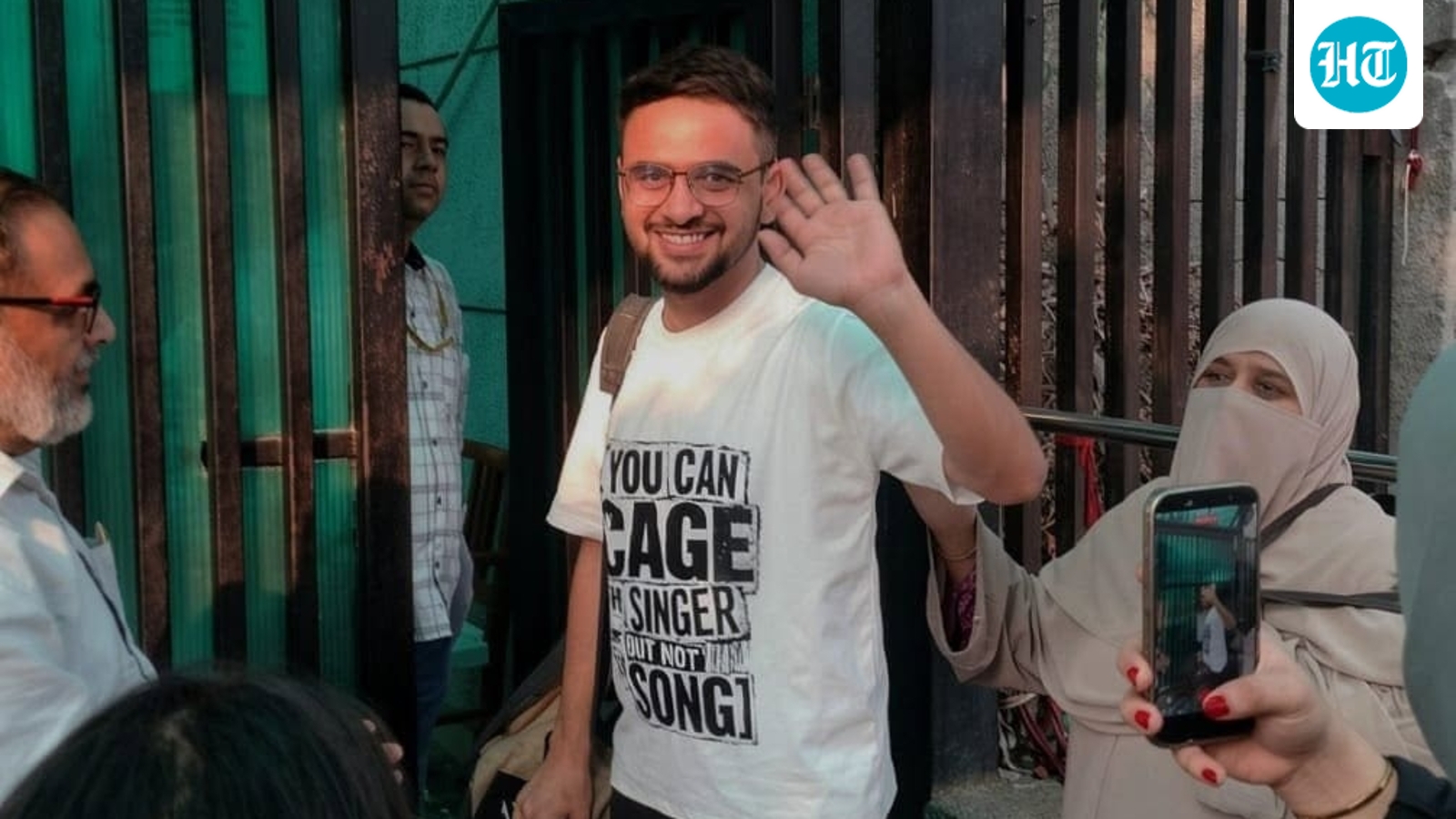
A scheduled discussion on jailed activist Umar Khalid’s book ‘Fractured Communities: Adivasi Histories and the Politics of Power’ at Jawaharlal Nehru University has snowballed into a row between the university’s Left-led student union and the RSS-affiliated Akhil Bharatiya Vidyarthi Parishad (ABVP), after the administration withdrew permission for the event’s venue.
The discussion, to be organised by the JNU Students’ Union (JNUSU) to mark Vishva Adivasi Diwas, or the International Day of the World’s Indigenous Peoples, was to be held at the School of Social Sciences-I auditorium at 3 pm on Monday, August 10. The book happens to be Khalid’s PhD thesis at JNU where he trained as a historian-researcher.
Barely 24 hours before the event, the university’s official handle on X cited “non-disclosure of the full facts about the program” as its reason for cancelling the booking. In the post, it tagged Vice-President CP Radhakrishnan, Prime Minister Narendra Modi, home minister Amit Shah, finance minister Nirmala Sitharaman, external affairs minister S Jaishankar and education minister Pralhad Joshi.
The JNUSU later said the discussion will proceed in the open, “near the SSS-II building”, and questioned the reason cited for the venue cancellation.
ABVP claims credit
However, the ABVP, student wing of the ruling BJP’s parent organisation RSS, said the cancellation came after its campaign. The ABVP JNU unit’s statement referred to Umar Khalid, who is in jail awaiting trial over allegations related to the 2020 Delhi riots, as “deshdrohi” (anti-national or traitor).
It said the ABVP raised the issue prominently across its social media platforms as soon as the event poster surfaced. “After ABVP JNU’s continuous protest and efforts, the programme has been cancelled,” it said. ABVP JNU president Mayank Panchal said the “university’s land cannot become a platform for glorifying a person accused in cases linked to serious anti-national activities and violence”. He called the cancellation “a victory”.
JNUSU alleges double standards
The JNUSU rejected the administration’s reasoning outright with president Aditi Mishra, of the Left Unity bloc (AISA-SFI-DSF), saying the booking form was filled in that format on the explicit advice of the Dean, School of Social Sciences. “Therefore, there was no question of incomplete disclosure.”
“This is a manufactured pretext for censorship. Why was permission granted at all if disclosure was not complete?” she added.
The union also alleged selective application of rules, claiming the administration had extended cooperation and space across the campus for spiritual organsiation ISKCON’s events.
“Cancelling a room does not cancel a conversation,” the JNUSU said in its statement, calling on students, faculty and staff to defend the academic and democratic character of the campus.
Who applied for permission
Avinash Kumar, assistant professor of Political Studies at the Centre for Informal Sector and Labour Studies under SSS, who submitted the permission requisition, said: “The stated reason for the cancellation of the booking of the SSS auditorium is false. The Dean, School of Social Sciences, was fully informed that the event was going to discuss Umar Khalid’s book ‘Fractured Communities’.”
He said the administration should come clean on the real reason and declare under which university rule it had unilaterally cancelled the venue without consultation at any level.
He noted that the book is published by a leading publisher (Juggernaut) and is based on a thesis for which JNU itself awarded Khalid a PhD.
The JNU administration did not yet respond to the allegations, nor did it speak on the ABVP’s claim of credit, as of 7pm, August 9.
The book and the case
‘Fractured Communities’ is based on Khalid’s doctoral thesis on the Adivasi tribes of Jharkhand’s Singhbhum region, submitted at JNU’s Centre for Historical Studies in July 2018; the degree was awarded the following year. Historian Ramachandra Guha, who wrote the foreword, has called it one of the finest doctoral dissertations by an Indian scholar he has read.
The panel at the vook discussion was to include professors Prabhu Mahapatra and Uma Chakravarti, writer-journalist Shuddhabrata Sengupta, activist Harsh Mander and scholar Banojyotsna Lahiri, Khalid’s partner.
Khalid has been in custody since September 2020 under the Unlawful Activities (Prevention) Act in the northeast Delhi riots conspiracy case, with the trial yet to begin. The violence, during protests against the Citizenship (Amendment) Act and the proposed National Register of Citizens, left 53 dead and over 700 injured.
‘His words are free, my son is not’
The row came just as Khalid’s mother, Sabiha Khanum, wrote a first-person piece in The Indian Express on the book’s publication.
She described opening the parcel of first copies with her husband and looking at the cover for a long time. It should have been a happy afternoon with their son present to sign a copy, she said. The thesis was not written in the comfort of libraries, she noted. Khalid wrote around his arrest, a hostile media trial, risks to his safety and court hearings. By submission in July 2018 he had already been charged with sedition, jailed, and rusticated from the university.
She said it saddens her that he cannot walk into a bookshop and see his own book. The waiting itself has become the punishment, regardless of what a court eventually decides, she added.
