


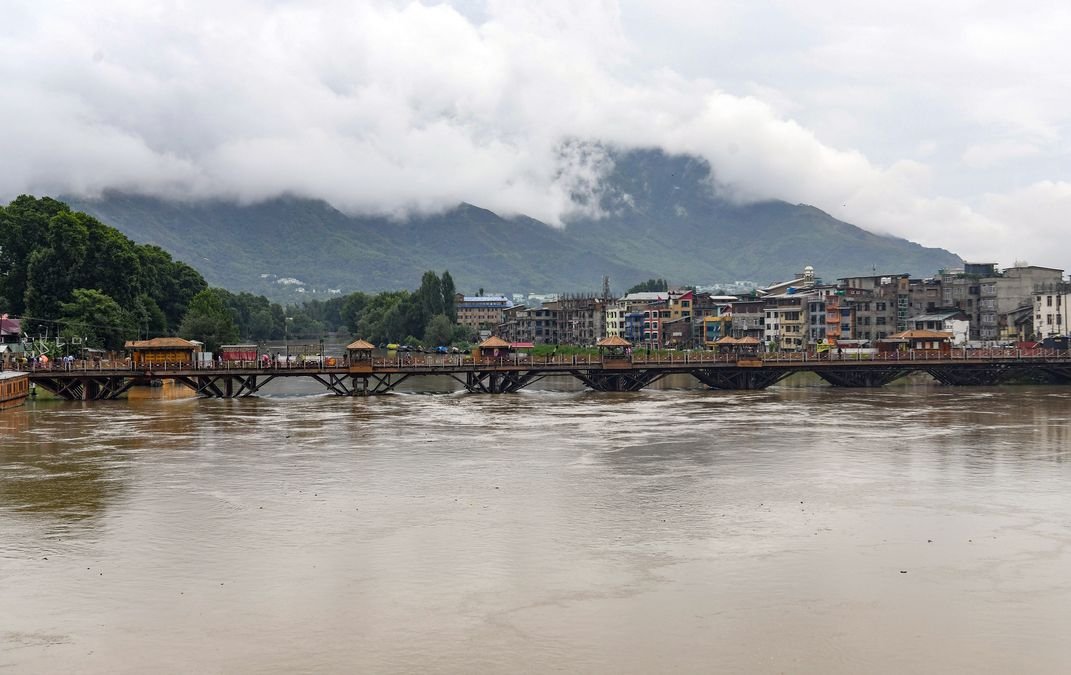
Srinagar, Aug 06: The health of Jammu and Kashmir’s rivers has come under increasing strain, with the latest official assessment revealing that 22 out of 52 monitored locations across 13 rivers failed to meet the prescribed water quality criteria during 2022 and 2023, raising serious concerns over pollution in the region’s freshwater ecosystems.
Surprisingly, Kashmir’s lifeline—the Jhelum stands choked under the pollution, as per the official report accessed by Rising Kashmir.
The report titled “Polluted River Stretches for Restoration of Water Quality – 2025” found that seven rivers—including the Jhelum- had stretches that did not comply with the prescribed standards.
The findings state: “Water Quality of 13 rivers in Jammu & Kashmir was monitored at 52 locations during the year 2022 and 2023, out of which, 22 locations on 07 rivers were found non-complying to the prescribed Water Quality Criteria.”
The assessment indicates that pollution is no longer confined to isolated urban stretches but has spread across several river systems, reflecting mounting pressure from rapid urbanisation, untreated sewage, solid waste disposal and human activities along riverbanks.
Among the rivers identified with non-complying stretches, the Jhelum remains the biggest concern due to its ecological, cultural and economic significance. Flowing through the heart of the Kashmir Valley, the river serves as a major source of drinking water, irrigation and livelihood for thousands of people.
Based on water quality monitoring carried out during 2022 and 2023, the report has identified the Jhelum stretch from the confluence of Vishav Nallah to downstream Baramulla as a polluted river stretch and placed it under Priority Class IV.
The report states that 13 rivers in Jammu and Kashmir were monitored at 52 locations, of which 22 locations on seven rivers were found non-complying with the prescribed water quality criteria with respect to Biological Oxygen Demand (BOD)—a key indicator used to assess organic pollution in rivers.
Besides the Jhelum, the document has identified polluted stretches on Chunt Kol, Tawi, Basanter, Devak, Gawkadal and Lidder rivers, highlighting the growing stress on the Union Territory’s freshwater ecosystems.
The Jhelum’s polluted stretch, as per the findings, extends from the confluence point of Vishav Nallah to Baramulla downstream, indicating that pollution is affecting one of the most densely inhabited and economically significant sections of the river.
The analysis classifies polluted river stretches into different priority categories based on pollution levels to facilitate restoration measures. The Jhelum has been placed in Priority-IV, while Chunt Kol falls under Priority-III and Basanter, Devak, Gawkadal and Lidder under Priority-V.
The report attributes the deteriorating water quality primarily to untreated domestic sewage, municipal waste, commercial effluents and other pollutants entering river systems. It notes that inadequate sewerage infrastructure, growing urbanisation and poor waste management continue to degrade river health.
Recognising the urgency of the situation, the document recommends comprehensive river rejuvenation action plans for polluted stretches. It says these plans should begin with identifying and controlling pollution sources, including assessing the functioning of Sewage Treatment Plants (STPs), Effluent Treatment Plants (ETPs) and Common Effluent Treatment Plants (CETPs), besides strengthening solid waste management and quantifying sewage and waste generated within river catchments.
The report further recommends protecting river catchments and floodplains through better land-use practices, rainwater harvesting, groundwater recharge, maintaining minimum environmental flows and undertaking large-scale plantations along riverbanks. It also advocates the creation of biodiversity parks on reclaimed floodplains by removing encroachments as part of long-term river restoration.
Emphasising the need to curb untreated sewage, the study calls for proper interception and diversion of sewage-carrying drains to treatment plants and greater reuse of treated wastewater to reduce dependence on groundwater and surface water resources. It stresses that every action plan should include clearly defined timelines for implementation.
The report concludes that restoring the health of Jammu and Kashmir’s rivers will require coordinated efforts by multiple government agencies along with active public participation, warning that without sustained intervention, pollution could further threaten the Jhelum and other rivers that are vital to the Union Territory’s ecology, water security and economy.
