


Dust lining city streets may seem harmless, but new research suggests it can carry a chemical legacy that has lingered for decades. A study led by researchers at the University of Virginia (UVA) found that road dust collected from seven mid-sized cities across the eastern United States still contains toxic metals linked to historic industrial activity, coal combustion and even metal-containing pesticides and insecticides used decades ago.Published in the journal Environmental Science and Pollution Research, the study analysed road dust from residential streets, public parks, schoolyards and areas near industrial sites. According to the researchers, the findings highlight how past contaminants persist in urban environments, potentially exposing nearby communities through everyday dust.
Legacy pollution still lingers in city streets
The research team collected road dust samples during August 2025 from seven cities: Trenton (New Jersey), Wilmington (Delaware), Richmond (Virginia), Raleigh and Greensboro (North Carolina), Charleston (South Carolina) and Augusta (Georgia). Samples were gathered from locations people regularly use, including neighbourhood streets, parks and school areas close to roads.Researchers tested the dust for 11 potentially toxic elements, including lead (Pb), arsenic (As), cadmium (Cd), copper (Cu), zinc (Zn), nickel (Ni), selenium (Se), molybdenum (Mo), cobalt (Co), vanadium (V) and iron (Fe). The analysis showed that while some metals mainly came from present-day traffic and industrial emissions, others reflected pollution left behind by activities that occurred decades ago.According to the study, hazardous metals such as lead, arsenic and cadmium appeared to be “legacy contaminants.” Their presence was linked to historical sources including coal-fired power plants, waste incineration and insecticides that contained metal compounds. Although many of these practices have been reduced or banned, the metals remain trapped in road dust and surrounding soils, where they can be repeatedly stirred into the air by vehicles, wind or human activity.
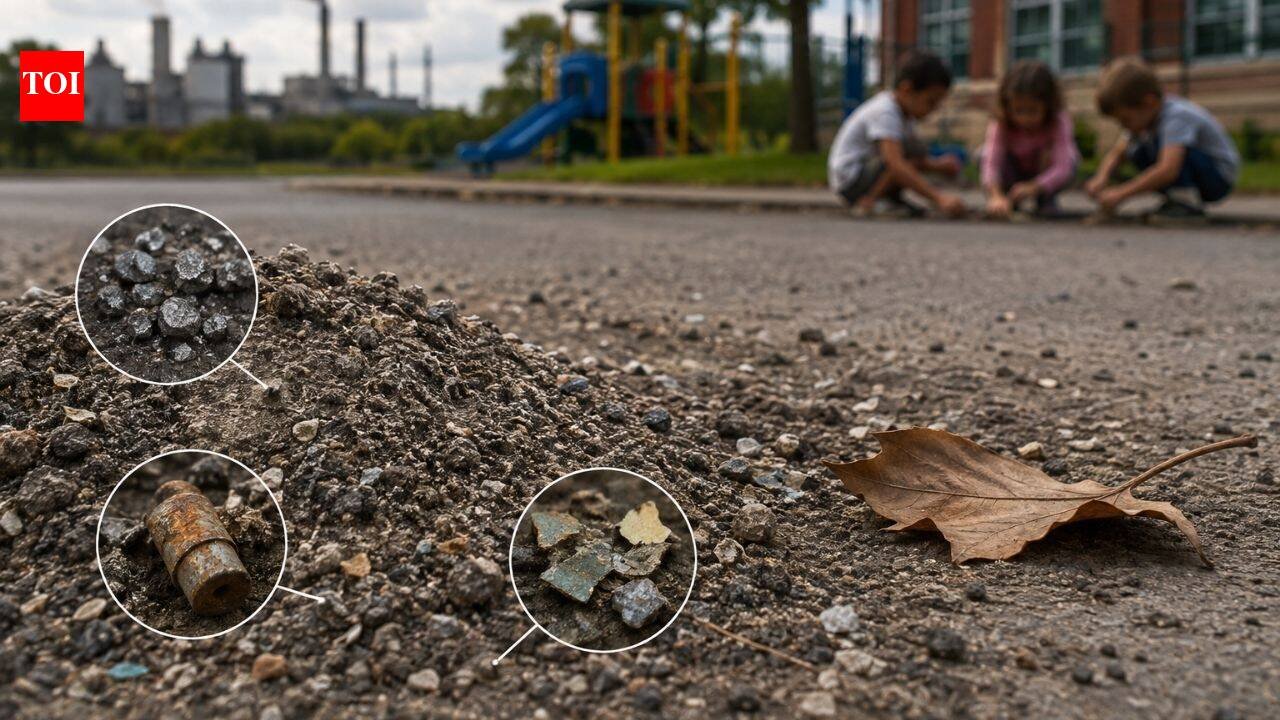
Representative Image (AI-generated)
Traffic adds new pollution, but the past still matters
The researchers found that not all contamination came from historical sources. Copper, zinc, nickel and molybdenum showed signs of enrichment from modern urban activities, particularly non-exhaust vehicle emissions such as brake wear, tyre wear and industrial operations.Using statistical modelling, the team estimated that around one-third of hazardous metal pollution originated from older sources like coal combustion and pesticide use, while roughly two-thirds came from ongoing urban activities including traffic, waste incineration, port operations and industrial emissions. This demonstrates that city road dust is shaped by both current pollution and contamination inherited from the past.The study also revealed regional differences. Northeastern cities such as Trenton and Wilmington generally had higher concentrations of hazardous metals than many of the southern cities, reflecting their longer industrial histories. However, contamination patterns varied depending on each city’s industrial development, transportation activity and local environmental conditions.
Children face greater exposure risks
Beyond identifying contamination sources, the researchers assessed potential health risks from contact with road dust. They found that children consistently faced much higher exposure than adults because of behaviours such as playing outdoors, frequent hand-to-mouth activity and their lower body weight.Overall, children’s cumulative hazard index was estimated to be about 4.5 times higher than that of adults across all seven cities. Augusta, Georgia, showed the highest potential health concern, where estimated hazard levels exceeded the threshold that warrants greater attention. The study also found that Trenton, Raleigh and Greensboro contained a relatively larger proportion of very fine dust particles, less than 10 micrometers in diameter, which are small enough to be inhaled deep into the lungs, potentially increasing respiratory exposure.The researchers also observed that some lead hotspots exceeding U.S. environmental screening guidelines were concentrated in lower-income neighbourhoods, suggesting that historical pollution may continue to disproportionately affect vulnerable communities.
Why the findings matter
Road dust is often overlooked compared with air pollution or contaminated soil, but it acts as a reservoir that accumulates pollutants over many years. As vehicles pass, people walk or strong winds blow, these particles can become airborne again, creating repeated opportunities for human exposure.According to the researchers, their work fills important data gaps for mid-sized eastern U.S. cities and provides a framework that can help identify pollution hotspots, guide environmental monitoring and support public health planning. They note that understanding where legacy contaminants persist is essential for protecting communities, especially children, living near busy roads, parks and schools.
