


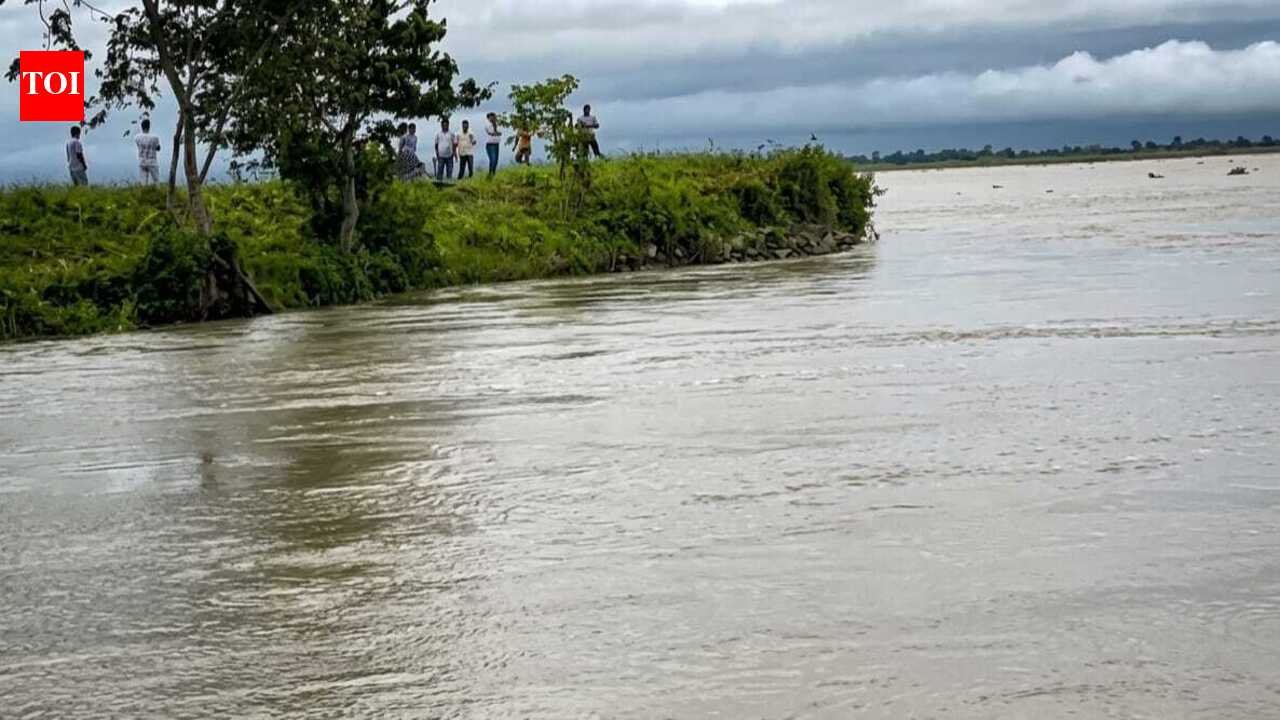
Dibrugarh: Fresh alarm has gripped residents of Maijan in Dibrugarh after severe erosion was reported at the historic Kahai Spur, also known as Spur No. 2. The stone structure, built in 1956 to shield the vulnerable banks of the Brahmaputra, has begun to weaken.Officials confirmed that rocks and boulders forming the spur are disintegrating after the protective fencing around the structure gave way under the river’s strong current.A spur, also called a groyne, is a barrier-like structure built perpendicular to a riverbank and extending into the river. Its purpose is to deflect the force of the current away from the bank, preventing direct erosion. By redirecting the flow, spurs also create calmer pockets near the bank where silt and sediment can settle, gradually helping rebuild land that erosion would otherwise wash away.Spurs are typically constructed using stone, boulders or gabion cages (wire mesh cages filled with rocks) and are considered a critical, time-tested method of riverbank protection, particularly along a river as powerful and unpredictable as the Brahmaputra.The Kahai Spur, located adjacent to the main embankment, is the longest and among the most vital protective spurs defending Dibrugarh town. It forms a key part of the Dibrugarh Town Protection (DTP) dyke system. Its potential failure has triggered concern among locals, many of whom fear that further damage could accelerate erosion and threaten the historic town.“This spur has stood for seven decades and protected our homes and land. If it collapses, we don’t know what will be left of Maijan,” said Bharat Gogoi, a local resident.The water resources department has deployed teams to fortify weakened sections of the spur. Officials said reinforcement work, including the use of geobags, is underway to prevent further deterioration.“We are aware of the severity of the situation at Kahai Spur. Teams have been mobilised to strengthen the affected portions on a priority basis. Every effort is being made to prevent further damage,” a water resources department official said on Wednesday.However, several residents remain sceptical about the effectiveness of current erosion-control measures, pointing to earlier failures of similar methods near Spur No. 2. “We have seen geobags being swept away by the current before. Unless stronger materials like boulders are used, we fear this erosion will continue,” said Biraj Hazarika, a local resident.
