


I notice the books before I notice the man.
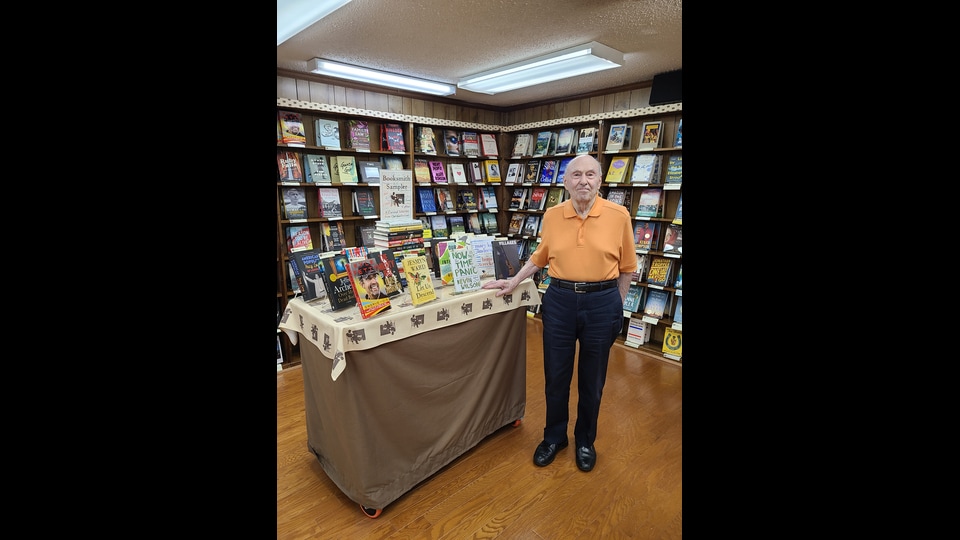
They don’t sit shoulder to shoulder in long rows of spines. Every cover faces out, an unusual way to arrange a bookstore. But Jake Reiss has never understood why anyone should choose a book from the sliver of a spine.
One of America’s best-known independent bookstores, the Alabama Booksmith sits beneath a busy highway in Homewood, just outside Birmingham, in a nondescript building. Inside, though, almost everything works differently.
The shelves hold only around 1,000 titles. Each a hardcover signed by its author, each selling for the same retail price as an unsigned edition. That simple idea has earned the Alabama Booksmith a devoted following among readers and collectors across the US and beyond.
But beyond the books, it’s the man behind the counter who draws people in. At 90, Reiss still comes to the store every day.
I ask him what a bookseller can offer in an age of online recommendations and algorithms. “We read every book before we put it on the shelves,” he says.
The store only stocks the books Jake and his team believe are worth putting into a reader’s hands – an old-fashioned way of running a bookstore, but one that has outlasted many others.
A second act he never planned
Jake didn’t set out to become a bookseller. His family had been making and selling custom clothing since the end of the nineteenth century, and he expected to stay in tailoring.
Books entered the picture almost by accident.
His younger son, Frank, worked in a used bookstore in San Francisco before he opened his own independent bookshop in Atlanta. Reiss often visited, tagging along as Frank bought stock and built the business.
Somewhere along the way, the “book bug bit”.
Books slowly began taking over the spare bedroom at home. When there was no room left, opening a bookstore seemed the obvious next step.
The Highland Booksmith opened in 1990.
Reiss is refreshingly honest about what he expected then. The business looked simple enough on paper: buy books cheaply, sell them for more, make a profit, and maybe meet a few women along the way.
The bookstore began with used books before expanding into new titles. In 1995, hosting his first author signing, Reiss noticed readers queue to meet a writer. Signed books flew off the shelves.
He realised the signature wasn’t just a souvenir; it turned a routine purchase into something personal.
That observation reshaped the bookstore over the next few years. More author events and signed copies followed. Eventually, the idea became the store’s defining principle: if a book was on the shelves, it had to bear the author’s signature.
Today, Reiss begins by asking one simple question: Is this a book worth putting into someone’s hands?
The bookstore finds itself
By the end of the 1990s, Reiss had outgrown his first bookstore. It was known for its author events, but the space was no longer enough. The room was crowded, parking was limited, and storage was tight.
An abandoned office building in Homewood, hidden behind trees and weeds, with a rumbling highway overhead, seemed an unlikely choice.
But Reiss visualised his dream store: shelves that would allow him to display books the way he wanted, a fireplace that let readers linger, storage for a growing inventory, and a room large enough to welcome authors and readers. And, perhaps best of all, 125 parking spaces.
In 1999, the bookstore moved. Around 40 customers volunteered to help carry roughly 100,000 books into the new building, a measure of the community the bookshop — and Reiss — had built over the years.
A place for readers and authors
The biggest transformation came more than a decade after the move. In 2012, after a renovation, Reiss made another decision: every new book in the store would be signed before it reached the shelves. The layout changed as well, with every cover facing the reader – allowing them to take note and pick up a book.
Since then, the Alabama Booksmith has become more than a place to buy books; it’s now a place authors support. More than a thousand writers have signed books over the years, including Harper Lee, Condoleezza Rice, and Kathryn Stockett.
Novelist Ann Patchett, who also owns Parnassus Books in Nashville, Tennessee, has made the three-hour drive to the Alabama Booksmith more than once. In an interview with Garden & Gun earlier this year, she explained why she admires Jake as a fellow bookseller. “He has read all the books that he sells. If it’s there, it’s because he wants to sell it… he knows his customers personally, so he is truly matching up the person with the book.”
Reading every book before showcasing it is a demanding standard, but it has earned readers’ trust.
“While we understand the fact that our books are all hardbacks and signed does not matter to the vast majority of readers,” he says, “but to those few it’s like a kid in a candy store.”
Every signed book at the Alabama Booksmith carries two stories: the one inside its pages, and the one behind the signature.
I ask Reiss if he has a favourite. At first, he refuses the premise. “Every single book has a story,” he says. “It’s impossible to select one.”
Throughout our conversation, he resists ranking books or writers. Then, almost reluctantly, he makes one exception. “Our private one-on-one lunch with President Jimmy Carter after his signing will be remembered for my lifetime.”
Still opening the doors
After more than three decades, Reiss isn’t interested in talking about legacy. What interests him is “tomorrow morning”. These days, one of his favourite moments comes before the bookstore has opened for the day. The first thing he does is look at the incoming orders.
“It’s the excitement and wonder of where the orders are coming from — what part of the world and how these folks found us.”
When he opened his modest bookstore in 1990, serving readers across every American state, and in countries halfway around the world, would have seemed far-fetched.
I ask if there’s a book that surprised him, one he almost didn’t stock but that turned into an unexpected success. His answer comes without hesitation. “Theo of Golden.”
Allen Levi’s self-published novel has sold more than 2.5 million copies and broken publishing records, and is one of the store’s biggest success stories.
Over the years, the Alabama Booksmith has weathered enormous changes in the way people discover and buy books. Online retail. Predictive algorithms. Bestseller lists. But Reiss has never tried to compete on volume or convenience. He believes that there will always be readers looking for recommendations made by someone who has actually spent time with the books.
In an age when everything is designed to help us choose faster, Reiss has built a bookstore around slowing down. Perhaps that’s why people keep coming.
I ask him how he sees the future. His answer is as uncomplicated as the philosophy that has kept the Alabama Booksmith going for more than three decades. “Keep on keepin’ on.”
Teja Lele is an independent editor and writes on books, travel and lifestyle.
