


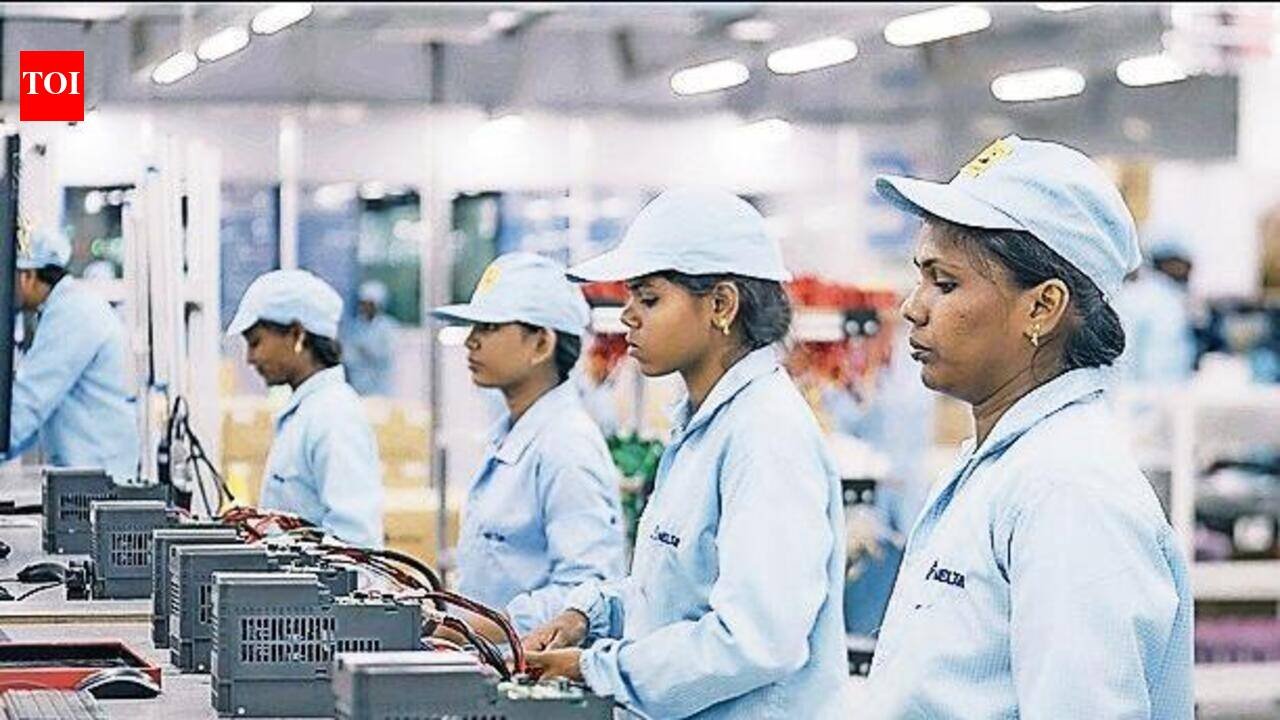
Bengaluru/New Delhi & Chennai: Every morning, thousands of young women board company buses headed for Foxconn’s manufacturing campus at Devanahalli on Bengaluru’s outskirts. The influx has transformed not just the lives of first-generation factory workers from Karnataka, Andhra Pradesh and Tamil Nadu, but also the local labour market. Foxconn’s aggressive hiring has triggered wage inflation across the Devanahalli region, forcing smaller manufacturers to struggle to retain workers and increasingly offer higher salaries and incentives to compete for talent.What is unfolding at Foxconn reflects a much larger shift in India’s manufacturing landscape. As electronics production accelerates under the government’s Production Linked Incentive (PLI) scheme and multinationals expand India operations, women are entering factory floors in unprecedented numbers. Their concentration on electronics assembly lines reflects the long-standing global manufacturing concept known as the “nimble fingers” theory, with each active assembly line producing 300-500 finished units an hour.Foxconn’s Bengaluru campus employs around 26,000 people, including 21,780 women, nearly 16,500 of them contract workers. The company recently opened women’s hostels with capacity for 30,000 employees, highlighting how accommodation, transport and safety have become as critical as production lines in scaling manufacturing. Foxconn’s Tamil Nadu operations employ about 41,000 people.Responding to TOI, Foxconn said: “At Foxconn, our employees and their wellbeing are our top priority. We offer a range of employee benefits, including housing. Our dorms—including women-only complexes—provide a safe and comfortable space for employees and reduce commute times for those living away from home. Foxconn also offers employees a wide range of professional development opportunities, including training in highly sought-after technical and professional skills like robotics, smart manufacturing, leadership and more.” The company crossed Rs 1 lakh crore in revenue in FY25 and is learnt to have lined up fresh investments of nearly Rs 14,000 crore in India.Karnataka drives the electronics jobs boomThe transformation is particularly visible in Karnataka, where electronics manufacturing has become one of the state’s largest employment generators. The state has 19,177 registered industries employing nearly 1.9 million workers. Bengaluru Urban alone accounts for 8,429 industries employing over 8.3 lakh people, while neighbouring Bengaluru Rural contributes another 1.6 lakh jobs, making the region India’s electronics manufacturing powerhouse. Women account for 5.9 lakh workers, or 30.4% of Karnataka’s industrial workforce. Industry executives attribute the rise to labour reforms allowing women to work night shifts with safety measures, better transport, hostels and changing social attitudes.Noida mirrors the trendA similar transformation is underway in Uttar Pradesh’s Noida-Greater Noida manufacturing corridor. The Annual Survey of Industries 2023-24 shows Uttar Pradesh has 22,141 registered factories employing 16.2 lakh workers. Gautam Buddha Nagar and Ghaziabad together account for nearly five lakh organised manufacturing jobs, with the Noida-Ghaziabad electronics belt employing an estimated 80,000 women, largely in mobile phone and electronics assembly. Women account for an estimated 22-25% of Uttar Pradesh’s organised manufacturing workforce, with participation highest in electronics, garments, footwear and food processing. Samsung, Dixon Technologies, Lava International and Optiemus have expanded apprenticeship programmes, transport, hostels and skilling initiatives to attract women workers. Lava recently inducted over 150 women into manufacturing roles and launched a women-only assembly line.Tamil Nadu’s growth solidifies women’s employmentTamil Nadu is India’s largest electronics manufacturing state, with 285 factories employing 1.2 lakh people—25.2% of the country’s electronics factory workforce. Women account for 40.8% of the state’s direct electronics workforce. Kancheepuram, near Chennai, and Krishnagiri, bordering Bengaluru, have emerged as key hubs for electronics exports and women’s employment. Foxconn employs about 41,000 people at its iPhone assembly plant near Chennai, including around 35,000 women. It scaled up operations after 2023 by tapping the region’s skilled mobile manufacturing talent, including many former Nokia workers after the handset maker shut its factory around 2014. Tata Electronics employs about 75,000 people at its Hosur campus, with women making up 70-80% of the workforce. Other major manufacturers in the state include Salcomp, Flex, Corning, Jabil India and Kaynes Technology.Automation is also reshaping factory workAt Delta Electronics’ Krishnagiri plant in Tamil Nadu, women account for 66% of the 3,925-strong workforce. Across Delta India, women’s representation has risen from 2% to 48% in six years. “Women bring higher dexterity, stronger attendance discipline and greater operational stability, but we believe talent—not gender—should determine success,” said Niranjan Nayak, managing director at Delta Electronics India. The company has redesigned shop floors, introduced electric trolleys to reduce physical strain and created women-friendly deployment zones. These best practices are now being replicated at its Gurgaon and Rudrapur plants.For electronics manufacturing firms, automation has significantly lowered traditional barriers to women’s participation. “Women are hired for their adherence to multi-step processes and their attention to detail during visual inspection. Increasing automation handling has significantly reduced manual lifting, which was once a major barrier,” said Nandini B, director at Tescom. Many women now move from operators to technicians, supervisors and line leaders while gaining exposure to global manufacturing standards in cleaner, technology-driven workplaces.Electronics leads the wayElectronics has quietly become one of India’s biggest creators of formal jobs for women. According to MeitY, women account for nearly 30% of the 25 lakh jobs created in electronics manufacturing over the past decade. In mobile phone manufacturing, they constitute nearly 70% of the 12 lakh direct jobs. The PLI scheme alone has generated close to 90,000 jobs for women. Executives say electronics assembly demands precision, consistency and adherence to standard operating procedures—areas where women have consistently performed well.Building workplaces, not just factoriesCompanies say attracting women requires more than just recruitment. “Progress cannot come from recruitment alone. It requires sustained attention to the talent pipeline, manager commitment, and a workplace where women can see opportunity, support and growth,” said Sunanda Sehgal, HR head at Corning India, Middle East and Africa.Corning, which partners with Optiemus, says safe transport, health programmes, apprenticeships and supportive managers are as important as factory infrastructure. Limited prior manufacturing experience among women makes retention as important as hiring..The next challenge: RetentionDespite the hiring momentum, companies say retaining women is now the industry’s biggest challenge. Lohit Bhatia, executive director and group CEO of Quess Corp, estimates India’s manufacturing sector employs 7.5-8 crore people. Within electronics manufacturing services, however, women account for nearly 74.5% of the workforce, compared with roughly 20% female participation across all manufacturing. “This shift is being driven by EMS roles that are more accessible to first-time women workers, often with structured shifts and formal employment terms,” Bhatia said. “But presence isn’t the same as stability.”Quess data shows 52% of women across sectors intend to leave within their first year. “Closing that gap means tackling the everyday barriers women face: wages that reflect real living costs, safe transport and housing near the workplace, clean washrooms, childcare facilities, clear career paths, and safety and flexibility built into shift design,” Bhatia said. “If we get these fundamentals right, we won’t just move a number—we’ll change what’s possible for millions of women entering India’s workforce.”
