


Congress MP Priyanka Gandhi Vadra‘s jab at the composition of the NTA reform task force in the Lok Sabha this week put V Kamakoti in a spotlight he rarely occupies, not as SHAKTI’s architect or as IIT Madras’s director, but as a political target, over a remark about cow urine he had made a year and a half earlier at a Chennai goshala.
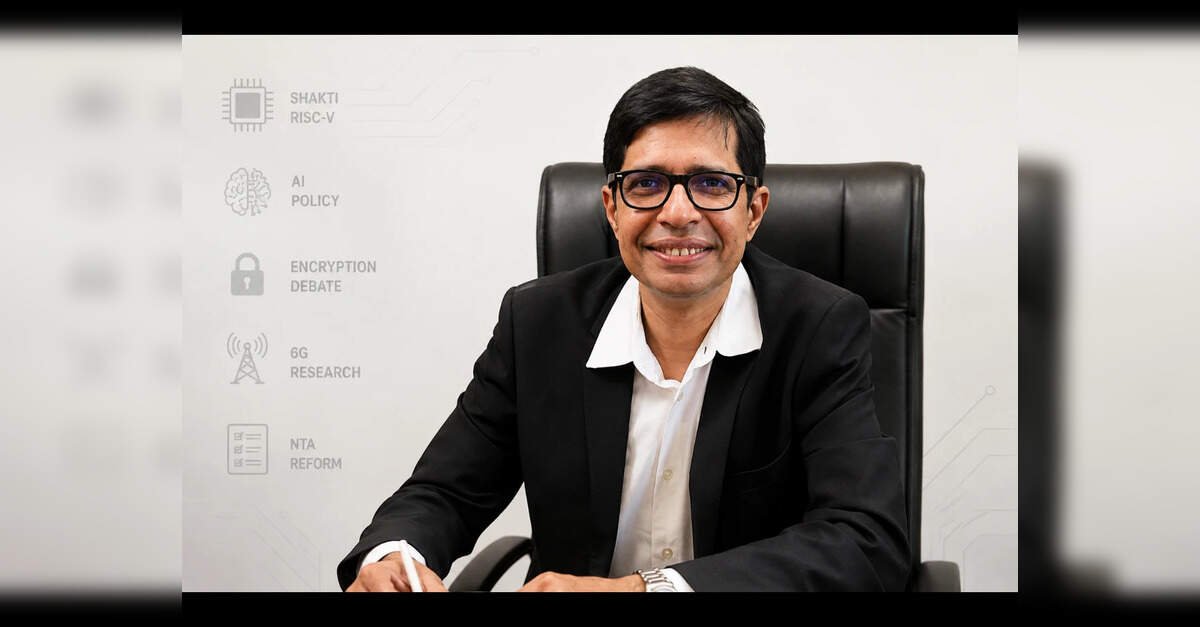
That controversy will eventually fade. The more enduring question is why, whenever India confronts a difficult technology problem, whether designing indigenous processors, framing artificial intelligence policy, balancing encrypted communications with law enforcement, or now rebuilding trust in national entrance examinations, the government keeps returning to the same computer scientist. Over the past decade, Kamakoti has quietly moved from being an academic researcher to becoming one of the country’s most frequently consulted technologists on questions where engineering, public policy, and national strategy intersect.
The chip architect
Kamakoti’s actual life’s work began in 2011, when he and his team identified a gap that would define the next fifteen years of his career. India needed a family of microprocessors that could scale from tiny embedded devices to full cloud servers, and did not have one it could call its own. The SHAKTI Processor Program formally launched in 2014 out of IIT Madras’s Reconfigurable Intelligent Systems Engineering group, directly addressing India’s near-total dependence on foreign-designed, IP-locked processor architectures across computing, communications, and critical infrastructure.
More than an academic project, SHAKTI represented India’s attempt to own the intellectual property layer of computing at a time when geopolitical tensions were exposing the risks of dependence on foreign chip architectures. Today, the SHAKTI ecosystem spans processors for embedded systems, edge computing, and servers, and has become one of India’s most visible indigenous computing initiatives built on the open RISC-V architecture. Under Kamakoti’s leadership, the programme evolved into one of the country’s flagship indigenous computing initiatives, pulling in more than a thousand teams nationally through a government-run Swadeshi Microprocessor Challenge, and later became part of the government’s Digital India RISC-V mission, with Kamakoti named chief architect of that programme in 2022, a component of a broader, ₹76,000 crore national semiconductor push.The AI policymaker, before the current wave
Long before generative AI became a boardroom obsession, Kamakoti was already helping shape India’s policy response to it. As chairman of the Ministry of Commerce and Industry’s Artificial Intelligence Task Force, constituted in 2017, he led one of the government’s earliest efforts to examine how AI would reshape manufacturing, employment, governance, and India’s industrial competitiveness. While today’s AI debate revolves around chatbots and frontier models, Kamakoti’s work belonged to an earlier phase, when policymakers were still asking how India should prepare for the technology rather than simply adopt it.
The encryption debate
In 2019, the Madras High Court, hearing a case on whether WhatsApp message originators could be traced, ordered Kamakoti to submit a technical report on the question. His answer, tag every message with its originator’s identity in encrypted form, so the content stays private while the sender can still be identified if law enforcement demands it, became known simply as the Kamakoti proposal. The proposal is widely seen as having informed the debate around the “first originator” provision that later appeared in India’s Information Technology Rules.
The proposal, however, remained technically contested. Cryptographer Manoj Prabhakaran argued it could still be vulnerable to spoofed originator information, while WhatsApp maintained it was infeasible without fundamentally altering the platform’s end-to-end encryption architecture. The case remains pending before the Supreme Court, six years after it was first raised.
The institution builder
As director since January 2022, Kamakoti has translated the SHAKTI instinct, build the thing India doesn’t have, into institutional strategy. He set up a dedicated centre housing ShaktiMAAN, a chip variant purpose-built for deep-learning inference. This July, he presided over the launch of a Centre of Excellence for classical and quantum 6G communications at the IIT Madras Research Park, building on the institute’s existing 5G Test Bed, inaugurated by the Prime Minister in 2022. Under Kamakoti, IIT Madras has emerged as one of India’s principal centres for next-generation telecom research, positioning the institute within India’s long-term 6G roadmap.
He has also been unusually willing to challenge the institute’s own students, pushing back publicly against what he calls the herd mentality of chasing Computer Science branches purely for starting salaries, and arguing that breakthroughs in AI and semiconductors now demand convergence across metallurgy, chemical, civil, and mechanical engineering, not narrower specialisation.
The government’s problem solver
Kamakoti’s influence extends well beyond academia. As a member of the National Security Advisory Board, he has contributed to discussions at the intersection of technology and national security, another indication that successive governments have relied on his ability to bridge technology and public policy. That pattern continues in 2026, with Kamakoti named one of six members, alongside Nandan Nilekani, former Intelligence Bureau director Tapan Deka, former ISRO chairman S Somanath, former CBSE chairperson Anita Karwal, and Amrit Lal Meena, on the task force rebuilding the National Testing Agency after this year’s exam-leak crisis.
Kamakoti has publicly framed that mandate in personal terms. In an interview with ANI on July 27, he recalled writing JEE in 1985 on paper and pen, when roughly 4,000 students appeared nationally, a contrast he draws deliberately against an examination ecosystem that now serves lakhs of candidates. That comparison seems to explain why, on the task force, he keeps returning to accountability at every link of the exam chain, not just its top, as a matter of engineering discipline as much as governance.
One technologist, six mandates
Across semiconductors, artificial intelligence, encrypted communications, telecom infrastructure, national security, and now examination reform, V Kamakoti has quietly become one of the few technologists repeatedly entrusted with problems that sit at the intersection of engineering and public policy. Unlike many public intellectuals who comment on technology from the sidelines, he has repeatedly moved from research into implementation, helping shape both India’s indigenous computing capabilities and parts of its digital governance framework.
Priyanka Gandhi’s criticism may have sparked renewed attention on Kamakoti, but it has also inadvertently highlighted a broader pattern: when the government confronts a technology problem of national consequence, his name keeps resurfacing. Kamakoti’s story is ultimately less about one professor than about the Indian state’s search for trusted technical expertise. When semiconductors, artificial intelligence, encrypted communications, national security, and examination reform repeatedly converge on the same handful of experts, it raises a larger question: has India built a deep enough bench of technology leaders for the challenges still to come?
