


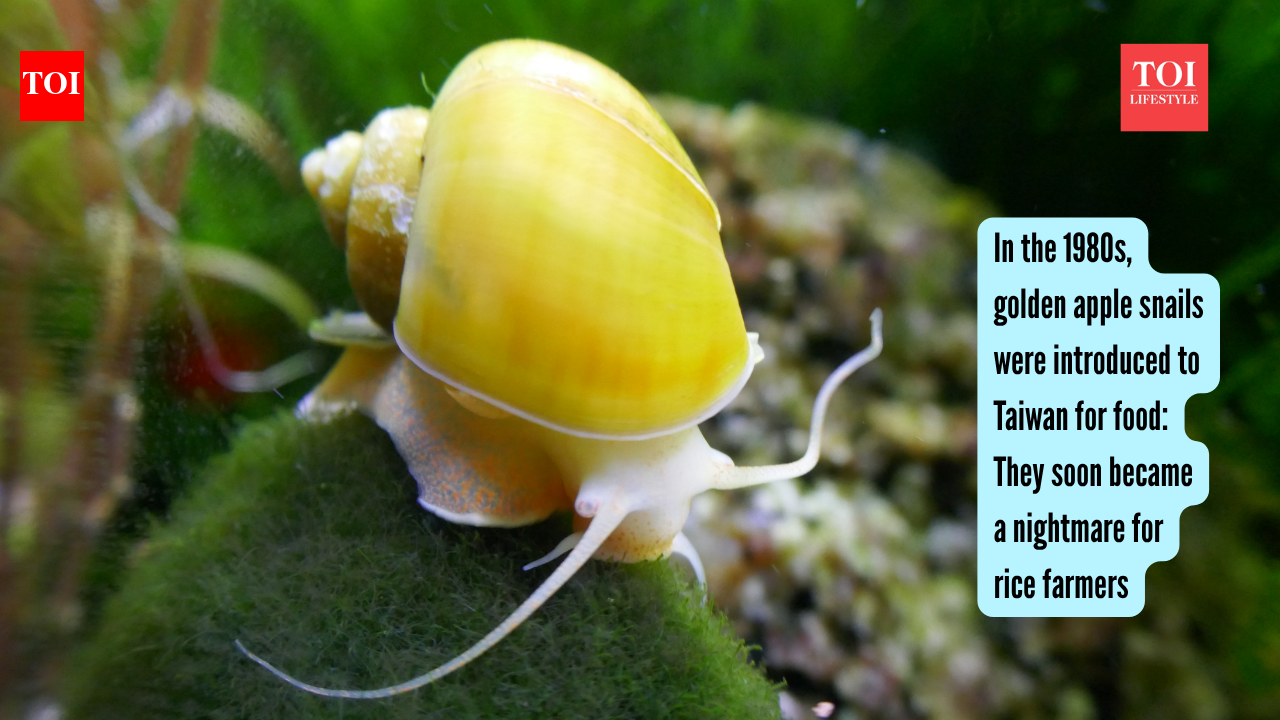
We often come across stories that are well planned but do not yield results as expected.Even in the case of fruits and farms, when nature refuses to adhere, that’s exactly what happened in Taiwan in the early 1980s, when farmers and entrepreneurs imported a striking, golden-shelled snail from South America with big ambitions for building a booming escargot export business and putting protein on the plates of rural families surviving on a rice-heavy, protein-poor diet.What initially seemed like a win-win turned out to be one of Asia’s most expensive ecological lessons.Let’s dig in to find out what exactly happened
A snail farm dream that consumers rejected
In the early 1980s, private entrepreneurs imported Pomacea canaliculata from Florida and South America into Taiwan, hoping to launch a profitable escargot export industry while giving rural, rice-dependent communities a cheap source of protein.According to a case study documented by the US State Department, the snail’s fast breeding and high protein content made it look like an ideal supplement. But local consumers simply weren’t interested in eating it, and market prices collapsed quickly as the farms had opened.
Abandoned snails were released into the wild
Once the commercial venture failed, farmers had little incentive to keep feeding snails nobody wanted to buy. Research compiled by the Azolla Foundation notes that discarded and escaped snails quickly spread through irrigation canals and waterways connected to rice paddies. From Taiwan, the same import pattern repeated in the Philippines and at other places in Asia during the same decade, giving the species multiple footholds across the region simultaneously.
Rice paddies became an unlimited buffet for the snails
Golden apple snails turned out to be devastating specifically because of what they eat, as young, tender rice seedlings form a part of their favourite meals.According to the International Rice Research Institute, the snails cut rice stems at the base, and without control measures, they can destroy an entire square metre of a field overnight, causing yield losses exceeding 50%. Seedlings remain vulnerable for roughly their first 30 days, after which stalks toughen enough to resist the damage.
The economic toll reached hundreds of millions
A 2007 study by researcher R. C. Joshi estimated crop losses in the Philippines alone at up to USD 1.2 billion a year once non-crop and health-related damage was factored in. By 1999, infestations had spread across more than 800,000 hectares of rice farmland in the Philippines.
The golden apple snails are now ranked as one of the most invasive species
The golden apple snail is now officially ranked among the “100 world’s worst invasive alien species” by the IUCN’s Global Invasive Species Programme. Recent modelling research published in the journal Biology has tracked its continued northward spread across China under changing climate conditions, while established populations remain as far away as Kenya.
