


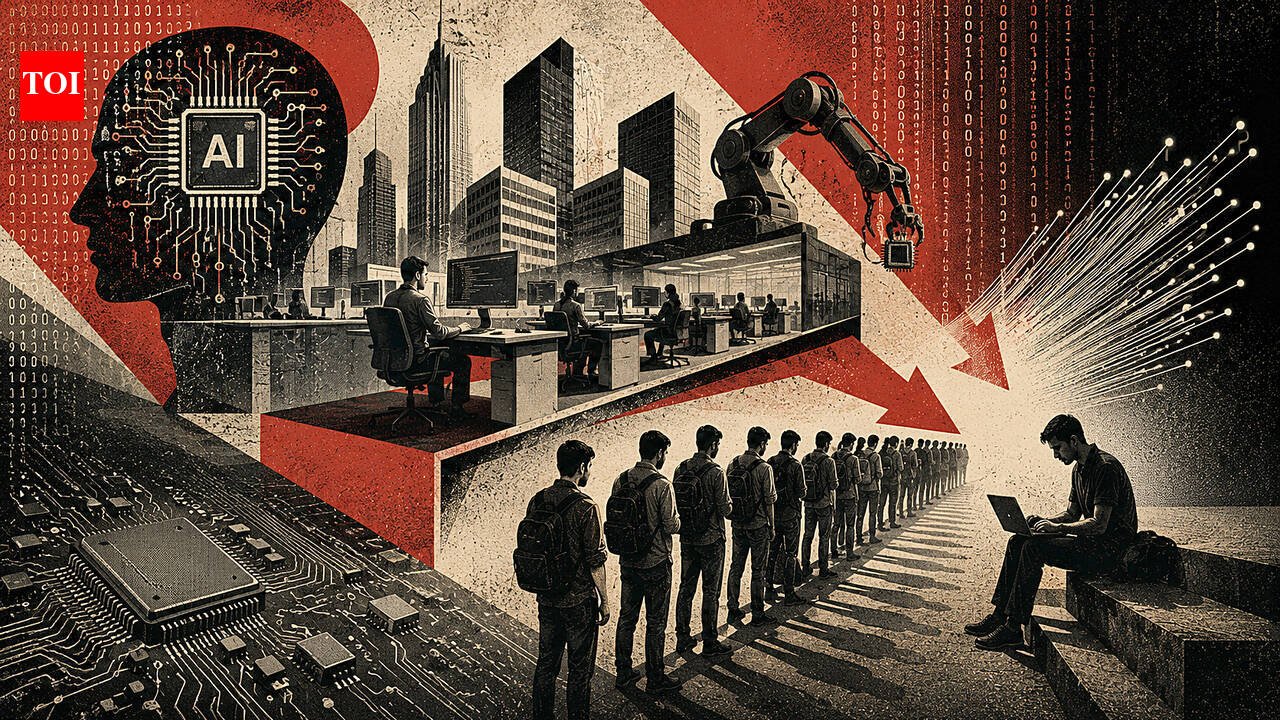
India’s IT sector is seeing a big shift in hiring – especially at the fresher level with big firms being selective in talent acquisition. Not only that, there is an emerging trend of delaying onboarding at the fresher level, leaving many hires in the lurch on their future job prospects.According to The Times of India’s report, firms including IBM, Accenture, Oracle Financial Services Software and Cognizant have informed candidates that joining timelines depend on project availability, business requirements or administrative processes. This has left many engineering graduates waiting months and sometimes more than a year – just to start work!Experts say the hiring landscape is becoming increasingly project and demand driven rather than a case where freshers were hired in thousands to increase bench strength.The trend reflects a broader reset in the IT sector. India’s five largest IT companies cut a net 6,981 jobs in FY26 after adding 12,718 in FY25, while Nasscom estimates the industry’s workforce grew by only 1.35 lakh to 5.9 million in 2026. But some green shoots have emerged – India’s six largest IT companies added a net 5,400 employees in the first quarter of FY27, reversing the 7,100 job reduction seen in the previous quarter. The increase was driven largely by TCS, which hired a net 9,000 employees and saw its biggest quarterly addition in three years.
IT sector workforce trends
However, for freshers the horizon is still uncertain.Is artificial intelligence (AI) the biggest disruptor that is causing uncertainty? Which pockets are seeing hiring and what skills should freshers eye in the current scenario?
How AI is reshaping the IT industry fresher hiring
The most fundamental shift that is visible despite the green shoots is that hiring is becoming increasingly more selective in nature.What is happening? HR experts say that hiring is increasingly focused on AI, data engineering, cybersecurity and other specialised skills, with experts saying the traditional volume-driven campus recruitment model is giving way to selective, demand-led hiring centred on AI-ready talent.According to Neeti Sharma, CEO of TeamLease Digital, large IT services companies are becoming far more selective about fresher hiring rather than stopping it altogether. “AI is not replacing freshers, but it is changing what companies expect from them. Employers no longer want graduates who need months of training before they become productive. They want people who can start contributing with AI tools from day one,” he says.Freshers now account for around 15% of hiring, down from nearly 28% a few years ago, as companies focus more on AI, cloud, data and automation skills. Hiring is also moving away from simply looking at degrees to evaluating whether candidates can actually apply AI in real business situations. “The bigger shift is that companies have moved away from hiring thousands of freshers in advance and keeping them on the bench. Today, hiring is happening when projects are confirmed. That means onboarding depends more on client demand than on campus placement calendars. So, expect more selective, skill-based hiring rather than widespread offer rollbacks,” Neeti Sharma tells TOI.Experts believe that high-volume entry level hiring is becoming irrelevant. The headline numbers of thousands of engineers being hired by the biggest IT services may now be a trend of the past.“As AI impact is highest at rule-based entry-level work in tech, the need for and relevance of high-volume entry-level talent has become increasingly questionable. The overall demand for and absorption of entry-level and fresher talent has been on a low for 3 years now,” notes Anil Ethanur, Co-founder of staffing firm Xpheno.“The visible drop in fresher intakes over the last 2 cycles endorses the fact that AI is reshaping hiring plans, intake volumes and velocity. The overall state of fresher hiring continues to be under stress as key industries attempt to stabilize their talent plans, margins and costs,” he tells TOI.Jang Bahadur Singh, Associate Director, Talent Solutions at Aon Hewitt makes an important distinction: AI is not eliminating the need for fresh talent, but it is changing the types of entry-level roles organisations recruit for.“Employers are becoming more selective and prioritising candidates who can work alongside AI tools rather than perform routine, process-driven tasks. The sharpest impact is being felt in transactional, repetitive and automation-prone roles. As AI automates elements of coding, reporting, testing, documentation and administrative workflows, companies are reassessing traditional hiring pyramids and focusing on productivity-led growth,” he tells TOI.Aon’s Human Capital Trends Study found that 43 per cent of organisations in India have already deployed AI and another 20 per cent are piloting programmes. “As AI adoption accelerates, employers are placing greater emphasis on digital, analytical and AI-related skills when evaluating fresh graduates. The shift is less about reducing overall employment and more about changing workforce requirements,” he explains.Aon’s research shows that 87 per cent of organisations across Asia Pacific believe AI will create new opportunities and require new skills, reinforcing the need for graduates to adapt to AI-enabled ways of working.
India IT Hiring – What’s Changing
GCCs as talent absorbers: But, how much?
Even as the traditional IT sector landscape evolves, Global Capability Centres or GCCs are emerging as major absorption centres for such talent. GCCs are the offshore centres of multinational companies that handle functions such as technology, engineering, finance, R&D, analytics and other business functions for their global operations.According to Jang Bahadur Singh of Aon Hewitt, there is a maturity shift in GCCs, moving from execution-oriented work towards innovation, ownership and global capability building. “This is creating opportunities for engineering graduates, although demand is increasingly concentrated in higher-value and technology-intensive roles. The broader outlook remains positive. While revenue growth may outpace headcount growth in some sectors, new GCC entrants, expansion by multinational organisations and growth in emerging industries should continue to create employment opportunities for graduates with relevant skills.”But even as GCCs attract talent, the hiring numbers, when it comes to campus hiring for freshers, don’t match.Anil Ethanur of Xpheno says that the scale at which Indian IT legacy companies hire during campus intake, can’t be matched by GCCs.“Although the GCCs cohort has overtaken the IT services cohort in net annual additions over the last three fiscals, the scenario differs in campus intake. Moreover, hiring freshers from campus placement is an expensive task, as for every 10,000 freshers hired, enterprises have to set aside Rs 400 to Rs 450 crore for compensation. Spending on talent that does not immediately generate revenue returns is a challenge amid sustained current market conditions,” Ethanur tells TOI.
Role of GCCs
Human Resource experts also see little like-for-like replacement options. They believe that GCCs are unlikely to be a like-for-like replacement for traditional campus hiring. Their hiring mandates increasingly focus on specialised skills in areas such as AI, data analytics, product development, cybersecurity and digital engineering rather than large-scale volume recruitment.Neeti Sharma of TeamLease also points out that while GCCs are helping offset some of the slowdown, they cannot completely offset the scale of hiring done by IT services companies. “GCC fresher hiring has grown from around 85,000 two years ago to more than 130,000 today, which is a significant increase. However, their hiring model is very different. They hire for specific roles and specialised skills rather than through large campus drives. So, GCCs are improving the quality of entry-level opportunities, but they aren’t replacing the volume of hiring that IT services companies traditionally created,” she explains.
What skills are needed to stay relevant?
This raises the important question: what kind of skills should freshers look to acquire to be more employable?Aon Hewitt’s Jang Bahadur Singh says that technical proficiency alone is no longer sufficient. Employers are increasingly looking for a combination of technology fluency, problem-solving capability, communication skills and sound business judgement.
AI-related skills in focus
“Graduates must develop a strong foundation in AI, data analytics, automation tools, cloud technologies, cybersecurity and digital engineering. Demand for these capabilities continues to grow across both GCCs and technology employers,” he says.Skilled based hiring has become a reality now. “Employers care much more about what candidates can build than what degree they hold. Basic AI awareness is no longer enough. Graduates need hands-on experience with tools such as LLM APIs, prompt engineering, RAG pipelines, along with strong data and cloud fundamentals. More importantly, Apprenticeships, Internships, Live projects and portfolios that demonstrate real problem-solving are becoming far more valuable than certifications alone,” says TeamLease’s Sharma.Xpheno’s Anil Ethanur believes that in India, the significant gap within the AI spectrum lies in the technical skills, driven by the service end and Core AI end requirements. It is the AI engineering end that suffers supply gaps against rising demand and are difficult to recruit.
Skill-based hiring a reality
“To stay employable in the AI era, engineering graduates need to constantly upskill themselves and have hands-on experience with and exposure to core AI engineering and development processes,” he tells TOI.Equally important are human skills. Aon’s Human Capital Trends research highlights growing demand for critical thinking, adaptability, change management and AI-enabled decision-making capabilities as organisations redesign jobs around technology. “Employers increasingly favour candidates who demonstrate workforce readiness and the ability to continuously learn. The future workplace will reward engineers who can combine domain expertise with AI literacy, apply technology to solve business problems and adapt quickly as roles evolve,” Aon Hewitt’s Singh concludes.
