


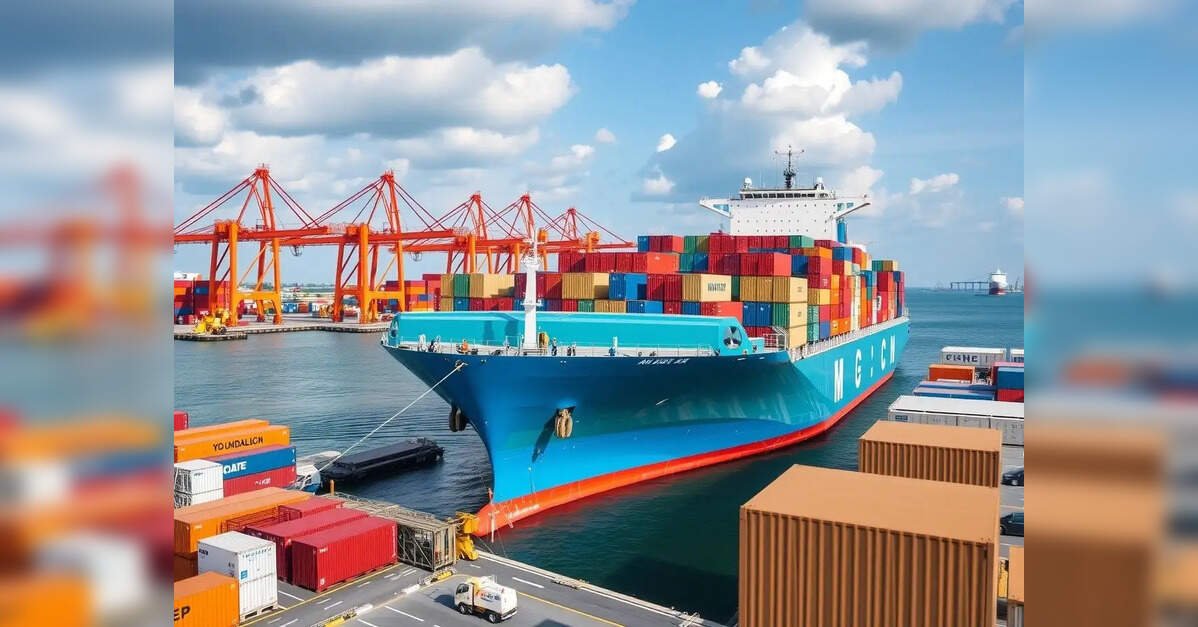
Britain handles more than a quarter of its seaborne trade through 21 ports it may soon know by a different owner. Adani Ports and Special Economic Zone, India’s largest private port operator, is weighing a bid for Associated British Ports, the United Kingdom’s biggest port group, according to people familiar with the matter. The prize on offer: a combined 63.9 per cent controlling stake being sold by two Canadian pension funds that have separately hired investment bankers to run the process.
For Gautam Adani, the APSEZ chairman who has set a target of building the world’s biggest transport utility by 2031, ABP would be the most consequential acquisition yet in a string of international port deals that already spans Israel, Tanzania, Sri Lanka and Australia.
Who is selling and what is at stake
Canada Pension Plan Investment Board holds 30 per cent of ABP, while Ontario Municipal Employees Retirement System owns 33.88 per cent. Together, they are the controlling bloc in a company whose remaining shareholders include Singapore’s sovereign wealth fund GIC with 20 per cent, Kuwait Investment Authority’s infrastructure arm Wren House Infrastructure at 10 per cent, and Anchorage Ports LLP, which is owned by the Hermes Infrastructure Fund.
ABP is not simply the largest port operator in Britain by name. Its 21 facilities, spread across England, Scotland and Wales, collectively move cargo equivalent to roughly a quarter of all UK seaborne trade. Immingham on the Humber estuary is the country’s biggest port by tonnage. Southampton handles £40 billion worth of British exports every year, making it the nation’s top export gateway. The network also includes ports in Cardiff, Grimsby, Lowestoft, Plymouth and Hull, giving ABP a geographic spread that no single rival can match.
In 2025, ABP’s ports processed 42.5 million tonnes of bulk cargo and 3.1 million units of containerised and roll-on roll-off freight. Revenue for the year came in at £819.8 million, generating an operating profit of £586.5 million. Those numbers tell a story about the quality of the business: an operating margin above 70 per cent is unusual even by port-industry standards, and it owes much to the structure of ABP’s income.
Why the financials are attractive
A substantial portion of ABP’s revenue is locked in through long-term customer contracts that guarantee a minimum income floor regardless of actual traffic volumes. ABP is also the statutory harbour authority and river authority for most of the ports it runs. That regulatory status means it collects mandatory pilotage and conservancy fees from vessels transiting its waters, a revenue stream that exists independently of commercial cargo volumes and is therefore largely recession-proof.
Pilotage and conservancy services have long been a focus area for APSEZ in its Indian operations, so ABP’s statutory income model would fit neatly into the Adani framework. The combination of guaranteed contract revenue, statutory fees and diversified cargo types makes ABP a rare infrastructure asset: one where the downside is structurally capped.
ABP is also a significant partner to Britain’s offshore wind sector, providing operations and maintenance services for more than 50 per cent of the country’s offshore wind activity. As the UK government accelerates its clean-energy build-out, that positioning could become considerably more valuable over the next decade.
APSEZ’s response and its global ambitions
APSEZ declined to confirm or deny the discussions. “We continuously evaluate opportunities that align with our long-term strategy and create sustainable value for all stakeholders,” a company spokesperson said, adding that the firm does not comment on market speculation or rumours as a matter of policy. That carefully worded non-denial is consistent with how the group has responded to acquisition speculation before it eventually closed deals.
The strategic logic is straightforward. APSEZ already runs 15 multi-commodity ports in India with a combined handling capacity of 653 million tonnes. Its four international ports, at Haifa in Israel, Dar es Salaam in Tanzania, the Colombo West International Terminal in Sri Lanka and the North Queensland Export Terminal in Australia, can collectively handle 144 million tonnes. In the financial year ended March 2026, the company handled 501 million tonnes of cargo across its entire network.
The group wants to expand total cargo handling capacity to one billion tonnes by 2030, and aims to handle 850 million tonnes of cargo by that year. ABP alone processed 45.6 million tonnes in 2025, which would be a meaningful contribution to those targets. Beyond tonnage, APSEZ has said it plans to grow its marine services fleet from 136 tugs and offshore support vessels to more than 200, a target that ABP’s existing marine services infrastructure could help accelerate.
Capital position and deal financing
The question of how APSEZ would finance such a deal deserves scrutiny. The company had cash and cash equivalents of ₹12,193 crore at the end of March 2026, set against gross debt of ₹55,103 crore. Its announced capital expenditure plan calls for spending up to ₹1 lakh crore over the next five years, of which ₹63,000 crore is earmarked for domestic port expansion and ₹7,000 crore for international port construction, primarily the second phase of the Colombo terminal.
Crucially, APSEZ has specified that strategic mergers and acquisitions are not included in that capex envelope. That means any ABP deal would sit outside the existing investment plan and would need to be separately funded, most likely through a combination of debt raised at the project level and equity from APSEZ’s balance sheet or capital markets. ABP’s stable, contracted cash flows would make it a bankable asset for lenders, which could ease the financing structure considerably.
The valuation of the stake has not been disclosed publicly, but infrastructure assets of ABP’s quality, with long-dated contracted revenues and statutory income, have typically traded at significant multiples of operating profit in recent years. A 63.9 per cent stake in a business generating £586.5 million in operating profit would command a substantial price tag by any measure.
A port empire with a deadline
Adani’s ambitions in global ports are not a recent development. The group has been methodically acquiring international port assets since the early 2020s, each deal adding a new geography to what is increasingly a global logistics platform rather than a purely Indian ports business. The Haifa acquisition, completed in 2023, gave APSEZ a foothold in the Eastern Mediterranean. The Colombo terminal, once fully operational, positions it at one of the world’s busiest transshipment hubs. A presence in Britain would add a G7 economy and one of Europe’s most important trade corridors to that map.
The 2031 deadline Gautam Adani has set for becoming the world’s largest transport utility is aggressive. ABP, with its scale, statutory protections and strategic position in UK trade, would move the needle in ways that smaller acquisitions cannot. Whether the bid materialises, and at what price, will depend on competitive dynamics in the sale process, where other global infrastructure investors are likely to be circling the same asset.
For now, Britain’s busiest ports may be on the verge of finding their most ambitious suitor yet.
