


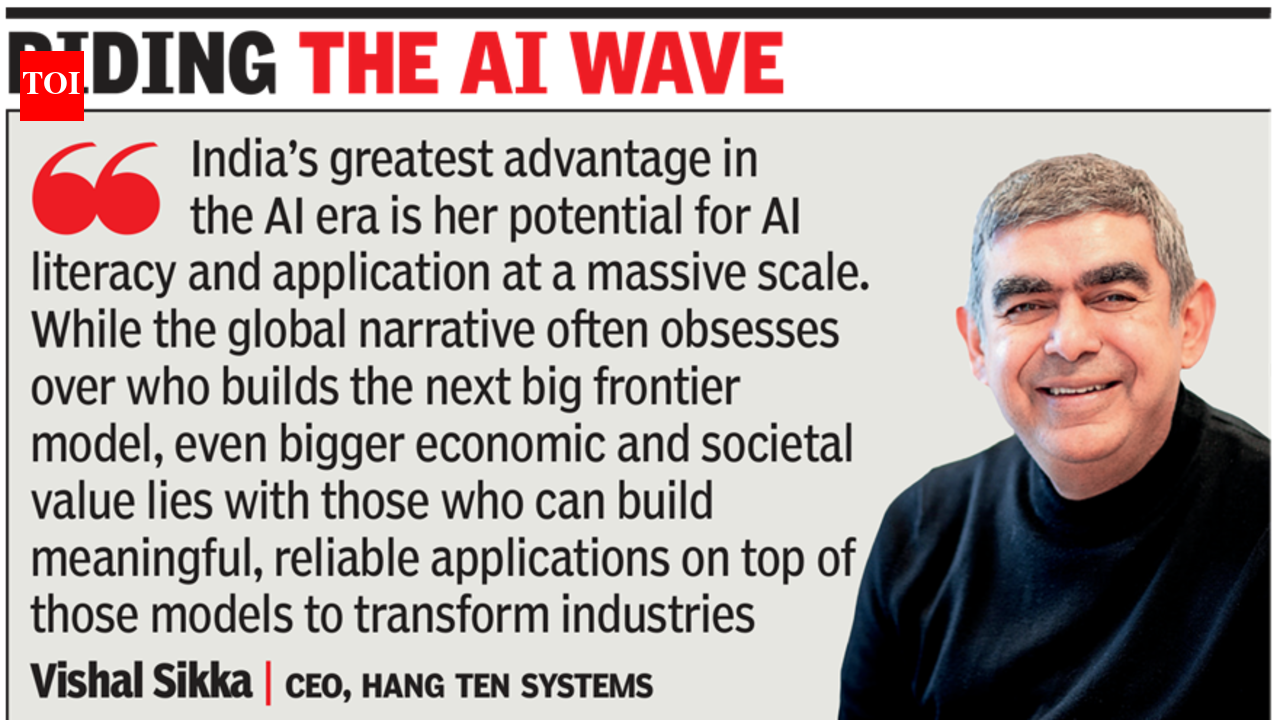
Bengaluru: Artificial intelligence is arriving “like a massive new wave”, and enterprises have two choices: be overwhelmed by it or learn to ride it. Former Infosys CEO Vishal Sikka said he learnt long ago that “when there are big waves around, it is time to surf”. But the real goal, he argued, is to “hang ten” — the surfing manoeuvre where a rider masters a wave so completely that they walk to the front of the board and hang all 10 toes over the edge.That philosophy inspired the name of Sikka’s new enterprise AI startup, Hang Ten Systems, which aims to help companies “not just transform with AI, but use it as a force to do what no one could do before”.“Instead of getting submerged by it or getting destroyed by it, how do you ride it?” Sikka told TOI. “We believe bridging this gap is the story of our times.”Investors appear to agree. Hang Ten has raised $32 million in seed funding led by Mayfield, with a strategic investment from Aramco Ventures and participation from angel investors. The capital will be used to expand its engineering team, strengthen its AI platform and deepen engagements with global enterprises. Customers already include Germany-based healthcare company Fresenius and Siemens Energy.Hang Ten begins by advising CEOs on AI strategy before helping transform products, finance, manufacturing, HR and supply chains. Sikka believes enterprises are underestimating AI’s impact.“It is not that you get 20% or 30% productivity gain,” he said. “You can get thousands of times productivity gain. You can do things that are not possible to do.”He cited one customer where a finance process that previously took nearly two weeks can now be completed in minutes using AI-driven data harmonisation and analytics. In software engineering, too, projects that once required hundreds of engineers can now be delivered with a fraction of the effort.Yet, he cautioned against treating enterprise AI like consumer AI.“People make mistakes with AI. People who don’t understand what to do with it cannot get the benefits of it,” he said.Enterprises still have to address hallucinations, security, privacy, governance and rapidly evolving AI models before deploying the technology at scale. That advisory gap is where Hang Ten hopes to differentiate itself.Sikka also believes AI is fundamentally reshaping software development.“The ‘how’ comes from AI,” he said, arguing that enterprises increasingly know what they want to build while AI increasingly knows how to build it.As a result, the traditional distinction between software products and IT services is beginning to blur.Asked whether AI would transform software companies — including enterprise software giants such as SAP, where Sikka was previously CTO, and the many SaaS firms emerging from India — Sikka said every software company would be affected.“What once took years to build can now be developed in days or even hours with the right tools,” he said.While software companies retain advantages such as deep domain expertise, enterprise trust and rich business data, AI fundamentally changes how software is created and operated. Instead of static products, software will become continuously personalised, customised and adaptive. AI is not replacing SaaS, he said, but redefining it.Hang Ten’s fresh funding will largely go towards hiring. The company plans to recruit around 250 engineers and technical specialists while investing in model fine-tuning and expanding its proprietary Hobie AI framework.“We build where we can stay close to customers and where we find the best talent,” Sikka said. “India is not a back office or a GCC for us; it’s a place to build real, impactful capability that can innovate and guide others.”Sikka said India’s greatest advantage in the AI era is its potential for AI literacy and application at massive scale.“While the global narrative often obsesses over who builds the next big frontier model, even bigger economic and societal value lies with those who can build meaningful, reliable applications on top of those models to transform industries,” he said.Despite AI’s rapid advances, Sikka insisted people will remain central to enterprise transformation.“People trust people,” he said.AI may allow one expert to accomplish the work of an entire team, but judgement, experience and trust remain irreplaceable.
