


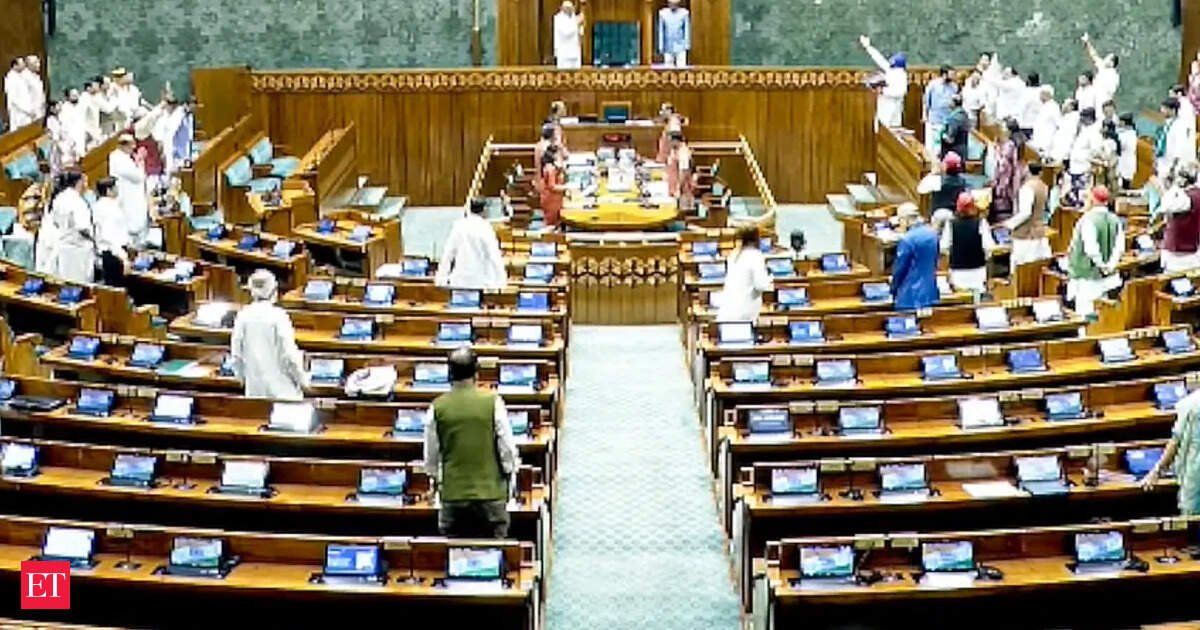
In the Lok Sabha, Congress MP Manish Tewari gave a notice for an adjournment motion, seeking a comprehensive discussion on the necessity of a new Anti-Defection Law. Tewari argued that the current legal framework needs an overhaul to prevent mass floor-crossing driven by political opportunism.
Also Read: Lok Sabha resumes business after days of deadlock, takes up anti-paper leak Bill amid sharp govt-Opposition clash
In his notice to the Secretary-General of the Lok Sabha, Tewari stated, “I move that this House do suspend Question Hour, Zero Hour and all other listed business of the day to discuss the contours of a new Anti-Defection Law that proscribes Mass Political Defections driven by opportunism and bereft of any genuine ideological or policy differences while simultaneously providing space for honest and critical dissent both inside and outside Parliament and the legislatures.”
Meanwhile, in the Rajya Sabha, MP Praveen Chakravarthy moved a motion under Rule 267, demanding the suspension of the day’s business to address what he termed a “misleading reply” by the Ministry of Jal Shakti regarding the Cauvery water dispute.
“I hereby give notice of my intention to move the following motion: “That this House do suspend Zero Hour and the relevant rules relating to Question Hour and other businesses of the day for an immediate discussion on the misleading reply given by the Ministry of Jal Shakti in this House on 27th July 2026 regarding the Cauvery water dispute, and on the Cauvery Water Regulation Committee’s order directing Karnataka to release 4 TMC ft of water immediately,” he stated in the notice.
Also Read: Opposition politicised anti-paper leak bill, says Kiren RijijuChakravarthy highlighted a discrepancy between the Ministry’s recent written reply and a 2021 statement regarding the requirement for Karnataka to obtain consent from lower riparian states like Tamil Nadu for constructions on the River Cauvery.
The Rajya Sabha MP noted that the Ministry’s reply to Unstarred Question No. 876 claimed no such consent was required, contradicting the 2021 stance of the then Union Minister.
“The Ministry’s reply to Unstarred Question No. 876 states that the Supreme Court’s judgment dated 16.02.2018 contains no requirement for Karnataka to obtain the consent of lower riparian States, namely Tamil Nadu, Kerala and the UT of Puducherry, before constructing any structure across the River Cauvery. This position is a direct contradiction of the stand taken by the then Union Minister for Jal Shakti, Shri Gajendra Singh Shekhawat, on the floor of the House on 5th August 2021. He categorically stated that the permission granted to Karnataka to prepare the DPR for the Mekedatu project was conditional. He further stated that under the Inter-State River Water Disputes Act, the consent of all lower riparian States sharing the inter-state river basin, including Tamil Nadu, was mandatory,” he added in the notice.
“This House deserves an explanation for why the Central Government has reversed a position it formally placed on record five years ago. Such inconsistency directly affects the interests and water security of the farmers of Tamil Nadu and cannot be allowed to pass unaddressed. This is particularly urgent at a time when the Cauvery Water Regulation Committee has directed Karnataka to release 4 TMC ft of water immediately, and compliance remains uncertain,” Chakravarthy further stated in his notice.
Emphasising the urgency of the situation, the MP added, “In view of these pressing concerns affecting the livelihood of farmers in the Cauvery delta, the matter requires urgent consideration and discussion by the House.”
