


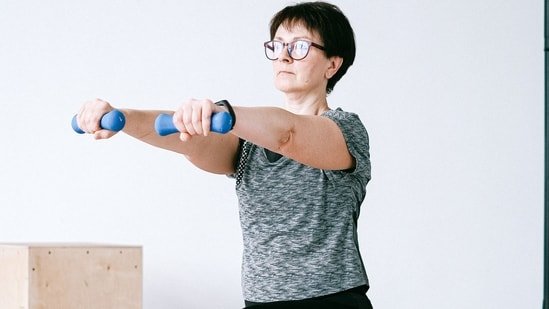
Muscle strength isn’t just about lifting heavier weights or looking toned—it’s the foundation of mobility, balance and independence as you age. From climbing stairs and carrying groceries to preventing falls and maintaining an active lifestyle, healthy muscles play a vital role in everyday life. However, muscle mass naturally begins to decline with age, especially after your forties, and without regular strength training, that loss can accelerate. The good news? Much of it is preventable with the right habits and a consistent approach to resistance training, nutrition and recovery.
Also Read | Fitness coach Raj Ganpath shares 6 non-negotiables you need to follow to lose weight, get fit and healthy
Dr Adrienne Towsen, an orthopaedic surgeon and performance medicine specialist, has shared five common habits that could quietly undermine muscle strength in women over 45. In an Instagram video posted on July 6, she explains, “If you’re a woman over 45, here are five things I would stop doing right now if I wanted to keep muscle and strength for the next 30 years.”
Stop relying on walking as your only form of exercise
According to Dr Towsen, walking is an excellent form of exercise that supports heart health, boosts mood and offers a host of other health benefits. However, it shouldn’t be your only form of physical activity. She recommends incorporating resistance and strength training into your routine to help preserve muscle mass and maintain strength as you age.
She explains, “Stop relying on walking as your only form of exercise. Now, I think walking is great and it’s important for your heart, for your mood, for your overall health, and it is a great form of exercise that you need to do, but it’s not the only thing you need to do. So, if preserving muscle is the goal, your body needs resistance. Muscle is going to stick around when you give it a reason to do so.”
Stop avoiding heavier weights
As Dr Towsen explained earlier, muscles need resistance to stay strong. If every weight you lift feels easy, your muscles aren’t receiving the stimulus they need to maintain or build strength. To preserve muscle mass over time, she recommends gradually incorporating more challenging weights into your training routine.
The surgeon highlights, “Stop avoiding the heavier weights. I’m not saying you need to become a power lifter, but if every weight you pick up is easy, your muscles are not getting the signal to stay strong or get stronger. So, you need to feel like you’re working a little bit; it needs to be a little bit hard at least.”
Stop undereating protein
Protein is the building block of muscle, making it essential for maintaining muscle mass. Getting enough protein supports muscle repair and recovery while helping preserve strength, mobility and overall physical function.
Dr Towsen emphasises, “Stop undereating protein. As we get older, we become less efficient at building and maintaining muscle. That means protein intake is more important, not less.”
Stop treating recovery as optional
While regular exercise is essential for preserving muscle mass, giving your body enough time to recover is just as important. Muscles repair and grow during periods of rest, so constantly pushing yourself without adequate recovery can be counterproductive.
The orthopaedic surgeon notes, “Stop treating recovery as optional. So, many women are just ‘go, go, go’ all the time. And if you’re trying to do everything and not giving yourself a chance to rest, it’s going to be counterproductive.”
Stop assuming weakness is just ageing
Much of the muscle loss and decline in strength commonly associated with ageing is preventable. Dr Towsen emphasises that muscle mass is one of the strongest predictors of longevity, independence and metabolic health later in life. That’s why, she says, your fitness goals at 45 shouldn’t just be about looking fit today – they should be about building the strength you’ll need to stay active and independent well into your seventies and beyond.
The orthopaedic surgeon explains, “Stop assuming that weakness is just ageing. A lot of what people call ‘getting older’ is actually loss of muscle and strength over time, and much of that decline is preventable. After 45, muscle isn’t about appearance; it’s one of the strongest predictors of longevity, independence, metabolic health, and how well you age. So the goal of lifting weights and with resistance, is not that you need to look 25; the goal is to be strong enough to do what you want to do and remain independent at 75 and beyond.”
Note to readers: This article is for informational purposes only and not a substitute for professional medical advice. It is based on user-generated content from social media. HT.com has not independently verified the claims and does not endorse them.
Dr Adrienne Towsen, MD, is a board-certified orthopedic surgeon and performance medicine specialist based in West Chester, Pennsylvania. She specialises in orthopaedic surgery, shoulder and knee care, joint reconstruction, and integrative performance/longevity medicine (including hormone and peptide therapies).
