


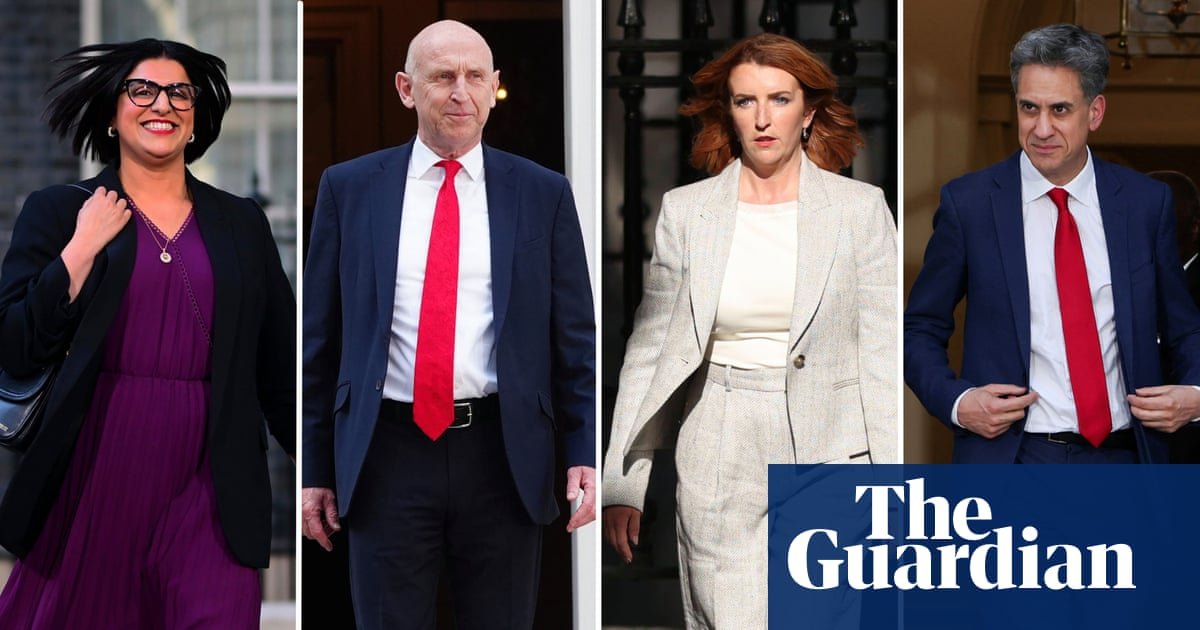
John Healey
The former defence secretary who quit the government over a lack of funding for the defence investment plan is the surprise appointment to the Treasury.
Healey, 66, is a steady and experienced force, having been an MP since 1997, and serving as a Treasury minister under Tony Blair.
The job had been first expected to go to Ed Miliband and then it was mooted for Shabana Mahmood. But one advantage of Healey is his longstanding history on Labour frontbenches for every faction of the party. He was a minister in the Blair-Brown years and a loyal member of the shadow cabinets of Miliband, Jeremy Corbyn and Starmer.
Healey grew up in Wakefield, studied political science at the University of Cambridge, and was a journalist, campaigns director at the Trades Union Congress and a disability rights campaigner before entering parliament.
Unshowy and not part of the usual Westminster dramas or scandals, it was a shock when he resigned his role under Starmer, in what would be one of the fatal blows for his premiership. In the job, he will be expected to push for a fuller funding settlement for the Ministry of Defence, which was denied to him under the Treasury of Rachel Reeves. His other major shared interest with Burnham is reindustrialisation.
His X bio describes him as “Husband and Dad. Proud Yorkshireman. Labour MP for Rawmarsh and Conisbrough and former secretary of state for defence”. He can now add chancellor to that list.
Shabana Mahmood
Mahmood will keep her role in Burnham’s cabinet after being appointed home secretary by Keir Starmer last year and charged with driving through controversial immigration policies.
She is considered to be on the Blue Labour right of the party, which is socially conservative and tough on crime. She grew up in Small Heath in inner-city Birmingham in the 1980s and 90s, where her father kept a cricket bat behind the till of the family shop to fend off would-be robbers. After going to the University of Oxford to study law, she worked as a barrister.
The 45-year-old is an MP in Birmingham and ran Labour’s election campaign in 2024, before a stint as justice secretary overseeing an early release programme to ease overcrowding. She is viewed as steely and decisive.
A cabinet colleague told the Guardian earlier this year that she “never wastes a word” in meetings, and last year warned that the government was still caught up in an opposition mindset and preoccupied with taking on the left instead of speaking to the concerns of the country more widely. She has also been a leading advocate for the UK to take a more pro-Palestinian stance, including on statehood.
Ed Miliband
Miliband is a great survivor in the Labour party – almost as much so as Andy Burnham. A former cabinet minister under Gordon Brown, he led Labour to an election defeat in 2015 before serving in the shadow cabinet of Keir Starmer.
He was a leading contender to be chancellor but there were fears his positioning on the soft left and as a firm defender of Britain’s net zero commitments would spook the financial markets. Having once made a speech pitching some companies as producers and others as predators, he is not a favourite politician of big business.
Born in north London in a political family, his father was a Marxist academic. He studied PPE at Oxford and worked mostly in politics and research before joining his older brother, David, in the House of Commons as a Labour MP. They became the first brothers to both serve around the cabinet table since before the second world war, and their sibling relationship was put to the test when Ed beat David in the leadership contest to succeed Brown with the support of the trade union vote.
As Labour leader, he led in the polls for many months against David Cameron and identified ahead of his time the public mood on the cost of living but was pilloried by some of the rightwing media as gaffe-prone and somewhat awkward. In Starmer’s cabinet he was viewed as one of the most successful cabinet ministers at driving through his priorities, including Great British Energy, and blocking more drilling in the North Sea – a policy expected to be partially overturned by Burnham.
As foreign secretary, he will be expected to take international matters off Burnham’s hands as much as possible, take a more pro-Gaza stance and potentially set a path to restoring Britain’s aid commitments to 0.7% of national income. He replaces Yvette Cooper.
Yvette Cooper
Among the Starmer-era big beasts who had been tipped for survival, Cooper is shifted from the Foreign Office to the vital domestic post of secretary of state for health and social care, the suffix especially important given Burnham’s stated mission to finally unlock the clogged adult care system.
Cooper does, of course, have recent experience of a tricky UK-focused post, starting out in Starmer’s government as home secretary, and she held several posts under Tony Blair and Gordon Brown.
While still in her 50s, Cooper is approaching Labour “grandee” status, having been an MP since 1997 and getting her first taste of ministerial life at the tail end of the 20th century. When Labour’s 2015 leadership campaign began she was initially viewed as a favourite, but finished third behind Corbyn and a certain Andy Burnham.
The daughter of a trade union leader, Cooper is a near-political lifer, having begun her career with then-shadow chancellor John Smith, although she did spend a period as a journalist before entering parliament.
For a decade of her time in parliament, Cooper was part of a political double act with her husband, Ed Balls, who lost his seat in 2015 and later became a broadcaster.
Pat McFadden
Work and pensions secretary
Some continuity had been expected with the new ministerial slate and it makes sense for this to happen with a department that could be central to Burnham’s political fortunes.
McFadden, one of the more experienced operators in government, will be tasked with continuing to pilot through some sort of reform to social security, with the intention of limiting the costs without cuts or conditions of the sort that prompted a major backbench rebellion for Starmer.
An MP since 2005, McFadden was soon propelled into the Blair and Brown frontbenches, and spent the buildup to the 2024 election as Starmer’s national campaigns coordinator, going on to take the Cabinet Office post at the centre of policymaking.
A trusted voice on even the trickiest morning broadcast round, the child of two Irish speakers from County Donegal transplanted to Paisley, McFadden trod the traditional political path of researcher and policy adviser before winning his Wolverhampton South East seat.
Louise Haigh
Chancellor of the duchy of Lancaster, first secretary of state and Cabinet Office minister
Haigh became a linchpin of Burnham’s byelection operation, so it is no surprise she is now his chief organiser in government and effectively his deputy as first secretary of state. As the most senior Cabinet Office minister, she will coordinate work across the government and oversee any changes to Whitehall.
It marks a return to cabinet for the 38-year-old Haigh, who was sacked by Keir Starmer as transport secretary for not having told him fully about a fraud conviction over a missing mobile phone when she was in her 20s.
She grew up in Sheffield and studied politics and government at LSE, then Nottingham University, before working in parliament, for Unite and later at the insurer Aviva. It was during her time at that company where she got in hot water over the phone, having reported it stolen but failed to update the police when it was found. She pleaded guilty to fraud, but it did not stop her political career.
Elected in 2015, she was one of 36 Labour MPs to nominate Jeremy Corbyn for the Labour leadership that year and was given a frontbench role when he made her a shadow Cabinet Office minister at age 28.
The MP for Sheffield Heeley rose through the junior ministerial ranks and was one of a handful of Corbyn’s frontbench to be appointed to Keir Starmer’s first cabinet when he took over. She became the shadow Northern Ireland secretary.
Known for an engaging communication style, she retained her frontbench role even as Starmer moved his party to the right. As transport secretary, she oversaw the nationalisation of railways legislation until she was returned to the backbenches. She replaces Darren Jones.
