


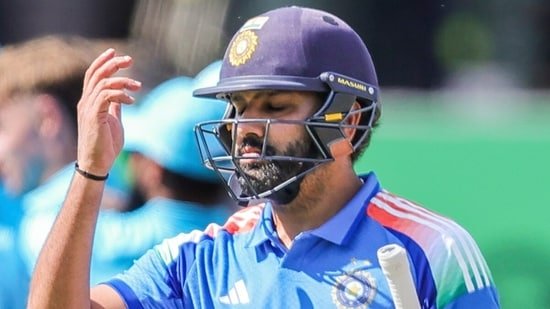
If the Lord’s ODI is indeed Rohit Sharma‘s last for India – which seems increasingly likely now that he has reportedly been informed by the BCCI selectors that he is no longer part of India’s World Cup plans – it would mean that, in the space of three years, one of India’s finest white-ball batters would have stepped away from one format after another, ultimately bringing the curtains down on a legendary career. But even before reports emerged last night that a swansong could be on the cards, a commercial for an upcoming show appeared to reveal more than it intended to. The signs were already there.
That may also explain why Rohit appeared ready to embrace life beyond cricket. Sourav Ganguly, Andrew Flintoff and Michael Clarke all got their own TV shows after retirement. Rohit wouldn’t have been the first.
How did it all come about? A few months ago, Rohit was sweating it out at Shivaji Park, shedding all the weight he had put on. He was always going to be a step behind Virat Kohli in terms of form and fitness. Losing 11 kg went a long way in boosting his chances of playing the 2027 World Cup, but beyond his control lay several other factors that slowly began to set the wheels in motion. A year later, they all combined to extinguish Rohit’s dream of winning the World Cup, something he had wished for since he was 11.
Agarkar’s blueprint for 2027 World Cup
Make no mistake. Ajit Agarkar has made some bold decisions. There may never have been a BCCI chief selector more willing to take gutsy calls, regardless of public perception. He dropped Shubman Gill from India’s T20I setup when many believed he was India’s next all-format captain. After the Border-Gavaskar Trophy, he drew a line under the extended runs Rohit and Kohli enjoyed in Tests because he believed they were past their prime. Mohammed Shami was overlooked despite strong Ranji Trophy performances because he was 35, with India keen to groom the next generation of fast bowlers. He removed Rohit as captain despite an ICC title, left Suryakumar Yadav out of India’s T20I setup after the World Cup triumph and appointed Shreyas Iyer captain.
What’s common across these decisions? A vision for the future. T20 World Cups matter, but India’s failure to win the 50-over World Cup since 2011 remains a major underachievement. As remarkable as the 2023 campaign was, India still fell short. Winning the 2027 World Cup – away from home and in South Africa’s demanding conditions – would be the ultimate statement of this team’s legacy, which, with two 40-year-olds, may not be the ideal setup.
A chief selector’s biggest priority is to secure the future of Indian cricket, and Agarkar has done exactly that. With fewer ODIs on the calendar and Rohit’s numbers dipping, India needed a backup. Like many greats before him, including the legendary Sachin Tendulkar, Rohit ultimately had to make way for a younger star.
Gambhir’s template and Rohit’s floundering fortunes
No prizes for guessing that Gautam Gambhir doesn’t exactly share the warmest equation with either Rohit or Kohli. That perception only grew stronger when Kohli indirectly questioned the team management during an RCB podcast. The relationship that initially showed promise at the start of his tenure was no longer the same after India’s disastrous Border-Gavaskar Trophy campaign. Before becoming India’s head coach, Gambhir was always high on Rohit. On several occasions, he even called him the most dangerous batter he had faced in the IPL. But at the end of the day, Gambhir has a job to do.
His plan was simple from the very beginning: build a formidable side for the 2027 World Cup. Throughout, Gambhir understood that at 40, even the fittest batter finds it harder to perform at the same level as he did a couple of years ago. Having already delivered two ICC trophies, he wasn’t going to let reputation, stature or records stand in the way of chasing a third.
Until January this year, everything seemed fine. Rohit was scoring runs. Even if he wasn’t batting with the same attacking intent, scores of 74 and 121 against Australia, along with a couple of fifties against South Africa, were reassuring. Even a poor series against New Zealand did little to dent his confidence. The IPL, however, was where concerns began to grow, with Rohit suffering a hamstring injury. No amount of match practice can stop Father Time. If the injury raised doubts, four low scores in five innings against Afghanistan and England only reinforced them.
The Jaiswal question: If not now, then when?
Spare a thought for Yashasvi Jaiswal. Twice he has scored an ODI century for India, and twice he has missed the very next match – 116 against South Africa last December and 110 against Afghanistan less than a month ago. That’s two hundred in his last three ODIs. It’s a price one has to pay when playing for India because the competition is that fierce. But another reality, as harsh as it may be, is that time waits for no one. In the early 2010s, Sachin Tendulkar’s prolonged stay delayed Ajinkya Rahane’s entry into India’s Test side by at least a couple of years. If India could eventually move on from Tendulkar, what chance does Rohit have?
Jaiswal has been India’s most prolific Test batter since making his debut in 2023 – a 700-plus series against England, one of only three Indians to score a century in Australia during the 2024-25 Border-Gavaskar Trophy, and 411 runs in the Anderson-Tendulkar Trophy. The bigger the stage, the bigger Jaiswal’s contributions have been. It may take time for him to cement his place in India’s T20I side, but, much like Rahane before him, he’s already been held back in ODIs.
Selection in Indian cricket has never been a reward for previous achievements. It has always been about who gives the team the best chance of winning the next big tournament. That’s a truth Rohit must face. He fought till the very end, reinvented himself and never stopped believing another World Cup was within reach. But time, fading returns and the emergence of a special talent altered the equation. If this truly is the end of Rohit’s ODI journey, it won’t be because he didn’t try. It will simply be because Indian cricket decided it was time to look ahead.
