


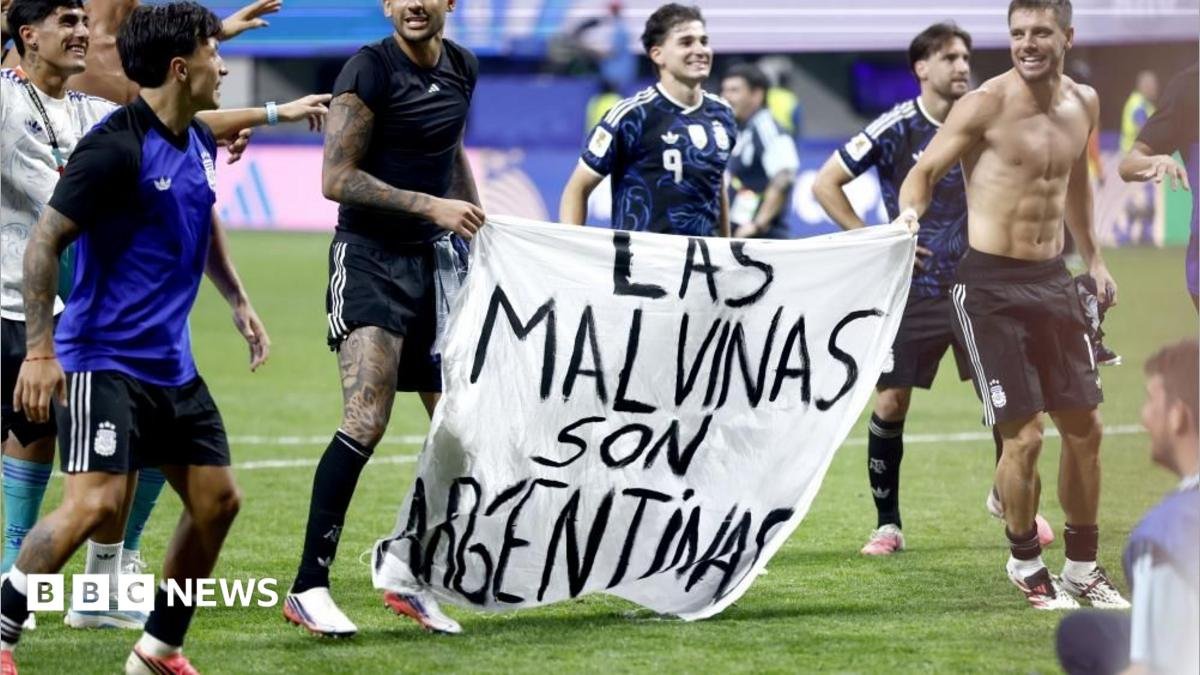
They remain the subject of a sovereignty dispute between Britain and Argentina, with the two countries waging a brief but bitter war over the territory in 1982.
A British military task force ejected Argentine forces, who had landed on the Falklands to stake a territorial claim.
The 74-day conflict led to the deaths of 255 British military personnel, three islanders and 649 Argentine soldiers.
The prime minister’s official spokeswoman said: “Our position is unchanged, self-determination rests with the islanders and our commitment to the Falklands will never waver.”
She said any potential action against Argentina players who unveiled the banner was “a matter for Fifa”, but echoed the view of the Business Secretary Peter Kyle that world football’s governing body should investigate.
In 2013, the people of the Falkland Islands voted overwhelmingly in favour of remaining a UK overseas territory.
Of 1,517 votes cast in the two-day referendum – on a turnout of more than 90% – 1,513 were in favour, while just three votes were against.
Liberal Democrat leader Sir Ed Davey said Argentina players who celebrated with the banner “must be barred from the final”.
He highlighted Spain players Alvaro Morata and Rodri being banned for one game by Uefa, the governing body of European football, after they chanted “Gibraltar is Spanish” during their side’s Euro 2024 victory celebrations.
Conservative Party leader Kemi Badenoch said: “The Falkland Islands are British. The Conservatives will always defend them.”
Reform UK leader Nigel Farage said he was “disgusted” at the behaviour of some Argentinian players, adding: “The most important thing to do is build up the Royal Navy quickly.”
England’s World Cup dreams were shattered on Wednesday as Argentina scored two late goals.
Anthony Gordon’s opener had allowed England fans to dream of a first World Cup final since 1966, before Enzo Fernandez equalised and Lautaro Martinez won it for the holders in injury time.
