


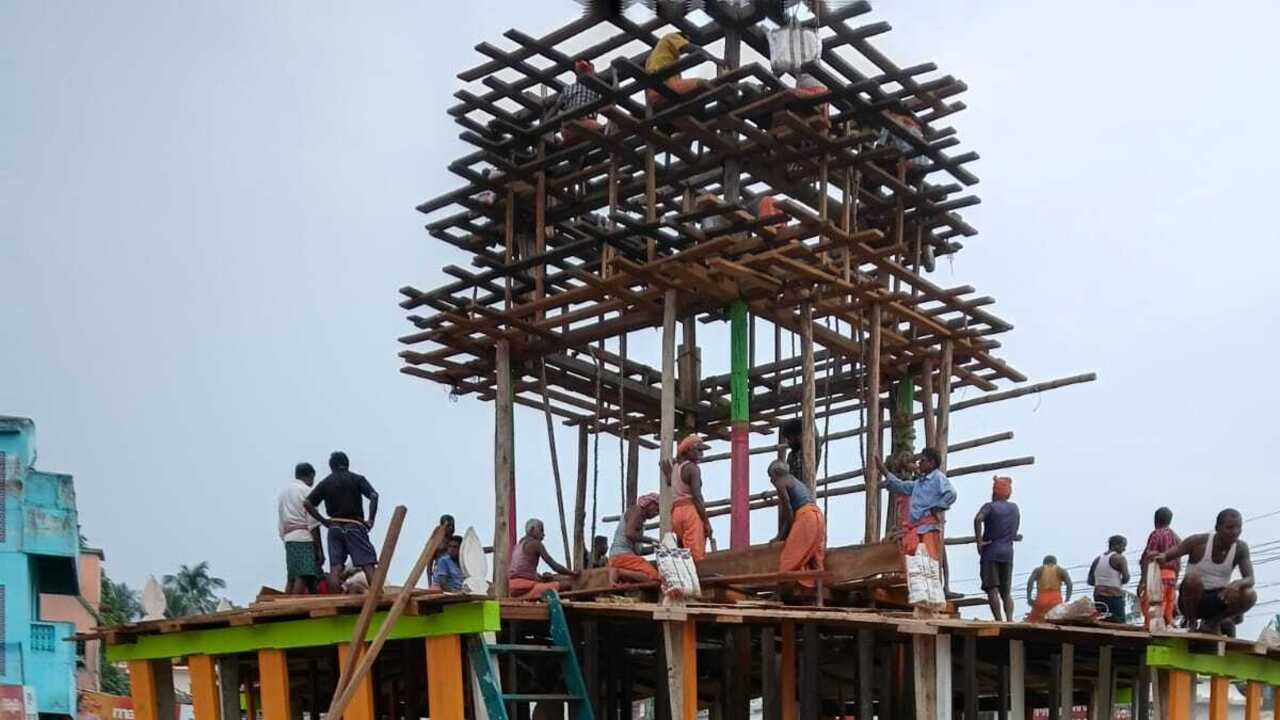
Kendrapada: Ahead of Rath Yatra on July 16, the administration of the centuries-old Baladevjew Temple in Kendrapada has modified the design of its chariot and upgraded the braking system to ensure its safe movement, following recommendations from the Indian Institute of Technology (IIT) Bhubaneswar.Balabhadra Patri, executive officer of the Baladevjew Temple, said the administration has implemented several recommendations made by IIT Bhubaneswar. “We have modified the 67-foot-tall Brahma Taladhwaja chariot’s design, upgraded its braking system, improved the geometry of the two-kilometre Grand Road and strengthened the drainage system to ensure a safe movement of the chariot during the Rath Yatra,” he said.Earlier, IIT Bhubaneswar had identified structural deficiencies in the wooden chariot of the famed Baladevjew Temple and recommended a series of engineering measures to ensure its safe movement. Following a comprehensive engineering assessment, IIT Bhubaneswar submitted both short- and long-term recommendations to the temple authorities, including structural stabilisation, conservation strategies and digital documentation of the chariot. “We have carried out a detailed engineering assessment of the chariot and proposed immediate stabilisation measures, a long-term conservation strategy and consultancy plan for digital documentation to ensure its safe journey,” said assistant professor Manas Ranjan Pattnayak of School of Mechanical Sciences, IIT-Bhubaneswar.The study was initiated after last year’s Rath Yatra, when cracks developed in some wheels of the chariot, causing it to tilt and delaying the procession. Following the incident, the temple management sought IIT Bhubaneswar’s technical expertise to improve the chariot’s structural stability.Pattnayak described the wooden chariot as one of Odisha’s finest examples of living cultural heritage, reflecting centuries-old indigenous knowledge of timber construction, traditional craftsmanship and structural engineering. Built every year by traditional artisans using age-old techniques, the chariot has never been comprehensively documented using modern engineering tools.The institute suggested using sandbags, wooden stoppers and dry sand during braking and turning the chariot; reinforcing the connection between the superstructure and base; modifying the rope anchorage system for improved load distribution; and enhancing the wheel-axle lubrication system among other things.Pattnayak said the temple is not only a place of worship but also a living repository of traditional knowledge in wood carving, temple architecture and ceremonial engineering. However, much of this indigenous expertise remains undocumented, making it vulnerable to gradual erosion due to changing socio-economic conditions and the lack of systematic engineering records.He stressed the need for preparing detailed computer-aided design models, engineering drawings, component catalogues, dimensional records and digital archives to preserve the traditional knowledge, facilitate scientific conservation and support future restoration work.Puri is known as ‘Shreekhetra’, whereas Kendrapada is famous as ‘Tulasi Khetra’, the abode of Lord Baladev, the elder brother of Lord Jagannath. The present Baladevjew Temple was built by the king of Kujang, Raja Gopal Sandha, during the Maratha rule in Odisha in 1761 at Ichapur locality within Kendrapada town.
The 67-foot-tall Brahma Taladhwaja chariot of centuries-old Baladevjew Temple in Kendrapada under construction
