


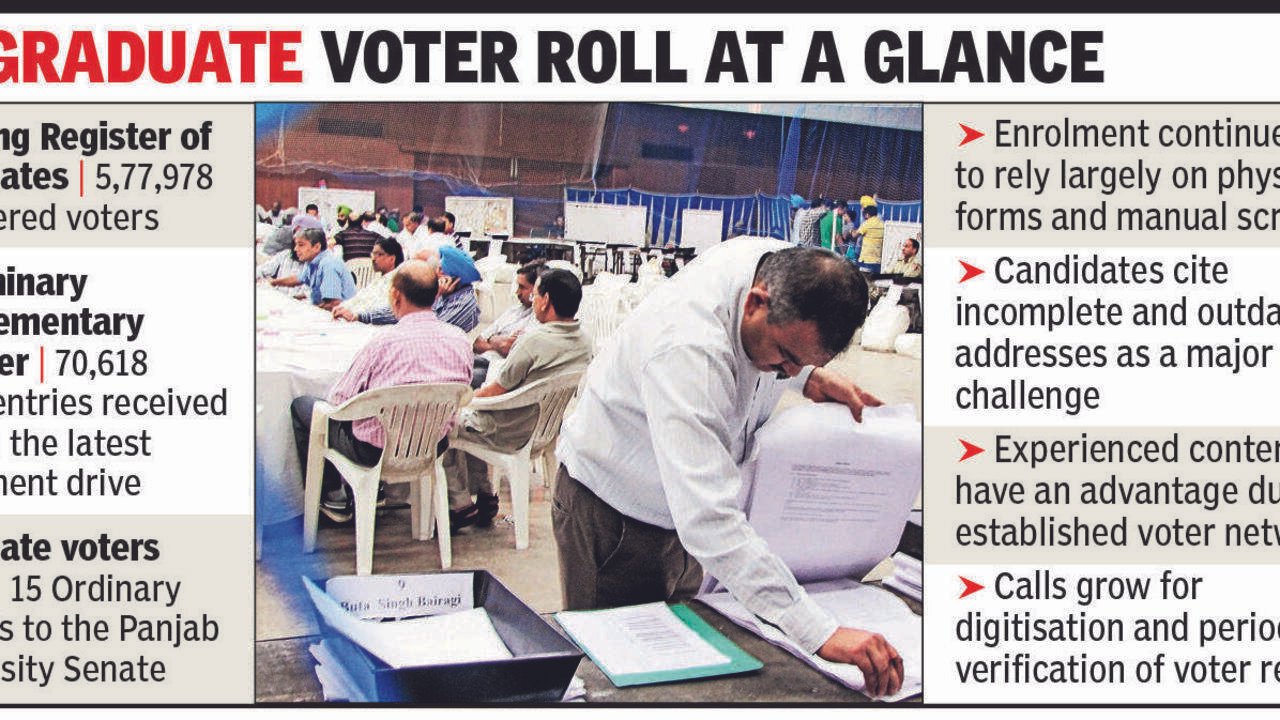
Chandigarh: As Panjab University prepares for its first Senate elections in nearly two years, renewed questions are being raised over its decades-old graduate voter registration system, which continues to depend largely on manual enrolment and paper-based verification.With 5,77,978 registered graduates already on the rolls and a preliminary supplementary register containing 70,618 fresh entries, candidates and election observers say the absence of a mechanism for periodic revision and verification has made maintenance of the electoral database increasingly difficult.Around 80 candidates are likely to contest the registered graduates’ constituency, making it one of the most closely watched segments in the Senate elections.The publication of the preliminary supplementary Register of Graduates, a key milestone in the election process, has again brought the accuracy of voter records under scrutiny. Candidates point to outdated addresses, difficulties in identifying deceased graduates and the lack of a streamlined digital platform to keep the rolls updated.The Senate elections, scheduled later this year, are being held after a prolonged period of uncertainty triggered by the Centre’s proposed amendments to the Panjab University Act, which sought changes in the composition of the university’s governing bodies. The proposals sparked protests from students, teachers, alumni and political parties before the election process resumed under the existing statutory framework.While the publication of the supplementary register has moved the electoral exercise into its final stages, candidates say building the graduate electorate remains one of the biggest challenges in contesting Senate elections.Unlike elections conducted by the Election Commission, registration of graduate voters at PU depends heavily on candidates and their teams identifying eligible graduates, persuading them to enrol, distributing forms, collecting photographs and documents, and ensuring applications are submitted before university scrutiny.“The registration exercise itself is a huge challenge because the graduate constituency is spread across Punjab, Haryana, Chandigarh and several other states. Unlike regular elections, there isn’t a ready digital database that candidates can simply access. You have to identify eligible graduates, reach out to them individually, collect documents and ensure their applications are submitted. It takes months of groundwork,” said Jodh Singh, a first-time contender from the registered graduates’ constituency.He said reaching registered voters during the campaign is equally challenging due to incomplete or outdated records.“Many entries carry old or incomplete addresses, while people have shifted over the years. In several cases, you have to trace voters through personal contacts. Those who have contested Senate elections earlier already have an established network of registered graduates and volunteers. A first-time candidate has to build that network from scratch, which naturally puts newcomers at a disadvantage,” he said.Ramanpreet Singh, another first-time contender, said candidates had suggested involving volunteers nominated by contesting panels in the verification process to make enrolment more efficient.“We had requested the university to engage volunteers from among the candidates who could assist in verification and help streamline the exercise. That would have reduced the burden on the Election Cell and improved the process. Ideally, the university itself should proactively facilitate registration of interested graduates instead of leaving much of the exercise to candidates. At present, it becomes an additional burden on contestants. The system should encourage greater voter participation, not make registration more cumbersome,” he said.Candidates also highlighted practical difficulties during campaigning. According to them, several entries contain only village names or localities without complete residential addresses, while many others continue to carry the addresses of colleges or institutions where enrolment camps were organised rather than current residences.They added that many graduates are reluctant to complete the registration process independently, leaving candidates and volunteers to handle much of the paperwork and documentation required for enrolment.A seasoned contender in the graduates’ constituency said the enrolment exercise itself demands considerable time and resources.“The registration fee is Rs 15 per graduate, besides Re 1 for the application form. In most cases, candidates or their supporters bear these costs because many graduates are unwilling to complete the process on their own. We spend months travelling, organising registration camps, collecting documents and getting forms submitted. The actual election campaign starts much later. First, you have to build the electorate,” he said.He added that the process tends to favour experienced candidates who already have established networks across districts.University officials maintain that publication of the preliminary supplementary register is a statutory requirement under the Panjab University Act. The register has been placed in the public domain to invite claims and objections before the final electoral roll is notified.With campaigning expected to intensify in the coming weeks, candidates across panels have called for comprehensive digitisation of the graduate registration process, easier updating of records and periodic verification of the database to improve the accuracy of electoral rolls and make the system more accessible to graduates spread across multiple states.
