


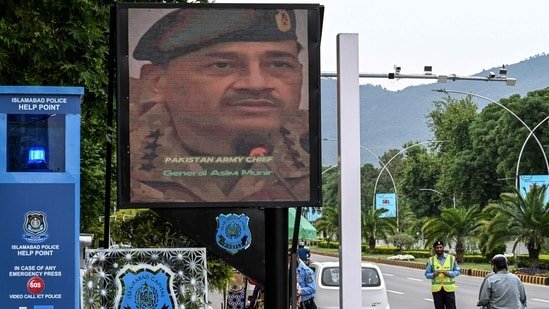
Pakistan has constituted a high-level committee on population management that includes Field Marshal Asim Munir, expanding the military chief’s role into another area of public policy as the country grapples with one of the fastest population growth rates in South Asia.

The development was announced by Pakistan’s health minister Syed Mustafa Kamal during a joint meeting of the Senate Standing Committee on National Health Services and the Senate Functional Committee on Human Rights, newspaper Dawn reported. Kamal reportedly told lawmakers that Prime Minister Shehbaz Sharif had convened several high-level meetings on population management and constituted a committee to address the issue.
Besides Munir, the committee includes finance minister Muhammad Aurangzeb and planning minister Ahsan Iqbal.
“The government is treating this issue with the highest priority and important policy decisions are being taken at every level,” Kamal told the parliamentary panel, according to Dawn.
Pak’s concern
The move underscores Islamabad’s concern over rapid population growth at a time when the country is trying to stabilise its economy after years of financial stress and repeated International Monetary Fund (IMF) bailouts.
Pakistan, the world’s fifth most populous country, recorded a population of about 241.5 million in its 2023 digital census, with an annual growth rate of 2.55%. Government officials have warned that, if current trends continue, the country could become the world’s fourth most populous nation by the end of the decade.
During the Senate committee meeting, Kamal said Pakistan records around 6.7 million births every year and argued that greater access to family planning services could reduce annual population growth by about 1.5 million people.
He also blamed the existing National Finance Commission (NFC) Award formula — which allocates 82% of federal resource distribution based on population — for creating an incentive for provinces to maintain higher population growth. He suggested reducing the population component in the formula to 50%.
The minister cited the limited availability of contraceptives as one of the factors contributing to high birth rates and said tax exemptions had been granted on contraceptive products, Dawn further reported.
Representatives of the Council of Islamic Ideology told the meeting there was no sectarian disagreement over measures to address rapid population growth, according to the report.
Population welfare became a provincial subject after Pakistan’s 18th Constitutional Amendment, prompting lawmakers at the meeting to question how the federal government planned to implement any new policy. Officials from the Ministry of Law reportedly said Parliament could not legislate on subjects exclusively devolved to provinces, following which the committee called for consultations among legal experts, religious scholars and parliamentary bodies.
Munir’s inclusion in the committee comes amid his steadily expanding role in Pakistan’s policymaking architecture.
Appointed army chief in November 2022 as General, Munir was elevated to the rank of Field Marshal after the India-Pakistan military conflict in 2025. Later that year, Pakistan, which has a history of direct military rule, created the post of Chief of Defence Forces, making Munir the country’s first holder of the office with unified command over the armed forces.
Munir’s profile rises and rises
Beyond his military responsibilities, Munir is also a member of the Special Investment Facilitation Council (SIFC), a civil-military body set up to fast-track investment proposals and coordinate economic decision-making. His participation in the newly constituted population management committee adds another policy domain to the list of government bodies on which he serves.
It remains unclear when the population committee will submit its recommendations.
Munir’s international profile has also grown over the past year.
During the US-Iran conflict earlier this year, Pakistan positioned itself as a mediator between Washington and Tehran. US President Donald Trump publicly credited Prime Minister Shehbaz Sharif and Munir with helping persuade him to pause planned military action and back a ceasefire, while later saying Pakistan had played an important role in efforts to advance negotiations with Iran.
Trump has repeatedly praised Munir, including describing him as his “favourite field marshal”, underscoring the unusually warm rapport the Pakistani army chief has developed with the US president.
