


Ace long jumper M. Sreeshankar recently said that the Asian Games was ‘bigger than the Olympics’ for Indians because the country collects a lot of medals at the continental event and the athletes receive handsome cash awards for the medals they win.
Understandably, the push from athletes to book their spots in the Aichi-Nagoya Asiad-bound squad through the only selection-trials event — the National Inter-State Athletics Championships in Bhubaneswar last month — was nothing less than spectacular.
Staging a surprise
Amid the fall of long-standing National records, the breaking of psychological barriers, and scores of personal bests, two unheralded women — 18-year-old hammer thrower Anushka Yadav and 25-year-old pole vaulter Sindhushree G. — surprised many by recording unexpected National marks and earning the right to make their Asian Games debuts.
Their journeys are different, yet interesting.
Influenced by her father Sushil, a local-level hammer thrower and farmer from Baleni village in the Baghpat district of Uttar Pradesh, Anushka took to athletics at the age of 12.
“My father used to train my younger brother with a hammer. My first choice was the 100m. I did it for six-seven months. Hammer was my father’s choice, which is why I began throwing,” says Anushka, who learnt her first lessons at the Sri Krishna Inter-College ground.
Apart from her father’s guidance, Anushka prospered while working alongside other hammer throwers under the tutelage of coaches Chirag Yadav and Gagan Yadav.
Anushka Yadav bettered Sarita Singh’s nine-year-old National record in the hammer throw, a stunning achievement for a teenager.
| Photo Credit:
Biswaranjan Rout
Anushka, who had a throw of 56.63m at the Junior Federation Meet in 2024, made her mark at the junior level before showing significant improvement to achieve a personal best of 62.89m at the National Games in Dehradun and create an under-20 National record in February last year.
She injured her knee in a freak accident earlier this year when her brother playfully pushed her while she was attaching the tiller to the tractor to help her father in the field. She made a comeback with a performance of 58.02m at the Junior Federation meet in April and registered 62.50m with only two athletes in the field in the under-20 section at the Indian Athletics Series in Ludhiana in June.
Her 67.02m in Bhubaneswar was stunning. She bettered Sarita Singh’s nine-year-old National record twice that evening and ensured an Asiad berth by improving her personal best by more than four metres.
In a highly competitive field monopolised by Chinese throwers, Anushka’s performance stands 12th in Asia this season. Considering that every country can field two athletes in an event, Anushka’s mark places her sixth, behind Chinese, Japanese and Taipei throwers.
Sushil, who quit athletics due to family compulsions, has bigger expectations from his daughter. “Anushka used to throw up to 71m in training prior to her injury. Now she does 70m. We had a target of 70m here. I knew when she would be fine, she would do a big one,” says Sushil. “The best thing about Anushka is that she competes with a calm mind. She is not far away from 70m.”
Sushil will keenly follow his daughter’s progress as Anushka has another important test — the World Under-20 Championships, for which she also achieved qualification in Bhubaneswar — in Eugene, Oregon, USA, from August 5 to 9, ahead of the Asian Games from September 19 to October 4.
A father’s dream
Like Anushka, Sindhushree, a quarter-miler turned pole vaulter, also stepped into the athletics arena because of her father’s strong backing. But she tragically lost her electrician father, R. Ganesh, six years ago, even before she could wear the India jersey.
“As I am a girl, my family had apprehensions when I began athletics. But my father fought with everybody. He used to wake me up every morning, make me train. I progressed to get inducted into the Sports Authority of India (SAI) centre in Bengaluru in 2016. His dream was to see me wear India colours, but he left us before that — even before I got selected for the World University Games in 2022,” says the 25-year-old Sindhushree.
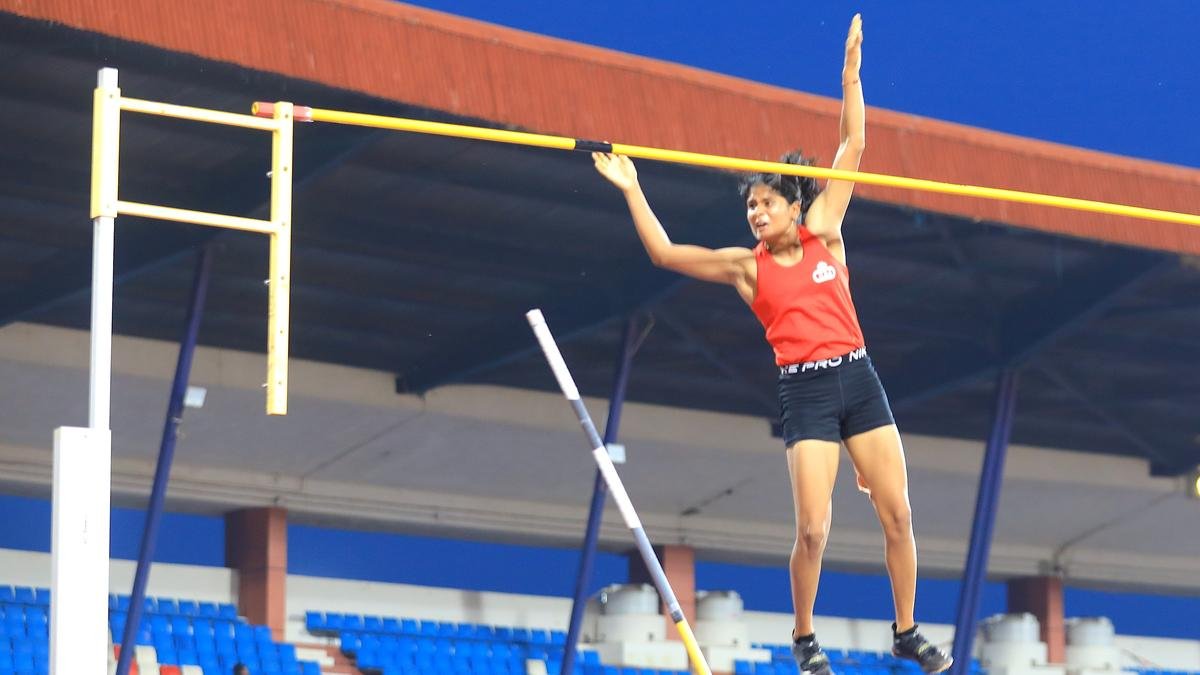
She proudly held a passport-sized photograph of her father after rewriting the National mark with 4.25m by surpassing the accomplished Baranica Elangovan’s mark by two cm.
It was because of the support of her grandfather Krishnappa that Sindhushree could pursue athletics without having to shoulder the responsibility of providing for her mother and younger sister.
But Sindhushree could not purchase a pole of her own due to a lack of funds. For the Bhubaneswar event, she borrowed a pole from a male trainee who had bought a shorter pole meant for women by mistake, and trained for two weeks before surprising everyone. After recording a noticeable improvement on her previous personal best of 4.00m achieved at May’s Indian Open Series in Chennai, she was overwhelmed with emotion and fell at the feet of her coach Vijeesh M.M. to express her gratitude.
Vijeesh had to keep Sindhushree’s short stature (156cm), hamstring injury last year, and financial condition in mind while training her, after she could not make it to SAI’s National Centre of Excellence (NCOE) scheme due to her below-par performances.
“We didn’t expect this kind of height. We are constantly trying to perfect her technique as we don’t have a pole… Now her run-up and jump are almost perfect. Maybe she can do 4.30-4.35m with the right kind of support, including diet and nutrition,” says Vijeesh, adding that ‘patience, hard work and dedication’ were the biggest positives of his trainee.
Her new mark has put Sindhushree in joint-sixth position in Asia this season, also joint-sixth if you consider the quota of two athletes per country in an event at the Asian Games.
As these two new champions nurture hopes of raising their performances in the continental extravaganza in a few months’ time, athletics lovers in the country would do well to be realistic while setting the bar for their expectations.
From an overall perspective, the powers that be in the Athletics Federation of India (AFI), Sports Ministry, and SAI must be cautious while anticipating podium finishes at the Asian Games and Commonwealth Games.
Scores of athletes across different sports, with athletics leading the chart, testing positive for banned substances has brought India the dubious distinction of being number one in this field for three consecutive years. Besides, India continued to lead the Athletics Integrity Unit (AIU) charts for June 2026 with 162 globally ineligible athletes and coaches.
Needed: constant vigilance
The National Anti-Doping Agency (NADA) is understood to have been focusing on athletics as far as testing is concerned in the run-up to mega events this year. It would do well to stay vigilant and hunt down erring athletes and support staff in order to deter them from taking short-cuts to success.
Even as the temptation of winning medals and cash awards will continue to test athletes’ honesty prior to big events, stricter anti-doping measures will save the country further embarrassment and help create a much-needed environment for clean competition.
