


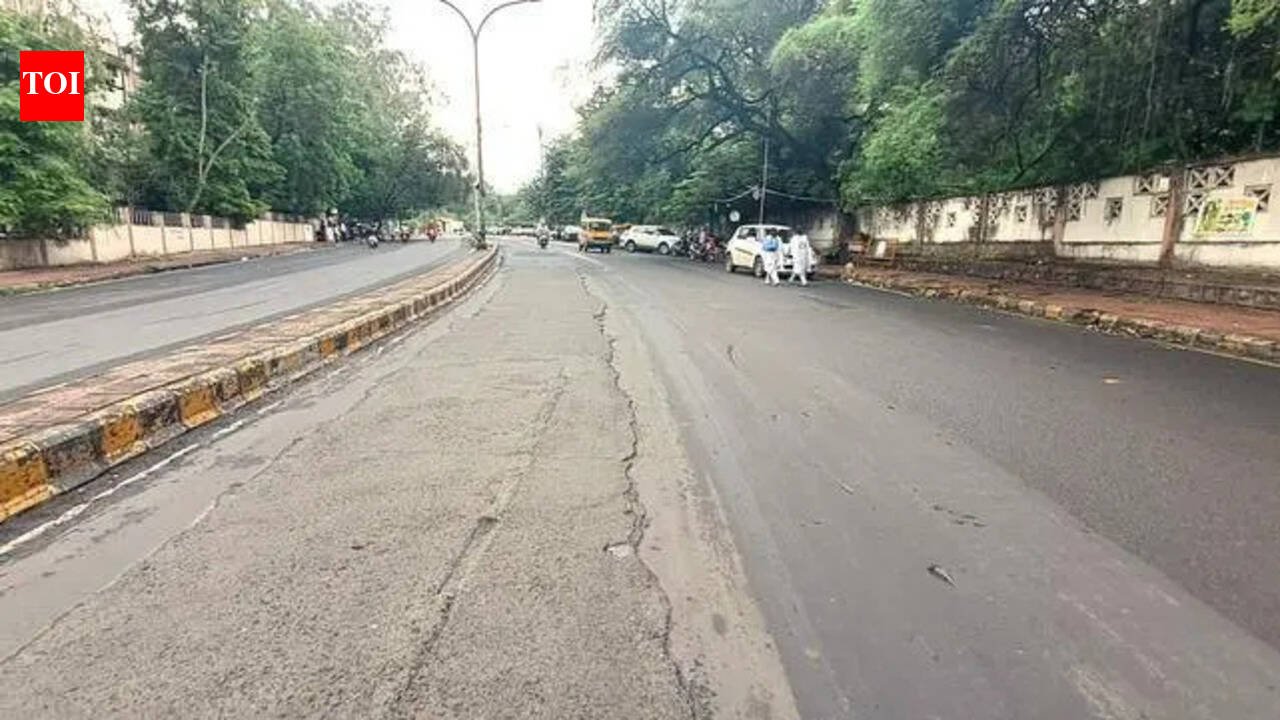
Nagpur: Widespread violations of a Standard Operating Procedure (SOP), prepared by the Visvesvaraya National Institute of Technology (VNIT) to ensure scientific restoration of excavated roads, have left motorists negotiating uneven, damaged and unsafe roads across large parts of the city.VNIT drafted the SOP during the tenure of then municipal commissioner Abhijeet Chaudhari to restore roads excavated for the 900-crore Pohra River Pollution Abatement (South Sewerage) Project to their original condition. Chaudhari directed the SOP be implemented on NMC-owned roads.Based on Indian Roads Congress (IRC) guidelines and incorporated into the project tender, the SOP prescribes every stage of restoration — from trench excavation and layer-wise backfilling to compaction, curing and restoration using the same pavement type as the original road. It also mandates geo-tagged photographs at five stages, multi-level inspections and approvals before contractors’ bills are cleared.However, the ground reality is starkly different.Across several stretches in the South and South-West Assembly constituencies, bituminous (tar) roads have been restored with cement concrete, while concrete roads have been patched with bitumen, in complete violation of the prescribed norms. A TOI survey found several such stretches in Pratap Nagar, Telecom Nagar, Narendra Nagar and adjoining localities, where the repaired portions stand at different levels from the original carriageway.Instead of restoring smooth roads, the repairs have created raised concrete strips, sunken patches and uneven joints. In many places, the restored stretches have cracked or settled within months, making the roads hazardous, particularly for two-wheeler riders. Residents say minor accidents and skidding have become common on these uneven surfaces.The faulty restoration has also narrowed the usable carriageway at several locations. Motorists are often forced to avoid elevated or depressed patches, reducing the effective width of the road and creating traffic bottlenecks.The SOP leaves little room for ambiguity. It mandates that tar roads be restored with 250mm Granular Sub Base (GSB), 150mm Wet Mix Macadam (WMM) and a 70mm bituminous layer, while concrete roads must be reconstructed with GSB, Dry Lean Concrete (DLC) and M-40 Pavement Quality Concrete (PQC) matching the original thickness. It further requires compaction exceeding 95%, mandatory curing, dust suppression, continuous barricading and stage-wise verification by the Project Management Consultant (PMC) before work progresses.More importantly, the SOP fixes accountability at every level. Contractors, PMC officials, junior engineers, executive engineers and even the superintending engineer have defined verification responsibilities before payments are approved.Yet, the recurring failures have raised serious questions over whether these inspections were actually carried out or merely certified on paper.During Chaudhari’s tenure, contractors executing sewerage works were penalised for substandard restoration. Despite that precedent, enforcement appears to have weakened, with visible deviations continuing across the city. The Nagpur Municipal Corporation earlier admitted to poor restoration quality.As restored roads continue to cave in, crack and deteriorate prematurely, questions are being raised on engineering supervision, contractor accountability and whether public money is being spent without ensuring lasting quality.INFOBOXWHAT VNIT SOP PRESCRIBESRestore roads using the same pavement type as the original road.Layer-wise backfilling with maximum 250 mm compacted layers.Achieve minimum 95% compaction before proceeding.Mandatory 10-day settlement period before final restoration.Tar roads: 250 mm GSB + 150 mm WMM + 70 mm bituminous layer.Concrete roads: GSB + DLC + M-40 PQC matching original thickness.Five geo-tagged, time-stamped photographs mandatory for every chainage.Bills to be cleared only after verification by Contractor, PMC, JE, Executive Engineer and Superintending Engineer.Deviations liable for rejection of work, penalties and rework at contractor’s cost.
