


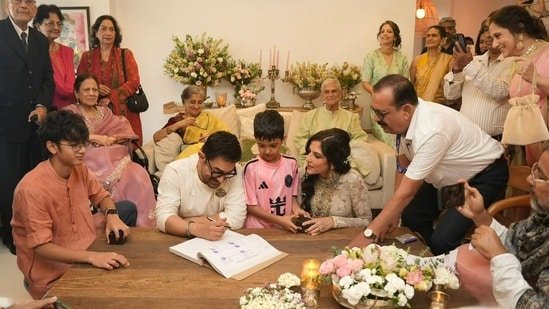
Aamir Khan and Gauri Spratt‘s wedding was intimate and understated, celebrated at home surrounded by close friends and family. The couple tied the knot in elegant monsoon looks, with Aamir in a white kurta set with a brooch and Gauri Spratt in a muted lehenga set with intricate detailing.

While the wedding stayed away from the characteristic celebrity spectacle, with no star-studded guest list or extravagant venue, one thing was definitely not low-key: the ring Gauri Spratt wore. Aamir Khan chose a natural ruby ring for the wedding, and QWEEN crafted it.
Let’s see how long it takes to make this and other details which make the ring majestic in its design and value.
How long did it take to make the ring?
The first spotlight falls on the natural ruby, which silently lends a regal quality to the ring. Sourcing the stone was an arduous process, adding to its elevated exclusivity.
Amit Kumar, co-founder and CEO of QWEEN, shared the timeline with HT Lifestyle and revealed the rarity of the ring, further reinforcing its grandeur. He said, “It took more than 3 months to source the Ruby, taking 256 hours by karigars. 131 pairs of skilled hands. This is a Madagascar ruby, which is rarer than 1 in a million. The wedding ring is designed to look, quite literally, like royalty.”
Now, after the rare ruby was sourced, the making of the ring was just as elaborate and time-consuming. The craftsmanship focused on the bigger picture, of going beyond a regular wedding band, but as a couture-like heirloom piece that could be handed down through generations.
“Set in a prong setting, the ring required over 256 hours of craftsmanship, from design development to setting and finishing, before being completed by QWEEN’s 131 pairs of masterful hands,” Amit added.
Amit also shared that this was the intention right from the beginning of the design process: to create something that did not look as if it had been ‘picked off a shelf.’ With extensive handiwork, every detail of the ring carried a sophisticated sense of style.
How was the ring designed?
What makes the ring truly stand out is that it takes a sharp departure from a conventional gemstone setting or a simple band. Amit described that the ruby does not sit directly on a plain band. Instead, the design takes a regal route, with the ruby placed inside a crown-like gold setting, making it look as though the jewel is being held and protected like a royal crown.
Further, Amit also mentioned how the ruby has been cut and polished. The ruby has been given a cabochon cut, which means it is polished into a smooth, domed surface instead of being faceted. This gives the ruby a rich, glowing colour, with the shade appearing to move or shift slightly, almost as if the stone is glowing from within.
The other details of the ring are just as majestic, as he shared, “The ruby is held by a scalloped gold gallery that peaks into points around the stone, echoing the shape of an actual crown, then drops into a band of fine milgrain beading, the kind of hand-finished detailing that historically marked coronation and heirloom jewellery. Turned on its side, the ring has the unmistakable silhouette of a bombé signet, high-domed, weighty, built to be noticed.”
Every aspect of the ring’s design process is rooted in heirloom-style grandeur, making the wedding ring one of a kind with its unmistakably royal detailing and rare craftsmanship.
