


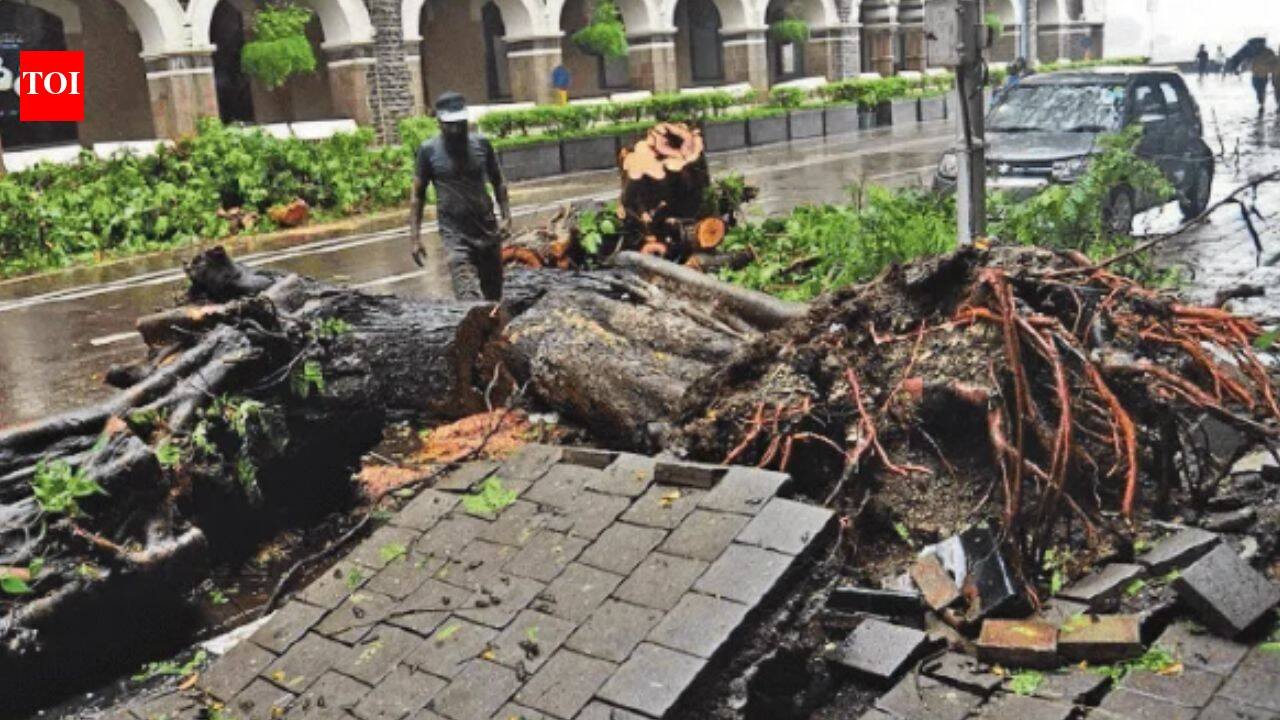
MUMBAI: Barely a fortnight into the monsoon, Mumbai has lost 826 trees—59 every day, or more than two every hour—highlighting the growing danger posed by ageing trees, infrastructure works and unusually strong monsoon winds.Even before monsoon diseases peak, Mumbai is grappling with another public safety crisis: falling trees. The problem seems acute this year compared to 2025, when 855 tree falls were recorded throughout the monsoon. In 2023 and 2024, BMC recorded 687 and 653 tree falls, respectively.In the first fortnight of rains (June 22-July 5), 305 trees on civic land and 521 on private properties fell or were uprooted. In the same period, another 1,223 tree branches crashed across the city.
The crashes have already claimed three lives, including 11-year-old Vihaan Srivastava, who passed away on June 30 when a tree crashed onto his school van in Chembur. Two deaths were reported in the July 4-5 period.A BMC official said the preliminary inquiry into the fatal Chembur tree collapse suggested that excavation during road works may have damaged structural roots on one side of the tree. “This may have triggered internal decay that could not have been detected during routine visual inspections,” he said. With the tree dependent on roots on the opposite side for support, heavy rains and strong winds could have led to its collapse, he added.The BMC’s disaster management cell received 1,124 complaints of fallen trees and branches between June 30 and July 6. This includes 336 complaints from the island city, 340 from the eastern suburbs and 448 from the western suburbs. The numbers climbed steadily through the week before spiking to 523 complaints on July 6 alone—more than three times the previous day’s tally —as wind gusts reached 77 kmph, among the strongest recorded this monsoon.Botanist Suchandra Dutta, professor at R D National College in Bandra and founding director of Green Neev Foundation, said the increase in tree falls cannot be blamed on the monsoon alone.“Pre-monsoon tree pruning is carried out every year, but it’s often not done scientifically. At the same time, road concretisation and repeated excavation around trees weaken their root systems,” he said. Trees need adequate open soil for their roots to grow, but in many places the area around the trunk is completely concretised. “During infrastructure work, roots are often exposed and left unprotected, making trees highly vulnerable to collapse,” said Dutta.Improper pruning also creates an imbalance, with trees becoming top-heavy or lopsided. “If urban planning genuinely factored in environmental concerns, protecting existing trees would be a priority. Infrastructure work should be carried out in consultation with experts so that root systems are not damaged and unnecessary digging around trees is avoided,” Dutta added.Two decades ago, Singapore reported over 3,000 tree and branch failures a year, some of them fatal. Today, following scientific pruning, risk assessment and continuous monitoring, the annual number has fallen to around 300. In parts of Australia, tree failures leading to falling branches are recognised as a major problem, though “loss of human lives is low”.(Inputs by Malathy Iyer)
