


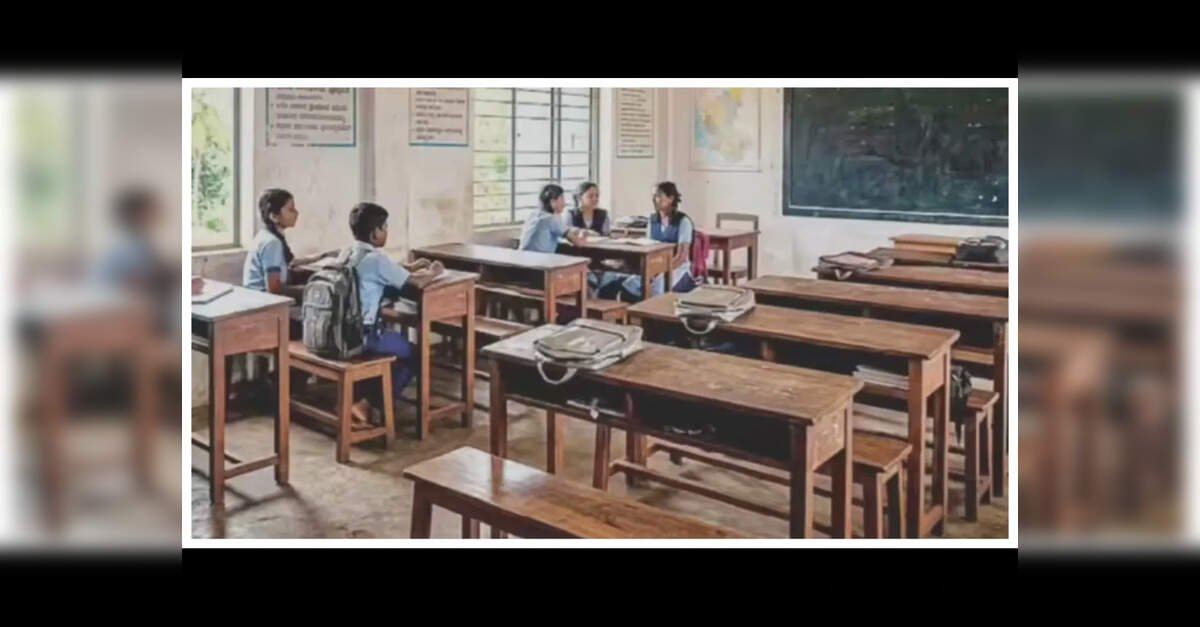
Since June 1, government primary schools in Dakshina Kannada have been running Kannada-English bilingual sections for Classes 1 to 5, extended this year to all 896 government primary schools in the district. Over 1,540 teachers completed dedicated training between March and April, and bilingual textbooks for Mathematics and Environmental Studies were distributed ahead of the academic year.
Read on its own, this looks like the latest round in India’s language debate. Read against the state’s own numbers, it looks like something else: an attempt to change where parents choose to send their children.
Karnataka’s Education Minister, Madhu Bangarappa, told the state Legislative Assembly in December that government school enrolment has fallen by roughly 17 lakh students over the past 15 years. He cited parental preference for English medium, growing interest in CBSE and ICSE over the state syllabus, unchecked private-school expansion, and internal migration, as families move toward cities. That last reason matters: some of the enrolment loss is families relocating, not rejecting the school down the road. In response, Karnataka has launched a statewide enrolment campaign (November 2025–June 2026), is expanding the Karnataka Public School (KPS) model, and has rolled out bilingual instruction well beyond Dakshina Kannada.Karnataka isn’t alone. Andhra Pradesh, Telangana and Delhi are running their own versions of the same bet at the state level; the Centre’s PM SHRI scheme is a similar wager nationally. The three state programmes are worth a closer look, later in this story.
The data says why this matters
India has roughly 14.72 lakh schools, employing over 98 lakh teachers and enrolling close to 24.8 crore students, per the Ministry of Education’s UDISE+ 2023-24 report. Within that total, the government network is shrinking while private unaided schools hold their ground.
| Metric | 2020-21 | 2024-25 / Latest |
|---|---|---|
| Government schools (national) | 10.32 lakh | 10.13 lakh (down ~18,700) |
| Private unaided schools (national) | 3.41 lakh | 3.40 lakh |
| Govt. schools with fewer than 10 students | n/a | 65,000+ (2024-25) |
| Govt. schools with zero enrolment | n/a | 5,149 (up 24% in two years) |
| Private unaided share of national enrolment | n/a | 34.4% (2023-24) |
| Government school enrolment, single-year change | n/a | down ~5.9 lakh in 2024-25 alone (~4.6%) |
| Private-unaided enrolment, single-year change | n/a | up ~5.8 lakh in 2024-25 |
Sources: Rajya Sabha reply to CPI(M) MP John Brittas; Lok Sabha reply to MPs Karti Chidambaram and Amrinder Singh Raja Warring; Ministry of Education, UDISE+ 2024-25.Responding in the Rajya Sabha, Minister of State for Education Jayant Chaudhary noted that school opening, closure and rationalisation fall under states’ jurisdiction, since education is a Concurrent List subject. Separately, over 70% of India’s zero-enrolment government schools are concentrated in Telangana and West Bengal, and the government sector lost close to 77,000 schools between 2017-18 and 2023-24 through closures and mergers.
None of this data says why parents are leaving. Some of it isn’t parents leaving at all: UDISE+ analysts have flagged India’s declining fertility rate, now near replacement level, as a separate driver of falling school-age enrolment. A shrinking pool of children thins both sectors; it doesn’t explain why the private sector is thinning more slowly. Untangling how much of the decline is demographic versus competitive would need sector-wise enrolment trends that UDISE+ doesn’t cleanly provide at the state level. That’s a limitation of this story, not a settled answer.
Telangana appears twice here: as a state actively expanding English-medium instruction and teacher training, and, per the zero-enrolment figure above, as one of the two states carrying most of it. Both are true at once. It may mean the reform is too recent to show up, or that it hasn’t reached the schools actually emptying out. This piece flags that rather than resolving it.
What the aggregate data can’t answer is why an individual parent picks one school over another. That has to come from parents themselves.
The aspiration gap
For years, the default government response was infrastructure: classrooms, functional toilets, drinking water, computer labs. Karnataka alone has committed ₹838.75 crore under Samagra Shikshana Karnataka for classroom upgrades and furniture, and set up computer labs in over 5,400 primary and high schools in 2024-25.
Parents notice the difference, but say it isn’t the deciding factor anymore. ET Education spoke to parents across six cities in three states for this story; their names have been changed to protect their privacy, and their locations retained.
“Government schools have improved significantly in terms of infrastructure. The classrooms and facilities are much better than before. Our concern is whether the quality of teaching, especially English, can match what private schools provide, ” said Ramesh Gowda, a parent from Mysuru.
Another parent, Anita Shetty, Mangaluru says: “We always believed a private school would give our son more opportunities because of the environment and stronger English exposure. But if a government school can genuinely offer good English teaching along with quality education, we’d definitely consider it. The money we save on fees could be invested in his higher education.
Parents are increasingly asking a different set of questions: Can my child speak confidently in English? Will the school prepare them for college? Will their classmates push them academically? Are teachers reliably present? A renovated building doesn’t answer any of that.
Why Karnataka chose bilingual
Karnataka’s bilingual push is best read as an attempt to close that gap without abandoning the state’s other commitment: to Kannada. Bilingual pre-primary sections were introduced gradually from 2018 onward and now run in 6,675 government schools; bilingual instruction for Classes 1 to 5 has scaled to 9,522 schools statewide. A parallel initiative is introducing Urdu-English bilingual sections across 15 districts this academic year.
“We speak Kannada at home and want our daughter to stay rooted in our language and culture. But we also know that English is essential for college and employment. If government schools can help children become confident in both languages, that’s the best option,” said Shilpa Kulkarni, parent, Anekal, Bengaluru Rural.
Alongside this, Karnataka has built 309 Karnataka Public Schools (pre-primary through pre-university on one campus), with 900 more slated for upgrade this year. The state has been explicit in Assembly proceedings that these reforms respond directly to the enrolment numbers.
Anubha Shrivastava Sahai, Supreme Court advocate and president of the India Wide Parents Association, is blunt about the gap between policy and practice: “Laws are in place for providing quality education, but implementation is not happening,” she says. Her suggestion is specific: states could tie up with Kendriya Vidyalayas and IITs to raise quality, but that alone won’t be enough. “Monitoring of teachers is a must, then only it will help, else it will be just an eyewash.” She also wants parents built into implementation as stakeholders, not informed after the fact.
Other States, a Closer Look
| State/Centre | Reform | What’s established | What isn’t |
|---|---|---|---|
| Andhra Pradesh | Nadu-Nedu | Best-documented of the three; enrolment rose by roughly 7 lakh between 2018-19 and 2021-22 | Figure predates the 2024 government change. A June 2026 opposition-commissioned governance audit alleges enrolment has since declined and Nadu-Nedu has been discontinued (an unverified, partisan claim, not independent data) |
| Telangana | English-medium expansion, teacher training | Real and ongoing | Sits next to the state’s own concentration of zero-enrolment schools, noted above |
| Delhi | Schools of Excellence | Narrower model, concentrated investment in fewer schools | Structurally different, harder to compare on the same enrolment metrics |
PM SHRI, the Centre’s equivalent scheme, sits outside the scope of this comparison.
“A few years ago, we would never have considered a government school. Today, the infrastructure has improved noticeably. If bilingual education is implemented well and teachers are adequately trained, many middle-income families will think differently, ” Suresh Reddy, a parent from Hyderabad, told ETEducation.
“English isn’t about prestige for us; it’s about giving our daughter more choices in the future. At the same time, we don’t want her to lose Telugu. A school that can teach both effectively is what most parents are looking for,” says Lakshmi Devi, parent, Vijayawada.
None of that invalidates the shared underlying goal: making a government school one parents choose rather than settle for. It does mean the goal is currently better documented as an intention than as a result. It’s also worth noting these parent voices are drawn from Karnataka, Telangana and Andhra Pradesh. Nobody was interviewed in Delhi or a PM SHRI state, so the reporting speaks to the bilingual/English-medium strand of this story, not the full comparative picture.
Will it work?
The honest answer, on the evidence gathered here, is that it’s too early to say. Karnataka’s own numbers show enrolment still falling through the years these reforms have rolled out: for the 2025-26 academic year, private schools recorded 1.68 lakh more Class 1 enrolments than government schools statewide, even as the bilingual rollout was underway. The national numbers show the same direction: government enrolment fell roughly 4.6% in 2024-25 alone, while private-unaided schools gained. No state in this piece has produced current, independently verifiable evidence that bilingual education, English-medium instruction, or infrastructure upgrades have reversed the flow of students out of government schools. That doesn’t mean the reforms are failing; the evidence simply isn’t sufficient to conclude success or failure either way.
A government primary school teacher in coastal Karnataka, who requested anonymity because they were not authorised to speak to the media, said parents’ expectations have changed significantly over the past few years. “Earlier, parents mostly asked about classrooms, toilets or whether midday meals were running smoothly. Now the first question is usually whether their children will learn English well. Infrastructure has improved in many government schools, but parents also want confidence that teaching standards match what they believe private schools offer,” the teacher said.
While a parent from Warangal, Rahul Naik stated that private schools still enjoy a stronger reputation because parents feel the peer group is more competitive and discipline is better. Government schools have reduced the infrastructure gap, but they now need to build the same level of trust in learning outcomes.
That trust gap is exactly what the reporting keeps surfacing. Karnataka, like most states, still has unfilled teacher vacancies, and many rural schools run multi-grade classrooms where one teacher handles several grades at once. A five-day training programme, however well-run, is a starting point, not a substitute for sustained coaching. Absent that follow-through, bilingual education risks becoming a credible-looking announcement without a credible-feeling classroom.
The affordability angle several parents raised, weighing fees against a government school’s improving offer, is the frame Sahai starts from too. “It’s the responsibility of every state to provide quality and affordable education to all,” she says, pointing to Kendriya Vidyalayas and Navodaya Vidyalayas as proof it can be done. “But as far as state boards are concerned, we don’t have good quality of education in state board schools.” That’s the crux of the calculation Anita Shetty and Suresh Reddy are both making, several sections back: whether a state-board government school can close the gap before it’s worth paying private fees to avoid it. If a state falls short, Sahai’s answer on recourse is direct: parents can approach the state education department or the child rights commission. Very few know that channel exists, which is its own kind of gap between what states are building and what they’re communicating.
Conclusion
For decades, government schools competed with private schools mainly on price. That competition has shifted. Karnataka’s bilingual classrooms aren’t really about Kannada versus English; they’re one state’s answer to a harder question several states are now asking in parallel: can the government convince a parent who can afford to leave that staying is still the better bet?
Government schools once competed on affordability; today they compete on aspiration. Buildings can be improved. Winning back parents may be the hardest reform of all.
