


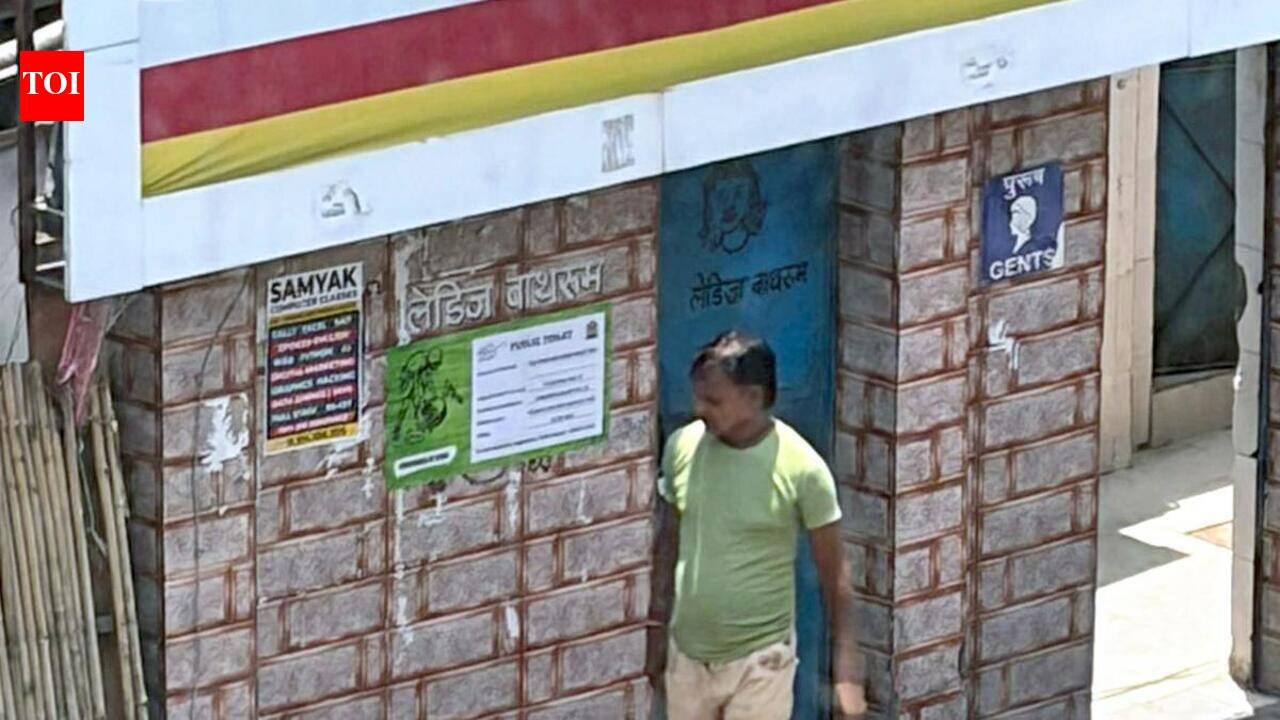
New Delhi: Almost no challan for urination and spitting in plublic places has been issued across most of Delhi in the past five years, despite these being offences under municipal laws.The city’s streets, however, tell a different story — urine trickles from public toilets onto roads, walls are stained with spit, public urinals are in ruins, toilets remain locked and women are often directed to nearby petrol pumps to use washrooms.A review of the data obtained by TOI from Municipal Corporation of Delhi (MCD) and New Delhi Municipal Council (NDMC), coupled with an on-ground look at public sanitation facilities, reveals a striking disconnect.MCD has no record of enforcing penalties in most zones, while the infrastructure that should encourage good sanitation practices is in a state of neglect.MCD records show that only Shahdara North issued challans against urination and spitting in public places in the last five years. There are 224 challans for urination in public places and 156 for spitting.Every other MCD zone — central, Karol Bagh, Civil Lines, south, west, Keshav Puram, Narela, Rohini and Najafgarh — reported nil enforcement in the last fibe years.In contrast, NDMC has issued 11,534 challans for littering between 2020-21 and 2026-27, imposing penalties amounting to Rs 5.76 lakh. Of this, Rs 4.38 lakh was recovered through 8,770 challans.The data shows that NDMC issued 395 challans in 2020-21, 75 in 2021-22, 4,859 in 2022-23, 3,000 in 2023-24, 2,130 in 2024-25, 920 in 2025-26 and 155 till now in 2026.NDMC imposes a penalty of Rs 500 for urination or defecation in a public place, and Rs 1,000 for spitting in a public space. Officers and field functionaries of public health, sanitation and other departments are empowered to act against such violations. In areas under MCD, however, the legal framework differs. Under directions of National Green Tribunal, a fine of Rs 5,000 can be imposed for urinating in a public place, spitting or littering. However, under the Delhi Municipal Corporation Act, 1957, the penalty for urination in public is Rs 50. The proposed Jan Vishwas (Amendment of Provisions) Bill, 2026, seeks to increase this fine to Rs 500.The condition of sanitation infrastructure presents another aspect of the problem.On Friday, this reporter found that most public toilets in the NDMC area appeared clean and well maintained. However, a few facilities at prominent locations, such as the National Science Centre and the Crafts Museum in New Delhi, were locked.The condition of several MCD-managed toilets was far from satisfactory, though.Behind the MCD Civic Centre, a public urinal was in a dilapidated state. The structure had large cracks, and sections of concrete had fallen off, exposing rusted reinforcement bars. The roof appeared damaged and partially detached. Plants have sprouted over the structure. The entrance door did not work, and the walls and floor inside were stained with grime, indicating poor maintenance and infrequent cleaning. Despite this, people used the facility. A men’s toilet nearby was locked, hence inaccessible.At Lajpat Nagar, next to the busy market and parking area, the women’s washroom was locked. Similarly, a public toilet near the Supreme Court Museum was clean from the outside but was locked.Near the Lajpat Nagar flyover, a public toilet equipped with an accessibility ramp and tactile paving for persons with disabilities was also locked. Signboards indicating separate facilities for men, women and persons with disabilities were visible, but the locked entrance made the facility inaccessible.Several toilets that were open were unfit for public use. Some had floors wet with urine and wastewater, broken or missing doors, and unhygienic interiors. Men were found sleeping on the toilet premises in some places.Near New Delhi Railway Station, wastewater from a public toilet was flowing onto the roadside, forming pools along the edge of the road. The foul smelling water had accumulated in an area crowded with vehicles and thousands of people.Near the station, the floor of a pay-and-use toilet was covered with dirty water. The men’s washroom was in a poor condition, and women said they avoided using it because it was unhygienic.Another public toilet behind the Civic Centre reflected poor upkeep. Dust and dirt had accumulated on the floor, the washbasin was stained, the door rusted, and the paint peeling off. Although a liquid soap dispenser was installed, the facility appeared not to have been cleaned regularly.In Defence Colony, two men were sleeping inside a public toilet complex. While the men’s washroom was operational, the women’s washroom was locked. Attendants reportedly advised women to use the washroom at a nearby petrol pump.At the Kalkaji Market, a man was found inside the women’s restroom. There was no staff or security guard to stop him.These sights raise questions about maintenance and accessibility of public sanitation facilities.An NDMC official, speaking on the condition of anonymity, said enforcing penalties against people found urinating or spitting in public is often difficult because many become aggressive when approached by civic staff. “Our sanitation workers and enforcement teams frequently face resistance. People argue, refuse to cooperate, and at times become confrontational. At the same time, over 90 per cent of public toilets in NDMC areas are clean, well-maintained and free of cost. Only a few are temporarily closed,” the official said.An MCD official said a significant number of offenders are not residents of Delhi but people from outside the city, including truck drivers, transport workers and wholesale market visitors. “When our teams catch them violating civic norms, many do not carry any identity documents or proof of residence, making it difficult to initiate legal action or recover fines,” the official said.The official said the civic body has initiated measures to improve sanitation infrastructure. For the people on the road who need to use the facilities, it is a matter of hygiene. Sindhu Sharma (34), who runs a dhaba near New Delhi railway station, said the toilet has “urine flowing out. It’s really sad. I don’t understand how people even manage to enter it…. We have to cross this busy road amid heavy traffic, but the smell is unbearable.” “Whenever I’m travelling with female family members, I prefer taking them to a restaurant because the condition of public toilets in the city is very poor,” said Vikas Kumar Prajapati of Saket.
