


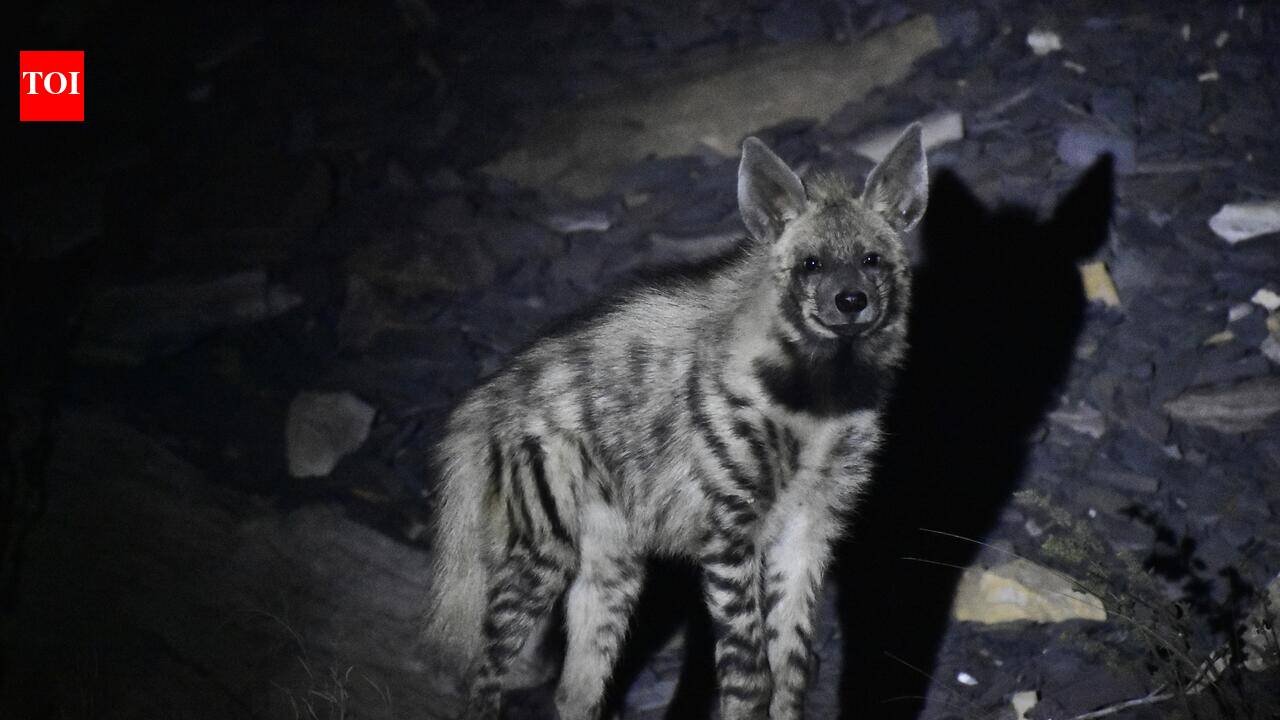
Kolkata: After elephant, tiger and wolf corridors, researchers have now unearthed two hyena movement corridors in south Bengal — one inter-state connecting the population of mining belt of West Burdwan to the larger source population of neighbouring Jharkhand through Maithon forest belt and another inter-state, between West Burdwan and Birbhum.The study, implemented by Durgapur-based Wildlife Information and Nature Guide Society (WINGS), over a period of one and a half years has also documented 30 striped hyenas across industrial and mining landscapes of West Burdwan.Conducted since Jan 2025, the project — carried out under a Wildlife Trust of India rapid action project in collaboration with the Bengal forest dept — recorded hyenas across six metapopulations spread over Churulia, Ramanagar, Bonjemari, Samdi, Jamgram, Maithon, Sonepur Bazari and Khottadihi. Researchers say the findings underline the ecological importance of fragmented mining and scrub habitats that continue to support one of India’s least-studied large carnivores.A metapopulation is a group of small, spatially separated populations of the same species that are connected by the occasional movement of individuals.“Among the most significant findings is an inter-state movement corridor through the Maithon forest belt. The corridor enables striped hyenas to move between Jharkhand and West Burdwan, helping maintain genetic exchange between otherwise isolated populations. The study also identified an inter-district corridor across the Ajoy river, linking West Burdwan with Birbhum,” said project lead Arkajyoti Mukherjee of WINGS.Researchers noted that while the existence of these movement routes has been established, further monitoring will be required to determine how frequently individual hyenas use them and how industrial development may influence their movements.“The survey combined one-kilometre transect walks, camera trapping, GPS mapping, direct observations, and the documentation of indirect evidence such as pugmarks, scat and howling. Interviews with villagers, mine workers and forest personnel supplemented the field surveys. Ten camera traps were deployed across four-square-kilometre sampling blocks,” said researcher Arindam Roy.Other team members included Nirnay Acharya, Manish Kumar Chattopadhyay and Dibyendu Mondal.Besides ecological research, the initiative conducted over 30 awareness camps involving over 1,000 stakeholders, including local communities, industries and govt agencies.
Do you believe that hyena movement corridors are essential for their survival?
3k+ users shared opinion today
5k+ users already voted today
3k+ users shared opinion today
Researchers have also outlined a series of measures to improve human-wildlife coexistence in mining landscapes. These include wildlife crossing signboards, speed-calming measures at known crossing points, ecological restoration of mine dumps, protection of breeding and denning sites and driver training.One intervention at Churulia has already emerged as a model for reducing wildlife risks. The relocation of a weighbridge, installation of four speed breakers and placement of five multilingual warning boards have been recommended as practical measures that can be replicated elsewhere in the region.Mukherjee say conserving these corridors will be essential to ensuring that striped hyenas continue to move safely between habitat patches, allowing the species to persist in one of eastern India’s most industrialised landscapes.
