


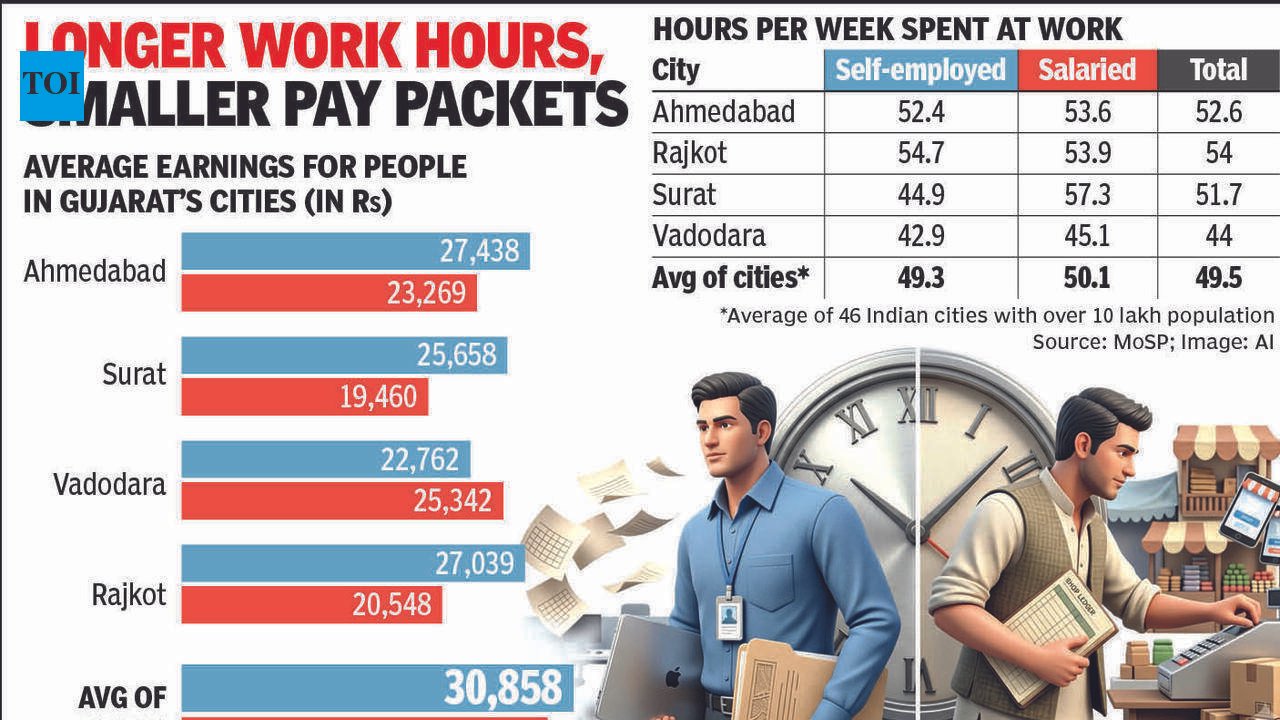
Ahmedabad: Self-employed people in Ahmedabad earn more than their counterparts in other major cities in Gujarat. However, they also put in longer hours and still lag behind the national average, according to the Union ministry of statistics and programme implementation’s (MoSPI) latest report, Labour Market Dynamics in Million-plus Cities. The report estimates the average monthly earnings of a self-employed person in Ahmedabad at Rs 27,438.This is higher than Rajkot (Rs 27,039), Surat (Rs 25,658), and Vadodara (Rs 22,762). However, Ahmedabad remains below the average of Rs 30,858 recorded across 46 Indian cities with populations exceeding 10 lakh. Navi Mumbai topped the list with average monthly earnings of Rs 66,613 for self-employed workers.The findings are based on a survey of more than 60,000 individuals across 46 cities, including nearly 8,000 respondents from Ahmedabad, Surat, Vadodara, and Rajkot.Among salaried workers, Vadodara reported the highest average monthly earnings in Gujarat at Rs 25,342. Ahmedabad followed with Rs 23,249, ahead of Rajkot (Rs 20,548) and Surat (Rs 19,460). Even the highest figure among Gujarat cities fell short of the national average of Rs 28,808, while Navi Mumbai again led the country with Rs 51,515.The report also found that people in Gujarat’s major cities generally work longer than the national average. Rajkot recorded the highest average workweek at 54 hours, followed by Ahmedabad at 52.6 hours, Surat at 51.7 hours and Vadodara at 44 hours. The average across the 46 cities was 49.5 hours per week.Except in Rajkot, salaried employees worked longer hours than the self-employed. The gap was widest in Surat, where salaried workers spent nearly 12 more hours at work each week than self-employed workers. The difference was about two hours a week in Vadodara and around one hour in Ahmedabad.The report also highlighted a wide gender gap in the share of people classified as ‘not in education, employment or training’ (NEET). While fewer than 4% of men in the surveyed cities of Gujarat fell into this category, the figure exceeded 40% among women.
