


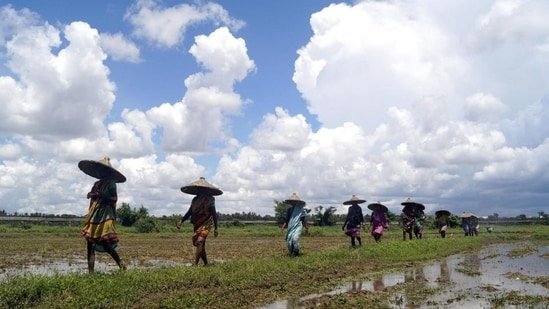
When one hears of a farmer who is toiling in the fields and spending the day feeding the cattle, sowing the field, de-weeding the soil, harvesting through the heat, the image is that of a male farmer. In reality, this is a description of a woman farmer’s day too; in fact, she has the added responsibility of cooking and tending to the family. This is the life of millions of women farmers in the country. Yet, when we hear ‘a farmer’, we always imagine a man. This is a fundamental problem that has crept into our legal-administrative systems as well. When a woman farmer goes to a gram panchayat or tehsildar office to apply for crop insurance or to get Kisan Credit Card or to claim benefits of a direct transfer, she is told that she is not ‘a farmer’ as the land record is in the name of her husband or father-in-law or other such male members in the family.
Recently on July 1, the government of Maharashtra tabled the ‘Maharashtra Women Farmers Empowerment Bill, 2026’ (Draft Bill) on the floor of the Assembly. It’s a good opportunity to reflect on why we need the Bill and what one can expect from it. According to the Periodic Labour Force Survey 2024, women constitute more than 42% of India’s agricultural workforce. This is nearly double of the 24.8% recorded in 2017. This reflects a profound structural shift in Indian agriculture, which is now often termed as “feminisation of agriculture.” Rural men increasingly migrate to urban centres for non-farm employment and thus women are left to manage the rural economy. Yet the land ownership remains the same. The Agriculture Census 2015-16 found only 13.9% of operational holdings is in women’s names. In Maharashtra, more than 88% of rural women are engaged in agriculture, the highest share of any major Indian state, while only 10% of the land is owned by women. The consequences of this are more than symbolic. Indian agricultural policy, from Kisan Credit Cards to crop-insurance schemes to the PM-KISAN income-support programme, is overwhelmingly designed around land-record eligibility. Thus, this ownership gap directly translates into exclusion from institutional support and welfare measures for farmers. And when a farmer in Vidarbha or Marathwada dies by suicide, his widow, who may have been managing the land alone for years, frequently cannot access compensation or credit in her own right because no document in the revenue office confirms she exists as a farmer.
The first attempt to address this problem was made in 2011 by MS Swaminathan, the architect of the Green Revolution. He brought a Women Farmers’ Entitlements Bill, 2011, as a Private Member’s Bill in the Rajya Sabha. It delinked land ownership from the status of ‘farmer’. It proposed a land title independent definition of “farmer” including operational holders, landless cultivators, tenant farmers, sharecroppers, and pastoralists. A Woman Farmer Certificate was to be issued by the gram panchayat as proof of farmer status for all administrative and judicial purposes. It created legal presumption of co-ownership over husband’s land with equal land and water rights. However, this Bill lapsed on 10 April 2013 without substantive debate. No government adopted it, amended it, or introduced a replacement.
The United Nations and FAO have designated 2026 as the International Year of the Woman Farmer, which triggered a global mobilisation around land ownership, credit access, technology and training. On March 13, 2026, the National Commission for the Entitlements and Welfare of Women Farmers Bill, 2026 was introduced in the Rajya Sabha, reviving Swaminathan’s framework with two key refinements: It creates a standing National Commission to monitor women farmers’ rights and it adds a portability clause that allows a migrant agricultural labourer to register as a farmer in the state where she actually works. However, this is again a Private Member’s Bill, introduced by Sandosh Kumar P, an MP from Kerala. There is no indication on whether this is intended to be adopted as a bill, or referred to a Standing Committee, or even debated formally in this session.
Hence, in this backdrop, the legislative measure by Maharashtra assumes even more importance, albeit its impact will be limited to the State unlike the earlier measures which were intended at a national level.
The Draft Bill is a government bill which is scheduled to be tabled in the ongoing monsoon session of the Maharashtra legislature.
While the Draft Bill is not yet made public, the official communication on the Bill states that it would provide women farmers an independent legal recognition as farmers while expanding the definition of ‘agriculture’ and ‘farmer’. It appears that the These definitions shall encompass allied sectors including dairy farming, fisheries, poultry, animal husbandry, sericulture, apiculture and the collection of minor forest produce. The Bill is also intended to improve access to credit, technology, markets, crop insurance, agricultural subsidies and social security benefits. The proposed framework will also support landless farmers, tenant farmers, agricultural labourers and migrant agricultural workers. Additionally, an integrated digital database of women farmers and a State Women Farmers’ Fund is also proposed. Crucially, women are to receive statutory recognition as independent farmers regardless of whether their name appears on the 7/12 extract, Maharashtra’s land-record document indicating ownership and crop details.
These are all good measures and if implemented, will further the agenda of women’s land rights. Alongside, it is critical for the Draft Bill to address certain lacunae that have historically been identified in the context of granting land rights to women.
First, the woman farmer certificate must become a door and not a barrier. The Draft Bill reportedly envisages the issuance of a woman farmer certificate by the gram sabhas and urban local bodies, with an appeal mechanism for rejected applications. It would be prudent to restrict too much discretion in the certificate granting process to ensure that the issuing authorities do not exercise arbitrary powers. Instead, it would be helpful to have the issuance process be rule bound and basis easily ascertainable criteria so that ny woman engaged in agricultural or allied activities is able to get the certificate. Further, the certificate must be linked automatically to scheme enrolment (KCC, PM-KISAN, crop insurance, MKSP) through a single, digital, panchayat-level process that is proactively offered to women. It must be a right-based entitlement rather than a welfare measure.
Second, the Bill needs to introduce substantial mechanisms to encourage land ownership of women. Women’s rights on land are predominately defined through her relationship with male family members. This needs to change. If the Bill relies on inheritance as the primary mechanism for women to acquire agricultural land, it will produce the same gap between the right on paper and the right in practice as it did with Hindu Succession (Amendment) Act, 2005. Families informally and consistently pressure women to surrender their claims. The Bill must introduce a mandatory and automatic inclusion of spouse of farmer on 7/12 extract. Supplementary mechanisms such as group land-leasing cooperatives, subsidised joint titling for couples registering land for the first time, land redistribution to women-led households under existing government land-reform allocations, all need to be part of the framework.
Third, there must be special provision for women farming in crisis zones. Specifically, the bill’s most urgent constituency is farm widows in Vidarbha and Marathwada. These women are already sole operators of their land, but their names appear nowhere in any revenue record and thus they cannot access drought relief, crop-insurance payouts, or loan restructuring. For them, the legal recognition is a survival necessity. Thus, the applicable regulations need a specific provision for widows of farmers ensuring automatic transfer of agricultural scheme entitlements within a fixed period, with a dedicated grievance mechanism.
Lastly, the implementation must be monitored by third party who has interest in catching a failure. Currently, the Bill proposes to appoint women farmer support officers at the district and taluka levels from among existing officials. They will help obtain certificates, access welfare schemes and adopt improved agricultural practices. While a dedicated official would be helpful, third-party monitoring can ensure better accountability. Interested civil society organisations with on-ground reach to identify where certificates are not being issued, where banks are still refusing women loans, and where scheme benefits are still flowing to male relatives, can serve the purpose. Additionally, there must be statutory obligation to publish the data involving women farmers including, changes in 7/12 extracts in favour of women, direct benefits transferred to women farmers under various schemes, crop-insurances, loan restructuring, enrolment under PM-KISAN. Regular monitoring and auditing can effective implementation.
It is distinctive advantage of any state bill on agriculture and land that the State has its own delivery machinery. We can claim to be truly celebrating the International Year of the Woman Farmer in 2026 only when right-based entitlements are statutorily mandated in favour of women farmers. Legislation is only a first step, not a destination. The test of Maharashtra’s bill, and of the national bill if it ever gets its day, will not come in the legislature. It will come in the revenue office in Nanded, in the KCC counter in Amravati, or in the gram panchayat meeting in Osmanabad where a widow who has been farming her land alone for many years is finally told, by a certificate in her hand, that the law has caught up with her life. Nonetheless, the Draft Bill is a critical first step in that direction and the State of Maharashtra must be lauded for taking that step.
This article is authored by Malini Mallikarjun, head, and Girija Bhosale, research coordinator, BhuSampada, NIAS.
