


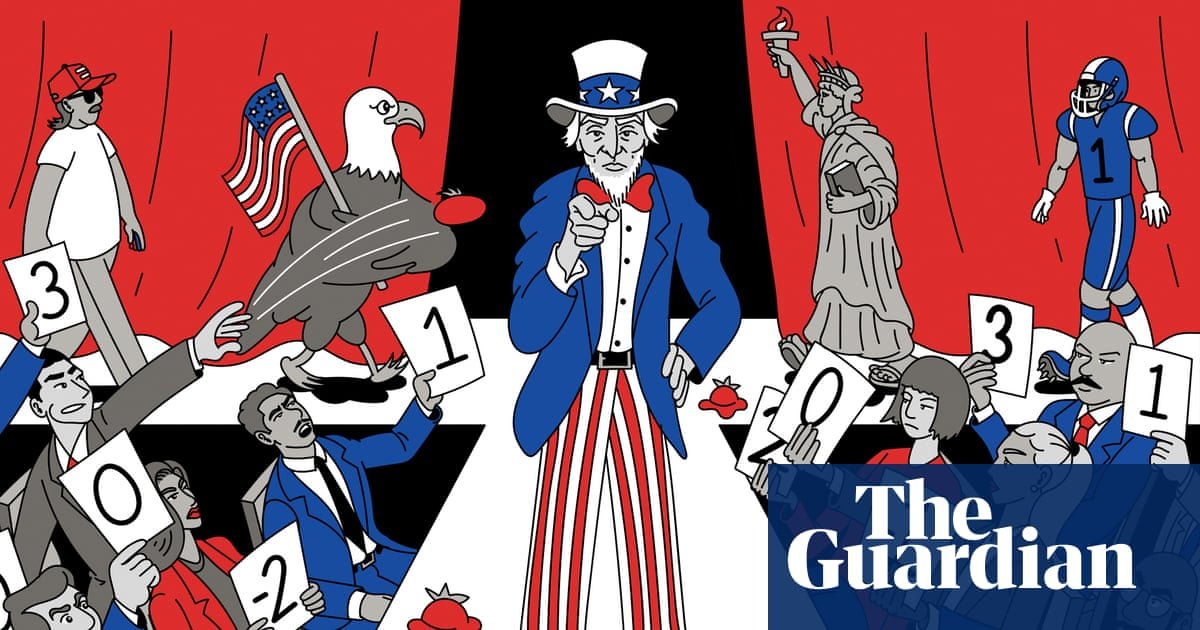
China: Confident rival hopes to eclipse US
Amy Hawkins in Beijing
On the shores of Beijing’s central lakes, elderly Beijingers relax under the shade of willow trees. Some swim, some play mahjong, and one old man plays darts: US and Chinese-flagged arrows competing for the bullseye.
The adversarial view of US-China relations is typical among people like these who lived through the cold war. Wen Feng, a 60-year-old retiree, described the US as a “troublemaker” – a viewpoint fanned by years of state propaganda casting Uncle Same as a villainous, hypocritical force on the world stage.
Nevertheless, the US’s wealth and abundance has long attracted even the most ardent Chinese nationalists. For years, the political and business elites – including China’s president, Xi Jinping – have sent their children to study there.
Across Chinese society, it used to be the case that everyone wanted a slice of the American dream. Dissidents flocked to the US for freedom and democracy, especially after the 1989 crackdown on protesters. Businesspeople sought out opportunities as China opened up in the 1990s and joined the World Trade Organization in 2001. For top students, studying in the US – where the schools outrank Chinese institutions and where academic freedom is encouraged – was the natural choice.
In the past decade, all that has changed.
Donald Trump has a lot to answer for. In both his administrations, he has weaponised the US economy to impose painful tariffs, punishing Chinese people for what many see as their own virtue: their ability to produce goods that US customers will buy. “Chinese people are very hardworking. We are willing to endure hardship to make money, unlike Americans,” said Liu Cheng, 47.
But it’s not just Trump that has damaged the US’s reputation in China. Since the financial crisis in 2008, the default perspective that a life in the US would be better has shifted.
Fed by propaganda social media accounts but also by their own personal experiences, more and more Chinese people look at the US and see gun violence, homelessness, police brutality and rampant populism. Chinese students are treated with increased suspicion that to many feels racist. In recent months, the term “kill line”, to describe the precariousness of life in the US, has been popular on Chinese social media.
At the same time, China’s self-confidence has grown. Consumerism, once one of the major draws of the capitalist west, is the engine of China’s big cities. It’s hard to find a product that cannot be delivered to your door within days, if not hours. China’s own economy remains beset by problems: the hyper-convenience is the product of a relentlessly competitive ecosystem in which goods are cheap and quick, but profits minimal. Nevertheless, as the US reflects on its 250 years of supposed greatness, China is looking ahead to the next 250 years and seeing a different country on top.
Mexico: So far from God, so close to the US
Oscar Lopez in Mexico City
A quote attributed to the late Mexican dictator Porfirio Díaz encapsulates the complex and often fraught relationship between the nations: “Poor Mexico, so far from God, so close to the US.”
Mexico’s proximity to the US has meant constant entanglements over trade, immigration and territory, and in 1846, US forces invaded and occupied the country, eventually forcing it to cede more than half its territory.
The Mexican-American war is still remembered bitterly in Mexico, and this year Donald Trump touched a nerve when he celebrated the conflict as “a triumphant victory for American sovereignty”. The comments were emblematic of his abrasive and often aggressive attitude towards Mexico.
The relationship had been marked for decades by cordiality and cooperation, both on trade and security. During Trump’s second term, however, the US has become Mexico’s bully. On his first day in office, Trump signed an executive order designating Mexican drug cartels as terrorist organizations, promising: “Mexico is not going to like it.”
Months later he began pressuring President Claudia Sheinbaum to allow US troops into Mexico to tackle the cartels, touching a political nerve in a country that has never forgotten the 1846 invasion.
Unsurprisingly, views of the US have tumbled, with nearly seven out of 10 Mexicans seeing their northern neighbor unfavorably, compared with six out of 10 Mexicans who approved of the US under Joe Biden.
Tensions between the two countries have become increasingly fraught, particularly after it was revealed that CIA agents had been involved in a counter-narcotics operation in Mexico without the federal government’s knowledge.
Weeks later, the US justice department indicted 10 Mexican officials, including the Sinaloa governor, Rubén Rocha, of the ruling Morena party, for alleged ties to drug trafficking. The indictment went off like a bomb, prompting Sheinbaum to angrily double down on calls to protect national sovereignty.
Trump “has used Mexico as a political-electoral piñata, has vilified Mexican immigrants, weaponized interdependence and threatened to unilaterally resort to force”, said Arturo Sarukhan, a former Mexican ambassador to Washington. This is “the worst moment in Mexico-US ties in modern history”.
Meanwhile, Trump’s domestic policy has also tainted the idea of the US as a “land of the free” thanks to a brutal immigration crackdown in which tens of thousands of migrants have been detained.
Luis Roberto García, 63, emigrated to the US from Mexico in 2006, seeing it as “a country filled with opportunity”. He built a life in Austin, Texas, working as a carpenter and cleaner.
But a few months ago, he was abruptly detained and deported back to Mexico. For him, and many other immigrants in the United States, the promise of the American dream has disintegrated.
“Little by little it falls apart,” he said. “It vanishes.”
Iran: Admiration, anger and grief
Deepa Parent covers Iran for the Guardian
“I often think about Central Park,” says Ali, a student in Tehran. “How heavenly it must feel to jog where families gather for picnics, puppies play fetch, and lovers meet for the first time.”
He pauses. “Then I compare it with Tehran. How lucky to have all that without fear of internet blackouts or armed checkpoints.”
Ali feels betrayed by Trump, who promised Iranian protesters “help is on its way”, and then appeared to lose interest in their cause as he unleashed a conflict which killed more than 3,300 people in the country, and sent aftershocks around the world. But like many Iranians – whatever their views of the government – Ali still consumes American pop culture and entertainment.
“The betrayal I feel has nothing to do with the hip-hop I dance to or the sitcoms I watch,” he adds.
In Iran, attitudes towards the US have become more complex and less predictable. People describe being caught between a repressive state at home and a superpower abroad.
“I have had a journey when it comes to my view of the US,” said Soroush (not his real name), a business owner from Tehran. Before Trump, he said he believed diplomacy could deliver lasting peace, building on the 2015 agreement to put limits on Iran’s nuclear progamme.
Now he believes that Trump was right to leave that agreement. “This regime took every dollar of sanctions relief and poured it into missiles and drones, with zero regard for its own people,” he said.
For activist and former political prisoner Pouran Nazemi, the issue is not of ideology but of survival.
Iranians are increasingly trapped between internal repression and external pressure, with civilians bearing the consequences, said Nazemi, pointing to recent strikes on two water facilities in southern Iran.
“Whatever the political disputes, civilians should never pay the price.”
If one event laid bare the human cost of the US-Israeli war on Iran, it was the strike on the Minab school, which killed more than a hundred children. The father of one of the victims had a message not for Trump but for all Americans: “Ask him – at night when he goes to sleep or when he sees his children and grandchildren – does he feel any guilt?”
Such views suggest an image of the United States in Iran that is neither coherent nor singular, embracing admiration for its culture, anger at its policies, and grief tied to the consequences of conflict.
Ukraine: A strange kind of ally
Shaun Walker in Kyiv
On a surprise visit to Kyiv in 2023, Joe Bidenembraced his Ukrainian counterpart, Volodymyr Zelenskyy, in the shadow of its golden domes.
The visit, as Russia’s brutal air and land assault entered its second year, seemed to confirm that Ukraine – which since the collapse of the Soviet Union had fluctuated between west and east – was finally firmly in the western camp.
For years, the country’s population had been split on whether to look to the United States as a beacon of democracy and economic prosperity, like other post-communist neighbours, or remain oriented towards Moscow. US officials who served in Kyiv in the 1990s remember a political elite that paid lip service to western aspirations but was still rooted in the Soviet legacy. Later, many Ukrainians wanted something in the middle: good relations with both east and west. But that equation became very different after 2014, when Russia annexed Crimea and sparked conflict in the Donbas.
The full-scale invasion of 2022 solidified things further, forging a much stronger sense of Ukrainian national identity, with the US as the prime ally – even if many in Kyiv complained that the White House, fearful of escalation, delayed weapons transfers.
Then came the re-election of Donald Trump, and everyone knows where the story went from there. A Gallup poll released this week showed that Ukrainian approval of US leadership has fallen from 66% in the months after the full-scale invasion of 2022 to just 7% now. The pollster said it was the largest-ever drop in support for the US across two decades of polling in 140 countries.
The US is still one of Ukraine’s most valuable allies, if only for the vital intelligence it continues to share with Kyiv. But it is a very strange kind of ally: one that has insulted the country’s president, belittled its battlefield chances and suggested it was Ukraine’s fault it “got into a war” with Russia in the first place.
“Back in the 1990s, America seemed like a dream world,” said Oleksandr, a 62-year-old engineer. “But now, it’s hard to know what to think any more.”
After four years of war, Ukraine is still acutely aware that it needs support from allies to continue to withstand the Russian assault, but now feels the answers are more likely to come from Europe.
“As America appears to be retreating from our corner … we are looking more to our neighbours in the West,” wrote the Ukrainian novelist Andrei Kurkov “Will they be able to step in to the void left by the US? We don’t know … All we can do for now is hope.”
Israel: Deep ties strained
Emma Graham-Harrison in Jerusalem
This week Israel handed the US a plot of prime Jerusalem real estate to build a new embassy complex. Washington paid a token $1 rent for the 99-year lease on land expropriated from Palestinian owners – whose descendants include US citizens.
The deal is “a recognition of history and a declaration of our shared future”, said the foreign minister, Gideon Sa’ar. “The bond between Israel and the United States is stronger than any threat.”
The ceremony was a marked contrast to reports of Donald Trump’s expletive-filled attacks on the prime minister, Benjamin Netanyahu, over wars in Iran and Lebanon, and accusations of American betrayal from pundits and politicians furious about negotiations with Tehran.
It was also a reminder of deep ties which bind the two countries, despite current tensions. The United States was the first country to recognise Israel in 1948 de facto, and became its most important ally.
Washington’s support has ranged from deploying its security council veto to protect Israel at the United Nations, to deploying bombers to strike Iran.
The European Union is critical to Israel’s economic health as the country’s top trading partner and most popular travel destination, but gets far less political focus.
Netanyahu, who has led the country for much of the last three decades – and been a dominant political force when in opposition – has often campaigned on the strength of his ties to Washington.
He grew up partly in the US, studied and worked there, and became a naturalised citizen before renouncing his American passport to become an Israeli diplomat.
For decades Israel’s foreign policy approach to the US had been rooted in cultivating bipartisan ties, on the grounds that the relationship needed to survive changes of administration.
Netanyahu tore up that approach in order to pursue a close personal relationship with Trump. He claimed the 2017 US decision to recognise Jerusalem as Israel’s capital, which overturned decades of policy, as one of the first paybacks.
Joint attacks on Iran this year perhaps marked the peak of Netanyahu’s White House influence, and had the backing of over 90% of Jewish Israelis, amid a wave of pro-American sentiment.
The subsequent US decision to halt bombing raids and negotiate with Tehran was met with fury and disbelief inside Israel, and followed by calls for greater self-reliance.
“Trump’s cold shoulder teaches us a strategic lesson that we should have learned long ago: Help is not on the way,” Nadav Haetzni wrote in Israel Hayom late last month. “Only strength and self-reliance will ensure our survival.”
Israel could pursue that vision, but at present its air force flies American fighter jets, US air defences were critical to intercepting Iranian attacks, and it relies on US diplomats for protection in international institutions.
Canada: A friendship that became a weakness
Leyland Cecco in Toronto
Canadians and Americans have long lived by the words of the late US president John F Kennedy: “Geography has made us neighbours. History has made us friends. Economics has made us partners. And necessity has made us allies.”
At times, the relationship strained but it has general reverted back to one of the most tightly integrated economic and political alliances on the planet.
All of that changed when Donald Trump, in his second term as president, floated the idea of annexing his northern neighbour, crushing them with economic coercion and making Canada the 51st state.
Canadians were not happy. Provincial leaders pulled American spirits and wine from the shelves of government-run liquor stores. Many tourists avoided vacationing in the US. The American anthem was booed at professional sporting events.
Soon, a hat went viral with a simple message: CANADA IS NOT FOR SALE.
“Canadians were very clear about how they feel: we’re a sovereign country, and we’d like to keep it that way,” said Liam Mooney, who created the hat with his fiancee Emma Cochrane. “And another thing was clear: we’d been betrayed.”
Most Canadians now hold deeply unfavourable views towards the US, especially after revelations that Trump officials had held covert meetings with separatist activists in the province of Alberta.
In response to Trump’s provocations, Canada’s prime minister, Mark Carney, called at Davos for a new global order to combat the rise of “hegemons”.
Trump bristled at the speech, snarling: “Canada lives because of the United States.” More consequentially, Trump has cast doubt over the future of a trade pact – valued at more than C$1tn (US$870bn) – that had defined the binational relationship for decades.
Trump said his country “didn’t need” products from Canada, adding that the USMCA free trade deal between the two countries and Mexico – which he himself helped renegotiate in his first term – was “irrelevant” to him.
That uncertainty has prompted Canada to seek out new trading deals to decrease its reliance on the US. “Many of our former strengths, based on our close ties to America, have become weaknesses – weaknesses that we must correct,” said Carney.
France: Alarm that Trumpism may be the real America
Jon Henley in Paris
Charles de Gaulle had what he described as “a certain idea of France”. Harry’s New York Bar in the centre of Paris epitomises what many French people might describe as “a certain idea” of the US.
The venerable watering-hole – birthplace of the Bloody Mary and the Sidecar – has been a Paris institution since 1911. Hemingway and F Scott Fitzgerald were regulars; Gershwin composed parts of An American in Paris downstairs.
“It’s a vision of America we’re fond of,” said Aurélien, a fortysomething risk management specialist at a French bank, nursing an after-work “French 75” (champagne, gin, lemon juice, a dash of absinthe).
“We’re a bit schizophrenic about the US. Some things we admire and envy – or at least, we copy. Some we despise. At the moment, more of the latter than the former.”
America’s founding ideals – freedom, equality, hope, the “shining city on a hill” – are admired, along with its dynamism, ambition, energy and restless innovation.
France loves the concept of America. The contrasting realities, not so much.
Never-ending gun violence, unaffordable healthcare, systemic racial inequality, hypercapitalism, an often simplistic, black-and-white worldview; the lack, above all, of the “social solidarity” that France so prizes – these, the French look down on.
American culture and lifestyle get a similarly conflicted reception.
On the one hand, an enthusiastic embrace of US film, TV, music, fashion, tech, even food (the home of haute cuisine is also McDonald’s second biggest market after the US).
On the other, the French cultivate anxiety and resentment at the impact of all this Americanisation on their exception culturelle. When Eurodisney opened near Paris back in 1992, the theatre director Ariane Mnouchkine called it a “cultural Chernobyl”.
Be that as it may, the return of Trump has undeniably trashed America’s present-day standing in France. The president himself gets 75-80% negative favourability ratings here.
Fewer than 8% of French voters now see the US as an ally “sharing our interests and values”, one recent survey found; more than 26% describe it as a rival “with whom we need to compete”, and 10% as an adversary “with whom we are in conflict”.
There is a reluctant but growing alarm at the prospect of Trumpism – complete with cultural (and ideological) imperialism, economic protectionism, foreign policy egotism – becoming a permanent fixture of the American landscape.
And yet, said Coralie, who, like Aurélien has lived in the US and loved it: “There’s still only one place to scale a promising European startup. For some things, America will always be No 1.”
Russia: Still hoping for a grand bargain
Pjotr Sauer, Russia correspondent
For generations of Russians, America has simultaneously been an object of admiration and resentment, aspiration and suspicion. Soviet citizens queued for hours for the first McDonald’s in Moscow and treasured smuggled Levi’s jeans, while state propaganda cast the US as the chief architect of global injustice.
Under Vladimir Putin, that contradiction has only deepened. The country portrayed on Russian television as a hostile and declining power remained the place where many members of Russia’s elite bought homes, sent their children to study and parked their wealth.
Then came Donald Trump’s return to power.
For a while, it appeared to upend the Kremlin’s most deeply ingrained narratives. The US suddenly appeared in official rhetoric less as a villain than as a potential partner. Instead, it was Europe that found itself cast as the chief obstacle to peace and stability.
“The old continent” – often with Britain singled out – was accused of prolonging the war in Ukraine and sabotaging efforts to improve relations between Moscow and Washington.
Putin struck a warm tone towards Trump, expressing confidence that together they could give US-Russia relations “a new quality”.
For many, Trump’s return revived the aspiration that Russia would finally be treated not as a rogue state but as a great power equal, free to negotiate spheres of influence and reshape the international order alongside the US.
The shift was reflected in public opinion. Polling showed Russian attitudes towards the US improving markedly after Trump’s return, reaching their most positive levels since before the full-scale invasion of Ukraine.
Yet as Trump’s administration maintained sanctions, continued to sell weapons to Kyiv and showed little sign of accepting Russia’s core demands over Ukraine, enthusiasm began to fade.
Trump’s return did not deliver the grand bargain many Russians had hoped for. Instead, he came to resemble the very force of disruption that Putin had long sought to embody.
Washington started a war against Iran, and continued to exert pressure on other key partners, including Cuba and Venezuela. The Trump administration also deepened its engagement in Armenia and Azerbaijan – a region Russia has traditionally viewed as part of its sphere of influence.
“It was as if Putin’s project to undermine the world order was being blown apart by an even greater disruption,” said analyst Hanna Notte.
For Russian hawks, the conclusion was obvious. “America is not a mediator but a key player in the enemy camp,” wrote the influential foreign policy thinker Dmitri Trenin.
Putin appears unwilling to abandon the possibility of a rapprochement. He made a point of telephoning Trump to wish him a happy 80th birthday and expressed confidence that together they could elevate Russian-American relations to a new level.
For now, at least, the Kremlin continues to act as though the US president – whose views often appear shaped by his most recent interlocutor – might still be persuaded to see the world through Moscow’s eyes.
United Kingdom: A ‘special relationship’ in crisis
Patrick Wintour in London
Britain’s loss of the 13 colonies 250 years ago did not end up being such a painful moment – largely because it gave London space to pursue its colonial interests elsewhere. Moreover, the British did not initially let go. As late as 1820, Senator Henry Clay complained the United States were “sort of independent colonies” of England, “politically free, commercially slaves”.
Now the tables are turned. Nominally, the UK is politically free, but commercially and in security terms, it is subservient to a country that polling shows Britons consider as much a security threat as China.
The crisis lies less in conflicts of interests, but something more fundamental: whether shared values and bedrock trust still exist.
The international relations and defence select committee of the House of Lords, a pillar of the British security establishment, recently published a report that opened with the boilerplate description of the “special relationship” – but then listed how that relationship had fractured: in Afghanstan, over Russia, relations with China, the future of Nato, tech regulation, migration, the politicisation of intelligence, Greenland and Trump’s inability to stop making disparaging comments about America’s supposedly closest allies.
It concluded that Britain “can no longer assume that the US will continue to guarantee European security or uphold the rules-based international order. Nor can the UK rely on historic goodwill and cultural affinity to sustain the relationship in an increasingly transactional context.”
Suddenly Charles De Gaulle – the French leader who warned that the Americans were “not reliable, not very solid and understand nothing about history or Europe” – is in fashion in London.
Meanwhile, Britain’s thinktanks are discussing how to strengthen a European defence alliance – inside or outside Nato.
By the end of Trump’s second term, the US contribution to the alliance is likely to have been eroded.
Some of the missing US expertise and heft can be replaced by Ukraine, currently the most powerful army in Europe. The country that Britain and the US rushed to protect in 2022 could be the one defending the UK in the absence of the US.
It was an article of faith inside the Foreign Office that Keir Starmer should avoid confrontations with Trump, deploying the royal family, state visits and a stiff upper lip. Disagreements – over tariffs, or Iran – have been acknowledged, but not articulated, and never inflamed. But it was harder to hold back when Elon Musk used his megaphone to urge his 240 million followers to “protest loudly and repeatedly” about migrants in the UK.
A new prime minister, looking to distinguish himself from his predecessor, may be tempted to take the commercial and security risk of distancing the UK from Trump.
Japan: Not angry, just disappointed
Gavin Blair in Tokyo
Few countries have as complex a relationship with America as Japan. US gunboat diplomacy forced the country open in 1854, ending two centuries of isolation and sparking rapid modernisation that gave way to imperial expansion and, ultimately, the Pacific war. After the atomic bombings of Hiroshima and Nagasaki, the US-led occupation – the closest Japan came to colonisation – imposed a constitution that has never been amended.
By the 1980s, breakneck Japanese growth had America fearing it would be surpassed as the world’s leading economy. Yet Japan remains its closest Asian ally, host to about 100 US military facilities and heavily reliant on it for security as China grows more capable and assertive.
Trump 2.0 has imposed heavy tariffs and pressed for large-scale investment on onerous terms. Talks are due this autumn amid real doubts over whether Washington would honour its security treaty commitments.
Reaction to these shifts is sharply divided by generation, said Laurie Wesselhoff, a cultural anthropologist who has spent decades as a lecturer at Tokyo’s Keio University.
“Among older adults, I sense not a disgust with or dislike of the US so much as a great disappointment – a feeling of being betrayed by a country we worked so closely with for decades,” says Wesselhoff.
However, she sees far more positive views of Trump among her students, not as a politician but as a social media personality: “They see Trump not as a heroic figure, but something you can laugh at. And at the same time, a lot of them support his anti-establishment rhetoric.”
But even among older Japanese, Wesselhoff sees no rise in enmity towards American people.
“For years I’ve been bracing for backlash of some sort that just doesn’t really come.”
American cultural might had already been declining in Japan since before Trump: Hollywood’s box office share fell from a peak of about 70% at the turn of the millennium to less than 25% in 2024; the drop in popularity of American music is even sharper.
Kosuke Takaya, who works in film and television production in Tokyo, believes the current administration has exacerbated that trend.
“Under Trump, the US can’t be relied upon as it once could. I think due to that, their soft power is declining,” he said. “It is more difficult to believe in heroes in Hollywood films than it was when America acted like the world’s policeman.”
Cuba: An abusive relationship
Ruaridh Nicoll in Havana
Ernesto Pérez left Havana in 2019 to work on a PhD in Mexico City, with no intention of returning home. He had a visa, a place to live and a promising future outside a collapsing Cuba.
But two years later, he crossed the Texas border illegally, and spent 15 days in a detention centre, before taking a grey economy job in Miami, where he now lives in fear of arrest by ICE.
Asked why he made the decision to head north, despite the threat of deportation, Ernesto (not his real name) said, “Mexicans hate Cubans. Americans are more like us: way more liberal in their ways.”
In that lies Cuba’s curse. Ninety miles and 70 years separate the island from the Florida coast. For any young Cuban wanting to escape a country caught in the 1960s, south Florida is so close you can almost feel it.
It is a feeling that hasn’t receded, even as the US strangles the island with an oil blockade.
Cuba’s communist leadership fights this by leaning on their people’s natural sense of patriotism. The slogan Patria o Muerte – homeland or death – is daubed on buildings, bridges and trees.
Memories here are long, extending back to the 19th-century independence wars against Spain. The US then took advantage of that conflict, by walking into the broken country, buying everything up, and then treating Cuba as a playground and protectorate.
After the 1959 revolution, waves of Cubans fled north. Miami became the de facto capital of Latin America, and direct flights meant reggaetón and reparto acts, actors, baseball players, ballet stars, all began moving somewhat easily between.
Money flowed south as remittances, and cross-straits businesses started. Florida-based Cubans began the complicated process of reunification, picking off family members, one visa at a time.
“I have a lot of admiration and respect for the United States and its people’s material progress,” said Carlos Alzugaray, Cuba’s former ambassador to the EU. “What I despise is the arrogant nature of their government. It seems part of the American psyche.”
No one exemplifies this as much as Donald Trump. The president’s highhanded comments on Cuba cause grimaces the length of the 777-mile island. “I can do anything I want with it,” he said.
A Cuban journalist in Havana, who asked not to be named, compared ties with the US to an abusive relationship. “Our free will doesn’t exist,” she says. “We are to blame, even for things actively inflicted on us. They gaslight us, deny what we say, create an image of us for others.”
Still, the situation in Cuba is so dire – after 67 years of communist rule, an all-but-equal period of US economic embargo and five months of full-scale siege – that it’s now possible to hear people on the street suggest a US intervention would be preferable to what they are enduring.
“C’mon Marco, get it over with,” said a fruit vendor, referring to Marco Rubio, the Cuban-American US secretary of state.
If a deal between the governments is done, or the Cuban leadership is removed by force, how the relationship would continue is anyone’s guess. The last US takeover in the early 1900s led inexorably to revolution.
India: Strategic partner turned transactional
Penelope MacRae in New Delhi
For much of the 21st century, the US-India partnership seemed to be on an unstoppable course toward ever-closer ties. After shedding their cold war mutual suspicions, Washington opened the door to civilian nuclear cooperation, championed India’s rise as a China counterweight and rolled out the Silicon Valley red carpet to Indian tech talent.
The world’s two largest democracies built a relationship around defence, technology, intelligence-sharing and trade. “The dominant narrative surrounding US-India relations has been one of growing strategic cooperation,” said Professor Harsh Pant, vice-president at the Observer Research Foundation, a New Delhi thinktank.
Then Donald Trump returned for a second White House term, and the goodwill began unravelling, upended by US tariffs, trade threats, immigration policies that affected Indian students and professionals, and the enthusiastic embrace of arch-enemy Pakistan.
Trump has revived “a foreign policy approach centred on immediate American interests”, said Pant.
“The Indian government and policymaking community still see the US as an essential partner and want the relationship to work,” said US-based south Asia analyst Michal Kugelman. “However, the Indian public has developed a much darker view of the US,.”
For many Indians, America was both a strategic partner and a personal aspiration. Millions of Indian students headed to US universities while families celebrated children getting green cards for work.
“For the longest time, the US stood out as a beacon of liberal values: the most advanced nation in the world, not just economically or technologically, but ideologically. The American Dream inspired millions to travel to the US in pursuit of opportunity,” said Anish Gawande, a Rhodes scholar and opposition politician.
Today, “that picture looks starkly different,” he said.
Visa curbs, immigration crackdowns and reports of a surge in racism have dimmed enthusiasm for the US as a destination. “For many young people, there’s no point in going to study in the US unless they can get a job, be secure from racism, and have a better future,” said Adyaa Khanna, a newly minted Delhi lawyer. Last year, Indian student arrivals in the US slid by 44%.
India “has perhaps been one of the biggest casualties of this second Trump administration’s aggressively transactional foreign policy”, he said.
There are still reasons for optimism. Defence cooperation and joint military exercises have continued. “That suggests the foreign policy bureaucracy in Washington remains supportive of the partnership,” said Kugelman. “Even amid serious tensions, a lot has been accomplished.”
But if the relationship is to recover, he said, the next US administration will have to reassure India that Washington sees it as a strategic partner rather than a transactional arrangement. It will also have to address Indian unease over Pakistan, China and immigration.
“Rebuilding trust will take time,” Kugelman said.
Australia: Shared values? Not at the moment
Ben Doherty in Sydney
Australia has always found its protection elsewhere. Before 1945 it was Great Britain and the Commonwealth; since the end of the second world war its “great and powerful friend” has unswervingly been the US.
But Australia is now reckoning with a world where its protector is no longer great, nor powerful – nor a friend.
The US remains the world’s best-resourced military, but it could not win its war in Iran, after being humiliated by the Taliban in Afghanistan.
And Australians have watched with horror as Donald Trump has acted with thuggish contempt for friends – threatening to invade, economically coercing through tariffs, and publicly abusing countries with which the US is ostensibly allied.
Australians are now wearily used to waking up to ask: “He’s done what?”
Emma Shortis, director of international and security affairs at the Australia Institute, said she felt many Australians were “deeply saddened” by America’s current convulsion.
“There is a version of the US with which we do share values, particularly democratic values, values of equality and justice. It’s just that’s not the version we’re getting at the moment.”
A 1990s prime minister, Paul Keating, urged Australia to “seek its security in Asia, not from Asia”. But his reactionary successor John Howard, spurred by the trauma of 9/11, sent Australia back to the embrace of the US.
Since then, Australia has been the most loyal – critics would argue sycophantic – of American allies. Government ministers regularly boast that Australia has fought alongside the US in every conflict since the first world war.
Australia had held a belief America would “snap back” from a Trump presidency.
The US’s cultural influence on Australia remains enormous: Taylor Swift’s tour sent the country into paroxysms of Tay Tay fever; the recent NBA finals series packed out bars in the middle of the day; Australian kids shouted “6-7” with as much enthusiasm as any around the world.
But Trump 2.0 is so much more unrestrained, and the changes it has wrought so much more structural – politicising and weaponising the justice department, eviscerating the Voting Rights Act, stacking the civil service with loyalists – that there is an eroding faith that the centre of gravity of the US system will bring it back to previously recognisable form.
South Africa: Bullied by a protector
Rachel Savage in Johannesburg
When Donald Trump returned to the US presidency in January 2025, South Africans were surprised to find themselves in his line of fire.
The false claim that white South African farmers are being murdered for their land has long been a staple conspiracy theory of the white far-right (white farmers have been killed, but not at a higher rate than the thousands of other victims of South Africa’s high violent crime rate).
With Trump back in office, it became US government policy.
First, Trump cut aid to South Africa. Then, in May 2025, the US started welcoming white South Africans as refugees, while stopping the program for people fleeing war and persecution. Later that month, Trump ambushed South Africa’s president, Cyril Ramaphosa, in the Oval Office with the false claim of a “white genocide” in the country.
For some white South Africans, Trump’s offer of refugee status was a “godsend”. Affirmative action policies, which created a black elite but have not lessened the country’s gaping inequality, have fuelled feelings of disenfranchisement for some white South Africans.
However, most South Africans were baffled and angered. As Ramaphosa put it, “We are rather amazed at the attention he gives to us. We are a small country, and we are no threat to the United States.”
For many, the incident was not an aberration. South African critics drew a straight line to Trump from the legacy of slavery and Jim Crow laws, and from what they saw as the hypocrisy of promoting democracy and freedom alongside the CIA’s long history of targeting leftwing leaders, the wars in Iraq and Afghanistan and uncritical US support for Israel. Last year, China’s popularity in the country overtook that of the US: 57% of South Africans saw China favourably, compared with half who viewed the US positively, according to the Pew Research Center. It’s a far cry from the latter years of Barack Obama’s presidency when in 2015 almost three-quarters of South Africans had a favourable view of the US.
Nonetheless, there is also a significant number of South Africans who still admire the US’s economic dynamism. And the US is still seen as an emigration destination of choice, for those fleeing crime and high unemployment.
“The US has always been an aspirational place to be – Silicon Valley, New York, Miami. It’s all amazing,” said Ben Ntshangase, a 28-year-old entrepreneur.
“But it is worrying, especially as a black South African … It kind of feels like I’m being bullied by someone who’s supposed to be the protector of everyone else.”
