


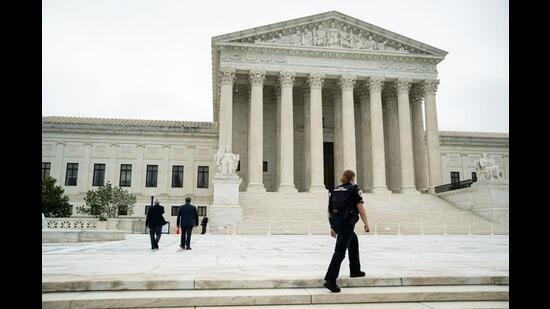
The US Supreme Court’s judgment on Tuesday settles the question of birthright citizenship in the country. As one of the first presidential actions in his second term, Donald Trump had circumscribed its ambit. Citizenship to children born after February 15, 2025 to undocumented immigrants and foreign nationals, who were in the US legally but “temporarily,” was denied. The US top court has now preserved the extent of birthright citizenship as understood before the Trump executive order. The court deemed the order “unlawful” in a 6:3 majority and violative of the US constitution in a slim 5:4 majority.
This is significant for two reasons. One, the Trump administration had relied on a narrow interpretation of the 14th Amendment to curtail birthright citizenship and the judgement ends the debate as far as the letter of the law is concerned. Two, the slim majority deeming the order unconstitutional underlines the politicisation of what had largely been a bipartisan consensus — anyone born in the US was a citizen. The conservative judge who deemed the order unlawful as it violated the will of Congress when the 14th Amendment was passed simultaneously didn’t see it as violative of the country’s constitutional principles. Theoretically, thus, Congress could curtail birthright citizenship by legislating this.
